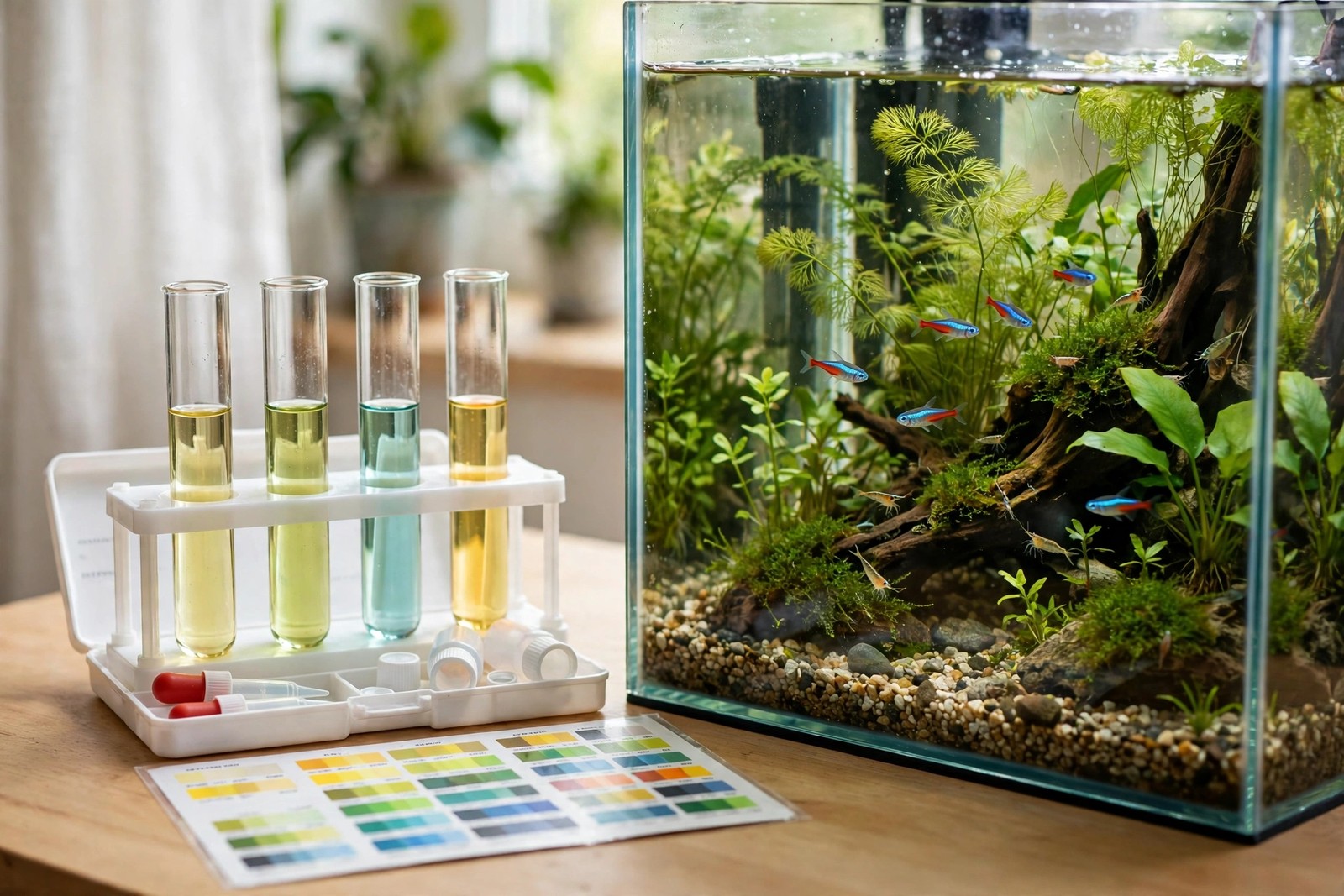
Yes. A water test log is an exceptionally useful record for a fish keeper to keep, because tanks rarely fail in a day. Nitrate creeps up as stocking grows, pH drifts as buffers are used up, and a filter slowly clogs, and none of that is visible if each test result lives only in your memory. A dated log turns isolated numbers into a trend, and a trend is what lets you act early, explain a problem to an aquatic shop or vet, and prove to yourself that a fix actually worked.
What each log entry should contain
Keep every entry in the same format so entries can be compared at a glance. Record the date and the time, then ammonia, nitrite, nitrate, pH, and temperature, each written exactly as your test kit reports it. Add the action you took after testing, such as a water change with its size as a proportion of the tank, a filter rinse, a new fish added, or medication discussed with a professional, and add one short observation line about appetite, behaviour, or cloudiness.
Which parameters matter, and why
Ammonia and nitrite are the emergency pair: in a settled tank both should read at the lowest level your kit can show, and any clear rise means something has changed, such as an overloaded filter, a missed dead fish, or overfeeding. Nitrate is the trend parameter: it rises steadily between water changes, and its rate of rise tells you whether your change schedule and stocking level are in balance. pH matters as stability more than as a single perfect figure, because fish tolerate a steady pH within their suitable range better than a swinging one. Temperature guards against heater faults, which a log exposes when readings drift over several entries rather than in one dramatic failure. Keepers of planted or specialist tanks may add hardness readings, in the same format, when their fish or plants require them.
How often to test
Test weekly once a tank is settled, choosing the same day and roughly the same time so entries stay comparable. Test daily while a tank is cycling, after adding fish, after a filter change, or while you are investigating a problem, and return to weekly testing once readings have been stable across several entries. Always test before a routine water change rather than after one if you want the log to show the tank at its worst, because a post-change reading flatters the figures and hides the trend you are trying to see. A weekly log therefore holds about four or five entries a month, which is a page you can scan in seconds.
Reading the log like a detective
Look for direction, not just values. Nitrate rising faster than it used to suggests heavier feeding, growing fish, or a filter losing efficiency. A pH that falls a little further each week suggests the water's buffering is being exhausted and needs discussing with an aquatic specialist before fish are stressed. Ammonia appearing in a previously stable tank sends you to check for a dead fish, a blocked filter, or a recent overfeed, in that order. Write what you found next to the reading, because the explanation is as valuable to your future self as the number.
Making the habit stick
Test at a fixed point in your routine, such as just before the weekly water change, and keep the kit, a pen, and the log together by the tank. Back up a paper log with a photograph, or keep the log digitally from the start, so a spill does not erase months of history. Bring the log when you ask a shop to test your water, so their result can be checked against your kit's readings on the same day. Keeping dated test entries together with stocking and equipment notes in KinsLe's Pet Passport means the full story of your tank is ready to hand over to a holiday feeder or an aquatic vet.