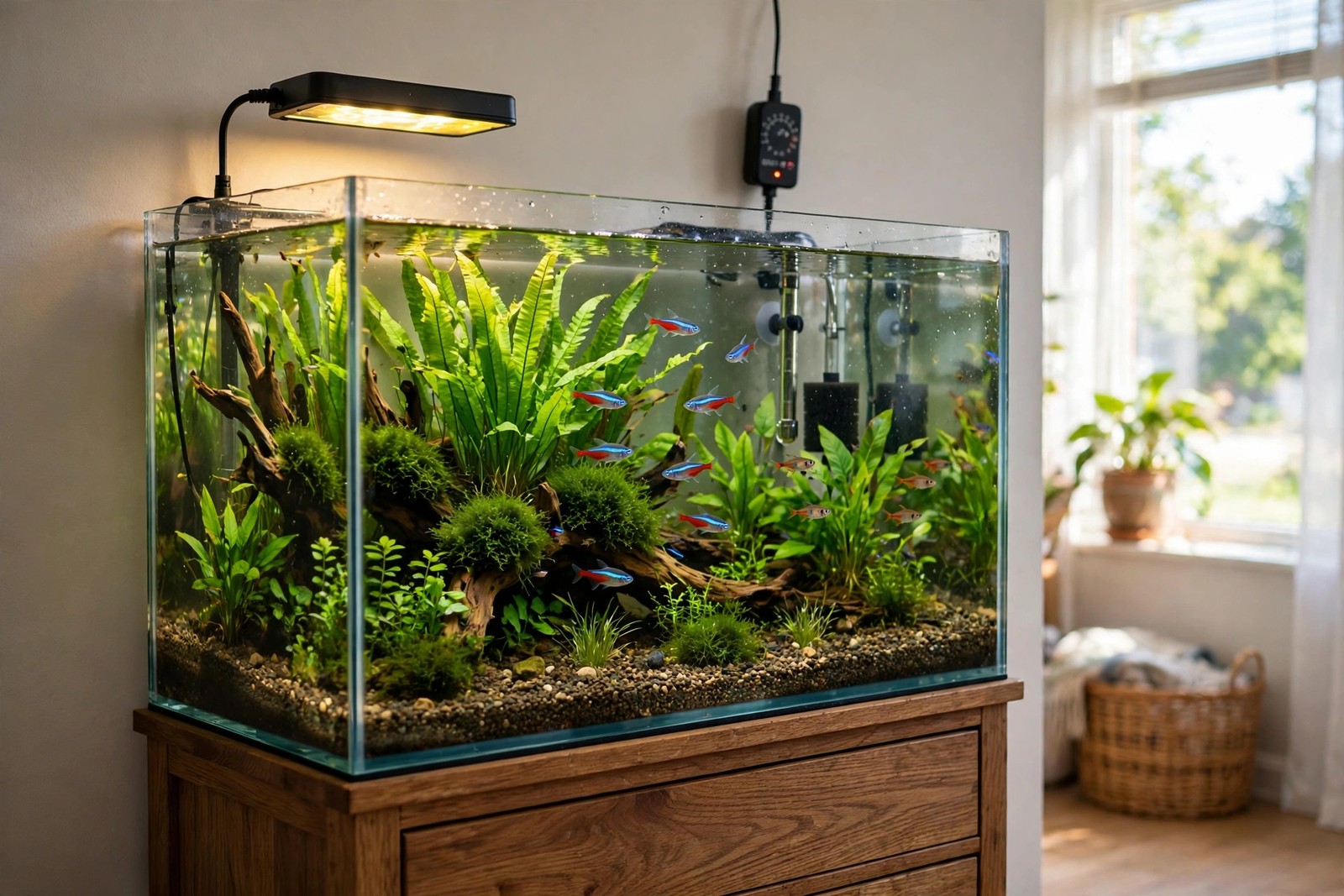
Yes — site your aquarium away from windows that get direct sun, or be ready to manage the two problems sunlight reliably causes. An aquarium is a glass box of water that behaves like a small greenhouse, and unlike a lake, it has no depth or flow to escape into. The fish, plants, and water chemistry all have to live with whatever the window delivers that day, which is why experienced aquarists treat placement as a health decision, not a decorating one.
Algae: The Visible Problem
Direct sunlight is algae fuel. Even a tank with balanced feeding, good filtration, and a sensible stocking level will green up if strong sun hits it for hours a day, because light is usually the limiting factor for algae growth and a window removes the limit. Algae clouds the water, films the glass, coats plants and decor, and outcompetes the plants you actually want. Wiping glass becomes a near-daily chore, and the swings between bright days and dull ones make the growth unpredictable. Your tank's own lamp on a timer — typically six to eight hours for a planted tank, less for a fish-only setup — gives you the control a window never will.
Temperature Swings: The Dangerous Problem
The quieter risk matters more. Sun striking a tank can push the temperature up noticeably through a bright afternoon, then let it fall again overnight, and repeated daily swings stress fish, weaken immunity, and invite disease outbreaks. Small tanks swing fastest because there is less water to buffer the change, so a nano tank on a sunny sill is the worst combination in the hobby. Cold is the other face of the same window: in winter, a tank against exterior glazing or in a draughty spot can chill at night and make the heater work against the glass around the clock.
Check your own tank honestly for a week before deciding it is fine where it is: note the thermometer reading morning and evening. A stable tank barely moves; a window tank often tells the story in its own numbers.
Choosing and Fixing a Spot
The ideal position is against an interior wall, out of direct sun but in a room with ordinary daylight, near enough to a socket for the filter, heater, and light without trailing leads, and where the floor can take the weight — a filled tank is far heavier than it looks, at roughly a kilo per litre plus glass and substrate. Keep it away from radiators and doors for the same temperature-stability reasons.
If the only workable spot is near a window, manage the light rather than surrendering to it: fit a blind or curtains and close them against peak sun, place the tank side-on to the window rather than square in front of it, or shade just the sun-facing side with a background panel. A thermometer check twice a day for the first fortnight tells you whether the fix is working.
Placement also decides whether the household routine protects the tank or undermines it — blinds left open, lights left on overnight — so share the setup clearly with everyone at home. On KinsLe, Family Sharing gives relatives you select access to this tank's profile.