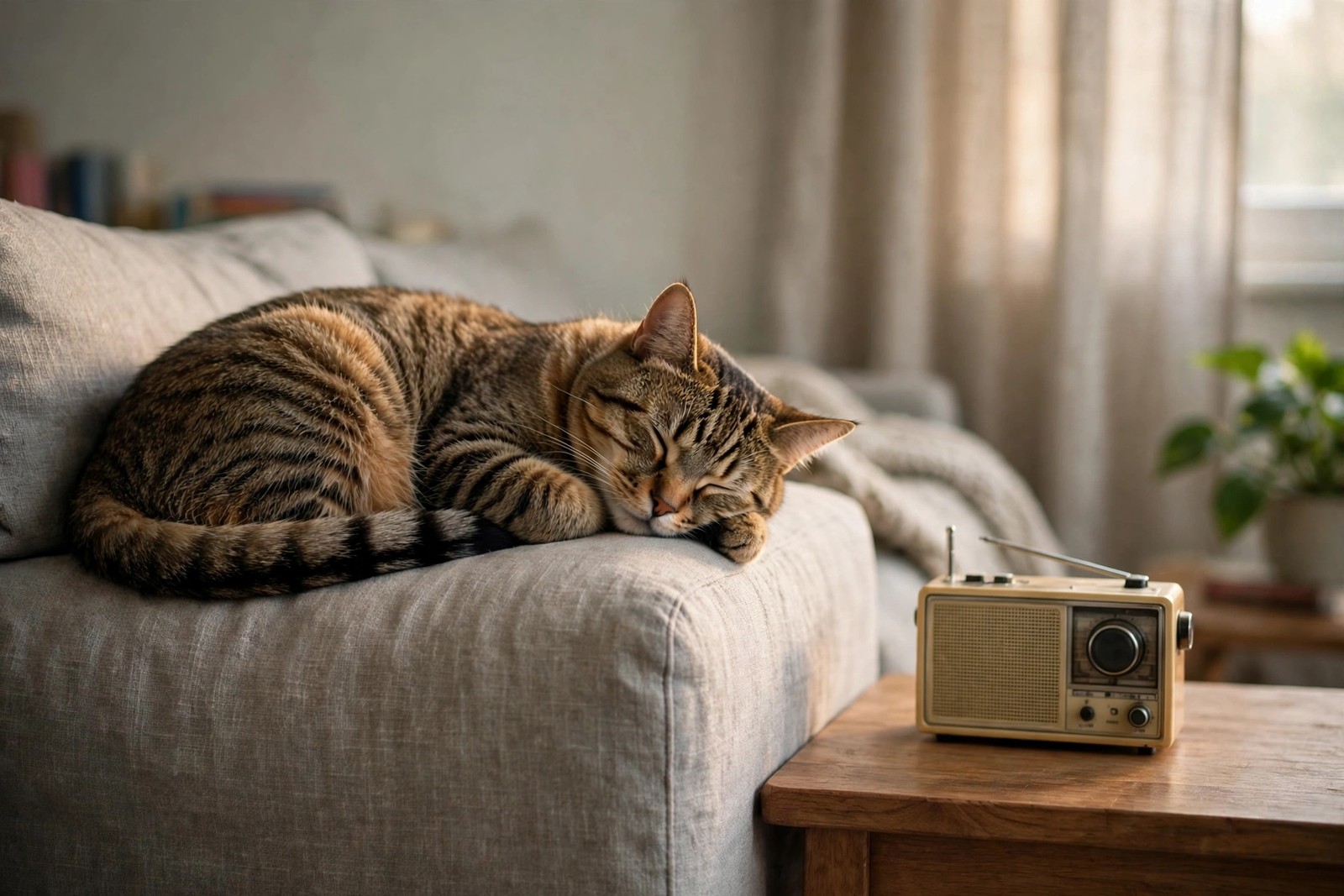
Leaving sound on for a cat is neither a kindness every cat needs nor a waste for every cat. Cats hear far more acutely than we do, rest in short cycles through the day, and take their cues from routine rather than from background noise. For a cat raised in a lively household, sudden total silence whenever you leave can itself be the change that unsettles her. For a cat who has always napped through a quiet house, a radio adds nothing she wants.
Read your own cat before you decide
Run a simple test across several ordinary outings. On some days leave a radio on low; on others leave the house silent, keeping everything else the same. Note what you find on return: where the cat is sleeping, whether food and water were touched as usual, whether anything was knocked over or scratched that normally is not, and how she greets you. A cat who settles in her usual place and eats normally in silence is telling you she does not need sound. A cat who is restless, vocal at the door, or only relaxed on radio days is telling you the opposite. One outing proves nothing; a pattern across a week does.
If you have an indoor camera, a short check mid-absence settles the question faster than any general advice. Look for relaxed sleeping and normal grooming, not a cat sitting fixed at the door or pacing between rooms.
Choosing sound a cat can actually rest through
Keep the volume genuinely low, at a level you could hold a conversation over without raising your voice. Speech-based stations and calm, slow music sit best with most cats because the level stays even. Avoid action films, sports with crowd surges, and anything with sudden bangs, sirens, or shouting, which can jolt a sleeping cat repeatedly. Programmes full of birdsong or small-animal calls cut both ways: some cats ignore them, while hunting-minded cats fixate on the screen or speaker, paw at it, and wind themselves up instead of resting.
Place the sound in the room the cat already naps in rather than expecting her to relocate to it, and leave her usual retreats available and quiet. A cat who dislikes the radio will simply move away from it if she has a choice of rooms, which is itself useful information.
Use a timer, and do not let sound replace company
There is rarely a reason for sound to run all day and all evening. A timer that covers the first part of your absence, when departures are felt most, and then switches off gives the cat both the familiar background and proper quiet for deeper sleep. Constant noise with no break is tiring for an animal with sensitive hearing.
Be honest about what sound cannot do. It does not meet a cat's need for play, hunting-style activity, or human contact. A cat left alone for long stretches still needs an interactive play session before you go and after you return, food-puzzle toys rotated so they stay interesting, a window perch, and a scratching post. If a cat shows real distress when left, such as toileting outside the litter tray, over-grooming, or refusing food, background sound is not the answer; talk to your vet, who can advise on next steps for separation-related stress.
Households often disagree about whether the radio helps, so KinsLe Family Sharing lets each person add their observations of the cat's behaviour to one shared profile, making the cat's own pattern easy to see.