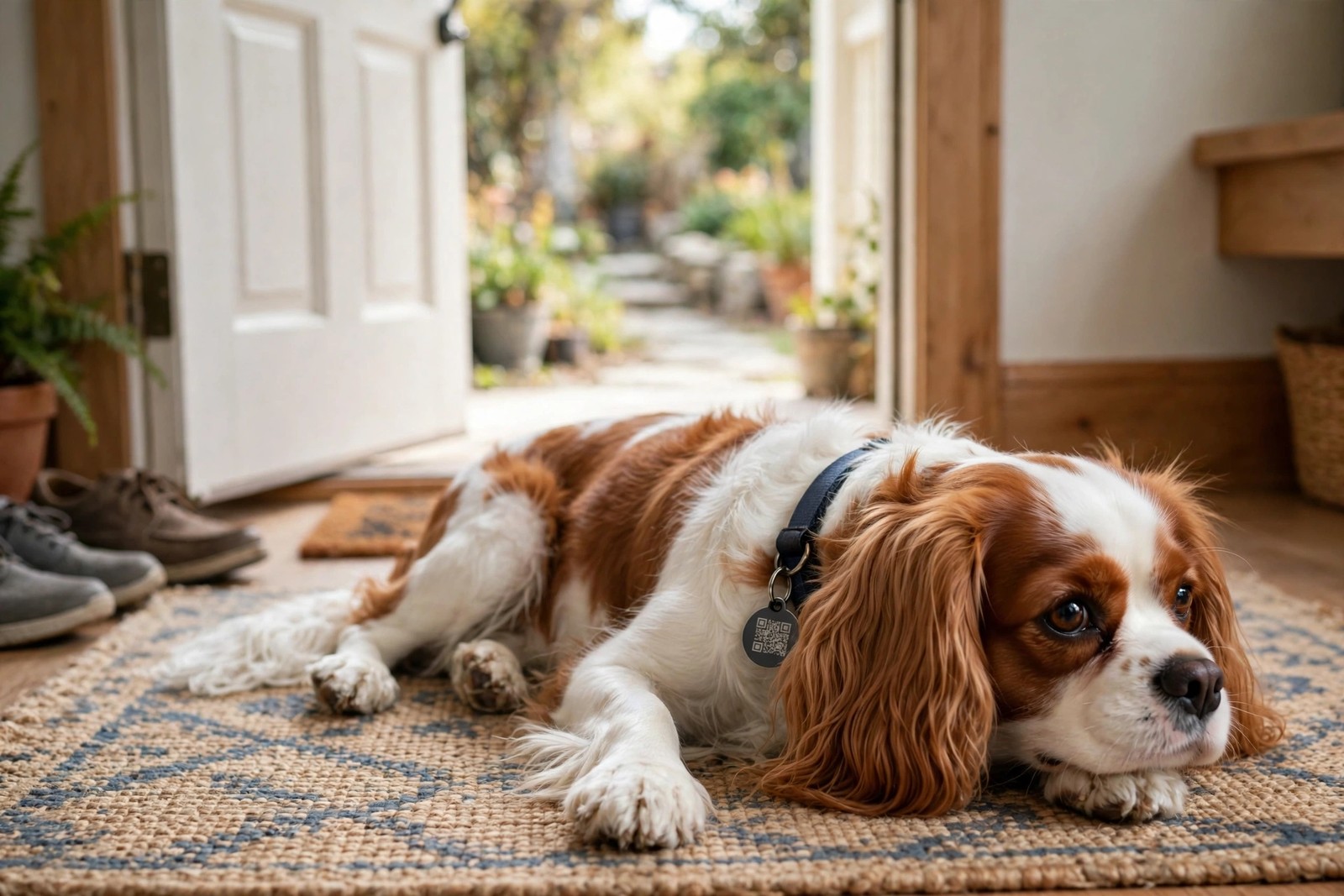
There is no single rule that suits every household, because an indoor collar does two opposite jobs at once. It keeps identification on your dog during the exact moments escapes happen — a delivery at the door, a child leaving a gate unlatched, a dog startled by fireworks bolting from the hallway. It also introduces a catching point in the places your dog sleeps, squeezes, and plays. Weighing those two facts for your own dog, rather than following a blanket rule, is the real answer.
What the Collar Buys You Indoors
Most lost dogs are not lost from walks; they slip out of homes and gardens. A dog found two streets away wearing a collar with a readable tag or scannable ID can be reunited by the finder in minutes, with no trip to a vet or shelter to check for a chip. A naked dog, however friendly, often gets taken in as a stray because the finder has nothing to act on. Collars also give you a safe grab point if you need to move your dog quickly away from a dropped pan, a visiting toddler, or a scuffle — far safer than grabbing scruff or fur. For nervous rescues, recent arrivals, and known door-dashers, that indoor identification is worth a great deal, and removing the collar at home removes it precisely when the risk is highest.
Where Indoor Collars Cause Trouble
The documented danger is snagging, and it is specific rather than vague. Collars catch on crate bars and the hooks of crate doors when a crated dog turns or scratches. They catch on heating vent covers, on the knobs of low cupboards, on branch stubs during garden play, and in the gaps between decking boards when a tag drops through and twists. The most serious household scenario is two dogs playing: one gets its lower jaw under the other's collar, panics, and twists, tightening the collar around the first dog's neck while trapping its own jaw. Dangling tags, loose chain collars, and collars worn two or three sizes too big multiply every one of these risks, while a snug flat collar reduces them sharply.
Fit, Style, and Sensible House Rules
Fit is the control you actually have. A collar for constant wear should sit mid-neck, snug enough that it cannot slip over the jaw or an ear, with room for two flat fingers between collar and coat — looser on a growing puppy, whose fit needs checking every week. Breakaway collars, designed to unclip under a hard load but hold on a lead clip point, suit households worried about snagging during unsupervised hours. Whatever the style, take the collar off for crated rest, for unsupervised wrestling between dogs, and for any dog who scratches persistently at it, since a hind foot through a collar is another common tangle. Puppies should wear a light collar for short, supervised sessions first so the collar itself is boring long before it is worn all day. Check the skin under it weekly for rubbing, matted coat, or damp irritation, especially on long-coated breeds and after wet walks.
Households that land in the right place usually settle on this pattern: collar on whenever doors are opening and dogs are awake and moving about, collar off in the crate and during boisterous play, and identification that does not depend on tiny engraved lettering being read by a stranger holding a wriggly dog. That is where KinsLe helps most, because a collar carrying one of its Verified QR ID Pet Profiles lets a finder scan the tag, see the details you have chosen to share, and message you through the profile while your dog is still standing in their hallway.