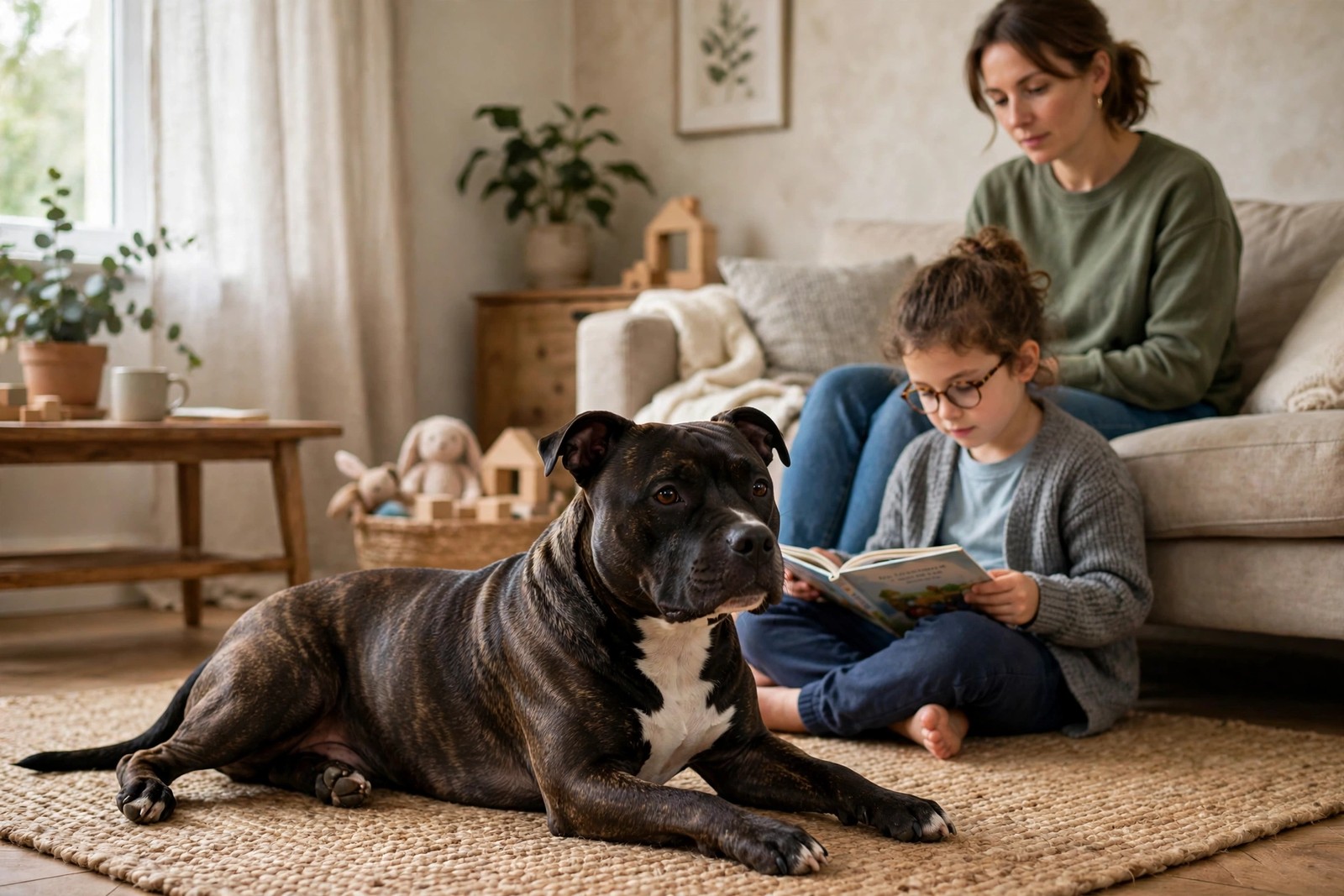
Few breed nicknames do as much quiet damage as 'nanny dog.' It sounds like a credential, as if Staffordshire Bull Terriers arrived pre-certified for child care, and families who believe it relax exactly the supervision that keeps children and dogs safe together. Treat the nickname for what it is: an affectionate claim repeated by fans of the breed. It describes enthusiasm, not a tested guarantee, and it says nothing reliable about the particular dog standing in a rescue kennel or a breeder's kitchen.
What the Breed Character Actually Offers
There is a genuine foundation under the folklore. Staffies are typically people-oriented dogs who seek out human company, lean into laps, and form strong, affectionate bonds with the family they live with, children included. Many are playful, tolerant of household noise, and happiest in the middle of family life rather than at its edges. That character is a real reason the breed suits many families, and it is fair to weigh it when choosing a dog. What breed character cannot do is certify an individual. Temperament varies dog to dog, early experiences shape how a grown dog handles grabbing hands and sudden shrieks, and a dog who adores the children it lives with may still find visiting toddlers alarming. The label describes a tendency; your safety plan has to cover the individual.
The Management That Never Comes Off
Adult supervision means an awake, attentive adult in the room and watching, every time the dog and young children share space. A dog is never left alone with small children, not for a minute and not because every previous minute went well; most serious incidents happen in ordinary moments nobody thought were risky. Separate the dog behind a gate or in a rest area during the chaotic stretches: birthday parties, rough play dates, meals dropped from high chairs. Give the dog a child-free retreat that children are taught never to enter, because a dog who can walk away from pressure rarely needs to escalate. Watch the dog, not just the children: turning away, lip licking, a closed mouth after panting, freezing over a toy, or moving off repeatedly are all requests for space that adults should answer by calmly creating distance.
Teaching the Children Their Half
Children need instruction as concrete as the dog's training. No hugging around the neck, no climbing, sitting, or leaning on the dog, no pulling ears or tails, and no disturbing a dog who is sleeping, eating, or chewing something valued. Games are adult-led: throwing a ball for the dog is fine, wrestling and chase games that wind the dog up are not. Teach children to invite rather than invade, calling the dog to them and letting the dog choose to come, and to stop touching when the dog moves away. Practicing these rules with a stuffed dog sounds silly and works remarkably well with young children, who rehearse the gentle pattern before a real animal is involved.
The Individual Dog Decides
Before adopting, ask about the specific dog's history with children rather than accepting the breed story. A rescue or breeder should be able to describe how this dog behaves around noise, handling, and visitors, and a dog with an unknown history deserves slow, observed introductions rather than instant trust. Put the plan in writing: in the Care Teams schedule on KinsLe, name one adult as the supervisor for each dog-and-child session, assign a second adult to manage doors and visitors, and record the dog's signals and any tense moments so the whole household learns from the same facts. Written duties matter because supervision assigned to everyone in general quietly belongs to no one in particular.
None of this argues against Staffies as family dogs. It argues for enjoying the breed's real warmth with your eyes open, so affection is backed by structure instead of folklore. KinsLe's Care Teams keeps each adult's supervision duty and the dog's known signals visible in the household schedule everyone follows.