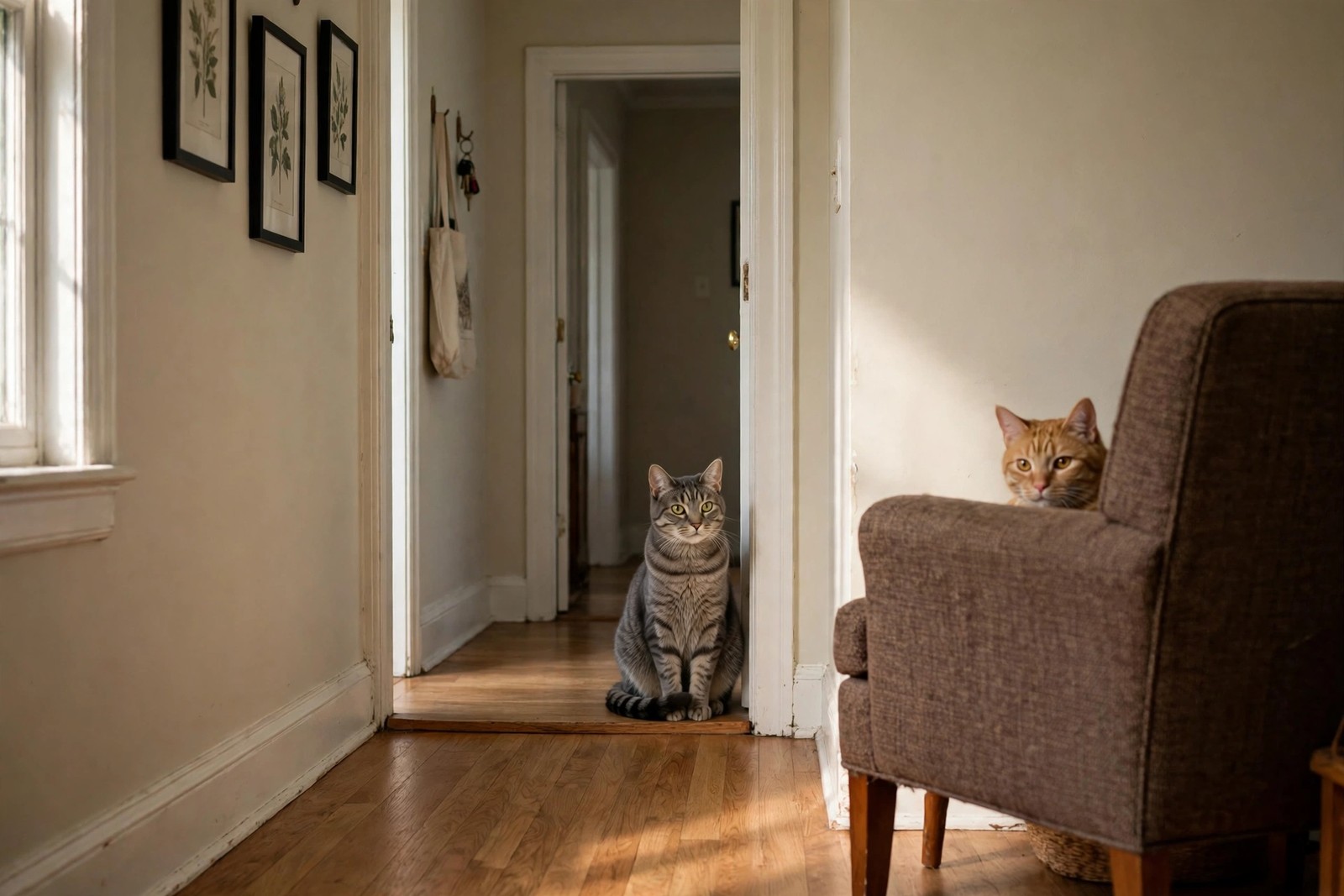
Two cats can share a home for months while one of them is quietly miserable, because cat conflict rarely starts with fights. Cats are territorial animals who would rather control space than brawl over it, so the early signs are about access — who gets to the food, the litter tray, the sunny bed, and you — long before anyone is bitten. Learning to read that quieter language is what separates a fixable tension from a household that needs full separation and reintroduction.
The Silent Signs: Staring, Blocking, and Avoidance
A hard, unblinking stare held until the other cat looks away, backs down, or leaves the room is a direct challenge, even though nothing has been touched. Blocking is its physical version: one cat sitting deliberately in a doorway, on the stairs, or across the only route to the litter tray, sometimes with a casual air that owners mistake for relaxation. The receiving cat tells the other half of the story — waiting for the coast to be clear before eating, creeping around the edges of rooms, spending most of the day hidden or shut in one safe area, and bolting from shared spaces when the other cat appears. A cat who has effectively surrendered half the house is not being shy; that cat is being managed out of it.
Where Conflict Shows Up Around Resources
Litter trays are the pressure point owners miss most. A cat ambushed mid-tray or chased away from it will start toileting elsewhere, holding on for long periods, or rushing the tray and leaving without covering — all commonly misread as a litter problem rather than a relationship problem. Food tells a similar story: one cat eating very fast, stealing from the other's bowl, guarding the feeding area, or losing weight while the other gains. Scratching posts, high perches, and your lap can all be guarded the same way. Stress leaks out in other behaviours too, including over-grooming one area of fur, appetite changes, and a cat who has become withdrawn or unusually clingy with people while avoiding the other cat entirely.
Conflict Versus Play, and What to Do Next
Play is the comparison that settles most doubts. Playing cats take turns chasing, break off easily, show loose bodies and forward ears, and come back for more; there is wrestling, but nobody is screaming, losing fur, or hiding afterwards. Conflict chases run one way, end with one cat fleeing or hiding, and come with flattened ears, hissing, growling, or tufts of fur. If you are seeing blocking, ambushes, and avoidance most days, step in rather than waiting for them to sort it out: give each cat its own feeding station, water, resting place, and litter tray in separate areas, with trays numbering at least one per cat plus a spare, and feed and play with the cats apart while tension is high. A cat whose toileting, appetite, or grooming has changed also deserves a vet check, since pain and illness lower tolerance and are often the hidden trigger. Coordinating that plan across everyone at home is where KinsLe's Care Teams earn their place, letting you assign the separate feeding, tray checks, and play sessions for each cat to specific people, with completions timestamped so the routine actually happens every day.