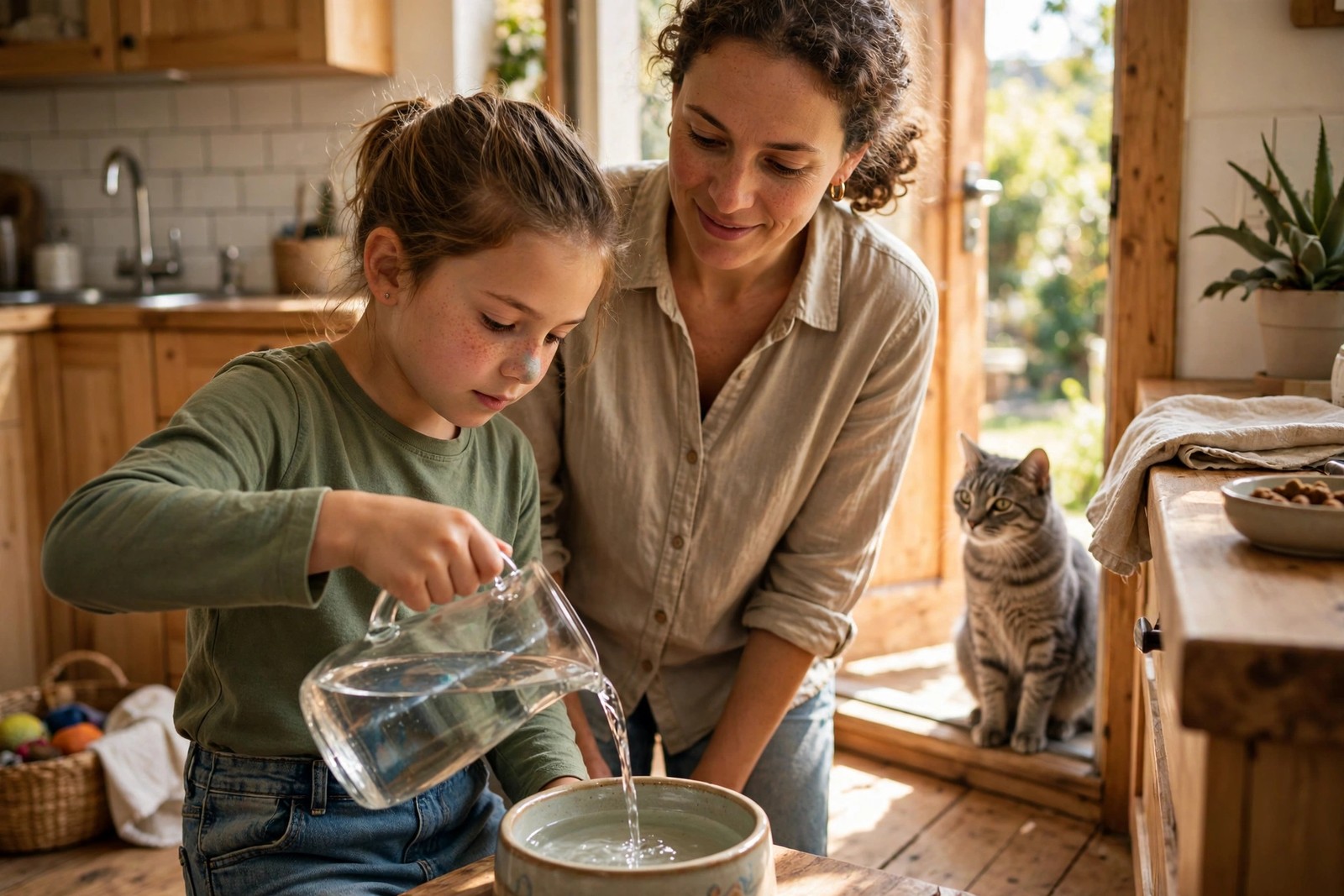
Giving children real ownership of a cat's care builds careful, observant young owners, provided the jobs are matched to what children at each stage can typically handle. Age bands here describe typical readiness, not developmental law: children the same age differ, cats differ, and supervision is what turns a plausible chore into a safe one. One rule holds at every age: an adult stays ultimately responsible for the cat, checking that jobs happened and that the cat is well, no matter whose name sits beside the task.
Young Children: Water and Gentle Brushing
The youngest helpers own small, closely watched jobs. Refreshing the water bowl is an ideal first chore: carry the bowl carefully, empty the old water, refill with fresh, and set the bowl back in the cat's usual place, with an adult beside the child for the whole sequence at first. The job is real, visible, and hard to get wrong, and a child who owns the water learns to notice the bowl every day.
Gentle brushing belongs in the same years, in short doses. With an adult right there, a young child can brush a calm cat for a minute or two, learning soft strokes in the direction the coat grows, and stopping when the cat moves away. Play with a wand toy under supervision teaches the companion lesson: hands are never toys. What young children should not own yet matters equally: no feeding measured meals, no litter contact, and no carrying the cat, because a dropped or squeezed cat is a frightened cat.
Middle Years: Portions, Play, and Observation
In the middle years, children can take on chores with a check built in rather than a supervisor standing over every second. Measuring food portions is the natural step up: the child scoops or weighs the portion the adult has specified, and an adult checks the amount before the bowl goes down, because a cat's ration is easy to double by enthusiasm. The child can also graduate to reporting: noticing an unfinished meal or a cat who seems off, and telling an adult, is genuine care work.
Play sessions can be owned outright in these years, with rules the child enforces: short sessions with a wand or thrown toy, pauses when the cat's tail starts lashing, and a calm cool-down before the toy goes away. Brushing can lengthen for a cat who enjoys the attention, and the child can become the household's early-warning system for mats or sore places, reported to an adult rather than investigated alone.
Older Children: Litter Duty, With Conditions
Litter duty is the chore that marks real ownership, and it belongs to older children who can follow hygiene without reminders. The job is the full routine: scooping daily, topping up litter, wiping spills, and washing hands thoroughly with soap immediately afterward, every time, as part of the chore rather than an optional extra. Gloves are a sensible addition, the tray area gets cleaned on the household's normal rhythm, and any change in what the tray shows, blood, diarrhea, straining, or a cat avoiding the tray entirely, gets reported to an adult the same day.
Older children can also own the feeding routine end to end and keep the grooming schedule for a tolerant cat. One boundary never moves, at any age: a child is never assigned discipline. Correcting, scolding, or punishing the cat is not a chore and never becomes one; children learn to redirect, to stop an activity, and to fetch an adult.
One Roster the Whole Household Sees
Owned chores fail quietly when the roster lives in one adult's head. Keep the age-matched duties written down where children and adults alike can see them, with names against jobs and an adult's check built into the routine, and ownership stops depending on reminders. In KinsLe, Family Sharing opens that profile to the relatives you pick.