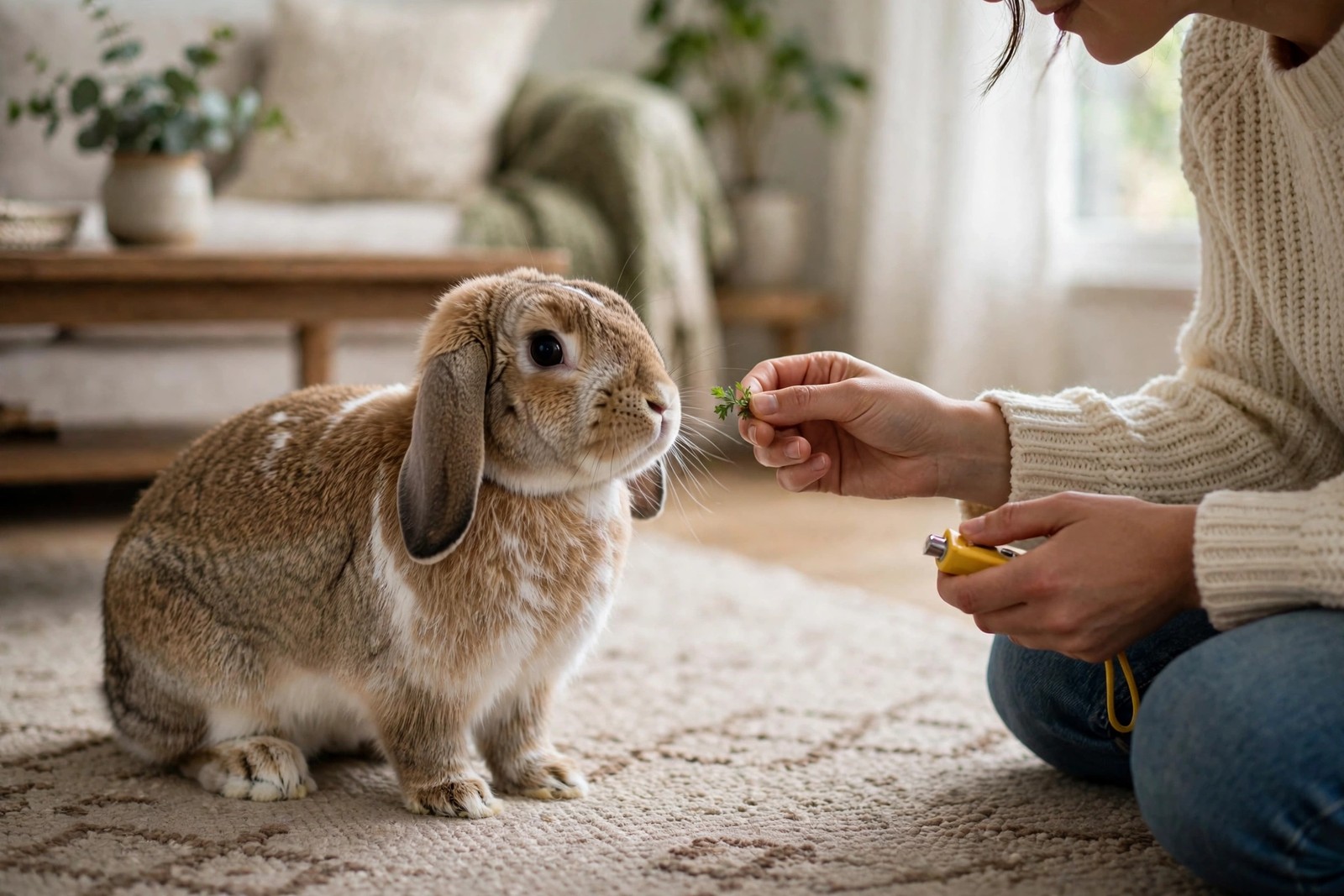
Rabbits are bright, food-motivated learners — they are simply not dogs. A rabbit will never work for praise alone or hold a position out of duty, but offer a tiny piece of coriander or a sliver of apple at exactly the right second and a rabbit will happily learn a small repertoire of named cues. Expect short lessons, progress over days, and a student who may decide a session is over and hop off. That is normal rabbit schooling, not failure.
Come when called and come to a name
This is the most useful cue and the easiest win. Say your rabbit's name once, then immediately reward any look or hop toward you, starting when he is only a step away. Build distance gradually across sessions, and always pay when he arrives — a recall that sometimes pays nothing fades fast. Many owners pair the name with a consistent sound, such as a soft click or a specific call, so the cue carries across a room. A reliable come is a safety skill as much as a trick: it gets a rabbit out from under furniture and back to you at the vet.
Spin, stand up, and high five
For spin, hold a treat at nose level and move your hand in a slow circle so your rabbit turns his whole body following it; reward the completed turn, then shrink the hand movement over repetitions until a small circular gesture works. For stand up, hold the treat just above nose height so he rises onto his hind legs to reach it, and reward the rise — keep these brief, because standing is effort and older rabbits or those with sore backs should skip it. For high five, hold a treat just out of reach beside a low surface so he lifts one front paw toward your palm; reward any paw lift at first, then only a paw that touches your hand. Each of these suits short repetitions: three or four good tries, then a break.
Go to a mat, into the carrier, and over a low jump
A mat cue — hop onto this mat and stay for a reward — gives you a station for weighing, nail checks, and calm handling. Lure each step onto the mat and feed on the mat itself. Carrier training uses the same idea: reward hopping in and out of the open carrier at home until it is a treat dispenser rather than a trap produced only on vet day, which transforms stressful trips. Confident rabbits can also learn to hop over a very low, solid obstacle on cue and to weave between a row of uprights, following a lure at first. Keep jumps low and on non-slip flooring, and never include them for a rabbit with mobility problems.
How rabbit lessons actually work
Sit or kneel on the floor so you are not looming, work on carpet or a mat for grip, and keep sessions to two or three minutes once or twice a day. A clicker, or a consistent tongue click, marks the exact instant he earns the reward, which speeds learning because rabbits connect the treat to the action, not to your fumbling. Use tiny amounts of foods he already eats safely, taken from his daily allowance, and train before a meal when he is interested but not frantic. End every session with an easy success, and write the agreed cue words on your rabbit's KinsLe Care Teams notes so everyone in the house rewards the same behaviour for the same word.