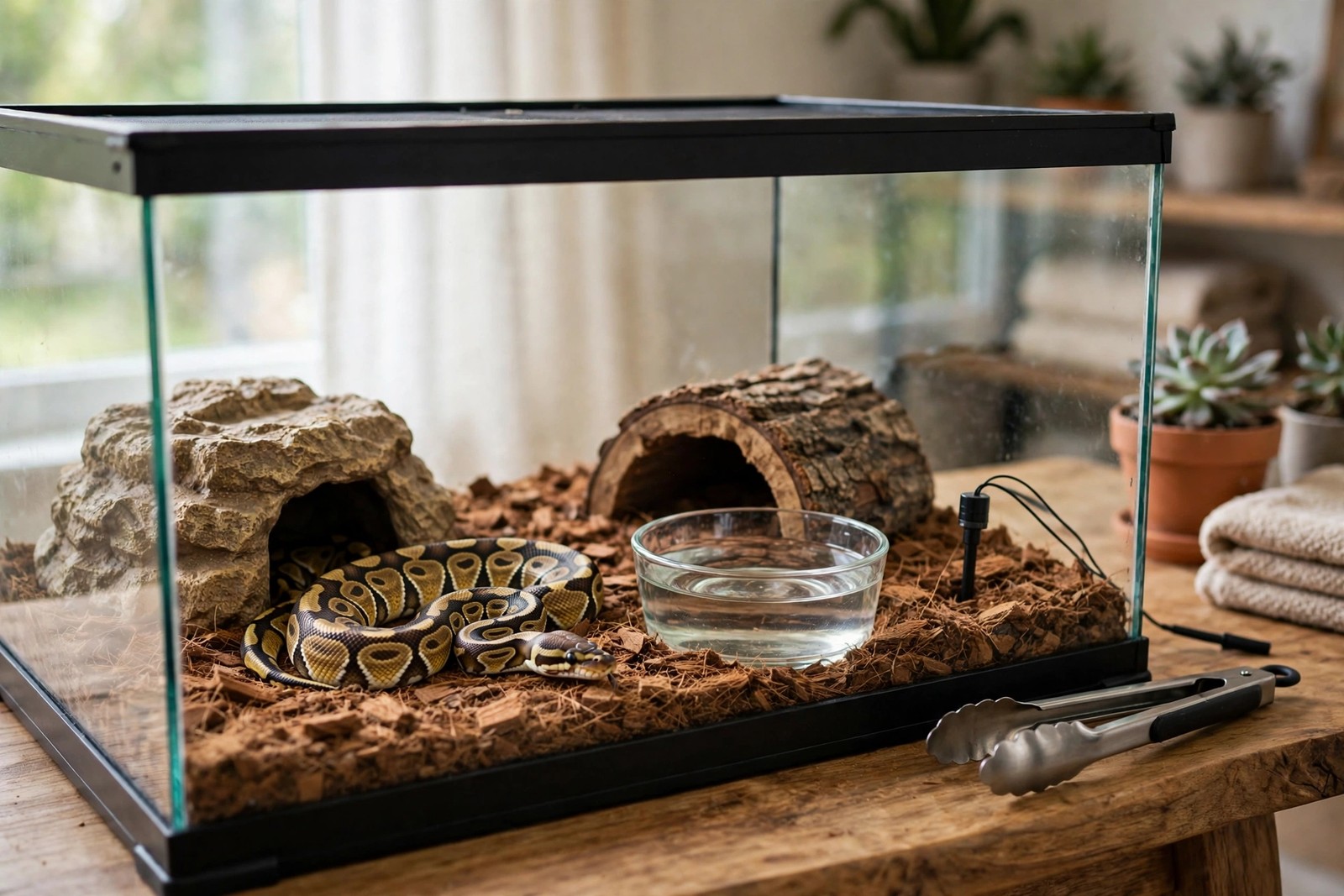
Everything a snake needs on day one is equipment rather than company, and all of it should be bought, assembled, and running before the animal comes home. A snake collected into a finished enclosure settles behind a hide and starts its routine; a snake that watches its owner build, drill, and adjust around it spends its first days stressed in a changing environment. Work through the list in four groups: the enclosure itself, heating and its controls, furnishings, and feeding and care supplies.
The Enclosure and Its Security
Buy an enclosure sized for the species and age you are bringing home, with a lid or doors that lock or latch firmly. Snakes test gaps with persistent strength, especially around cable holes and door corners, so check every opening against the snake's head size: if the head fits, the body usually follows. Front-opening enclosures suit snakes that startle at a hand descending from above, while top-opening designs suit calmer species; either is sound if it closes securely, holds humidity at the level your species needs, and is easy to clean without dismantling it.
Place the enclosure where it will stay, away from direct sun that can overheat glass in an hour and away from heavy household traffic. Fill cable ports, seal unused vents that leave an escape gap, and run the setup empty long enough to prove that opening doors for feeding and cleaning never leaves an unguarded exit.
Heating, Thermostat, and Measurement
Buy the heat source and the thermostat together, because an uncontrolled heat mat or lamp can overheat and burn a snake that cannot move far enough away from it. A thermostat switches or dims the heat source to hold the set temperature, and it is a safety device, not an optional extra. Choose the heat source for the species: an under-tank mat suits many ground-dwelling snakes, while a guarded overhead source suits snakes that bask or need warmer air temperatures.
Buy two thermometers, one probe at the warm end and one at the cool end, because a single reading cannot show the gradient the snake moves along to regulate its own temperature. An infrared temperature gun is a useful addition for spot-checking the warm surface itself. Run the whole system for at least a full day before collection and adjust until both ends sit in the ranges your species needs, through the room's warm and cool parts of the day.
Furnishings, Substrate, and Feeding Supplies
Furnishings are functional, not decorative extras. Buy at least two hides, one at the warm end and one at the cool end, each snug enough that the snake touches the sides when coiled inside, plus a heavy, tip-resistant water bowl large enough for the snake to soak in, branches or other cover for species that climb or that cross open ground reluctantly, and substrate suited to the species and its humidity needs, deep enough to hold moisture where burrowing matters.
For feeding, buy long tongs so prey is presented at a distance from your fingers, and frozen prey in the exact size and type the snake already eats, confirmed with the seller before you shop. Add a secure ventilated transport tub for collection day and future veterinary trips, plain cleaning supplies reserved for the enclosure, and a notebook or record habit from the first feed. Ask the seller for feeding, shedding, and health notes; snakes are not vaccinated, so those husbandry records are the history that matters. KinsLe's Transferrable Profiles moves that feeding and shedding history from seller to you with the snake's profile, so the routine you have just equipped continues without a gap.