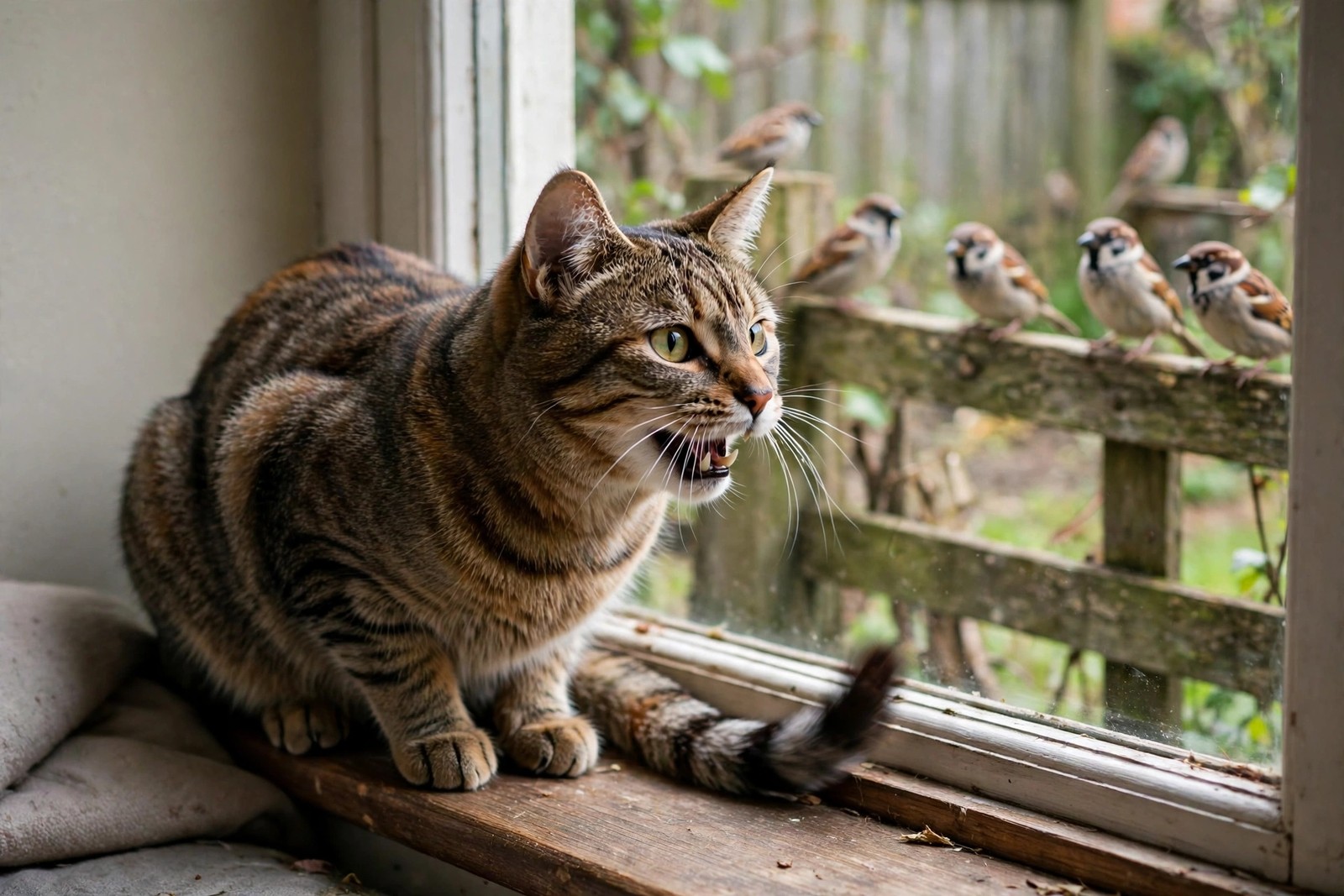
Few cat behaviours puzzle owners like window chattering. Your cat is fed, safe, and warm, yet at the sight of a sparrow on the fence it crouches, fixes its stare, and starts a strange stuttering chatter of the jaw, sometimes with chirps and clicks, as if the bird has short-circuited something. Nothing is wrong. You are watching one of the oldest pieces of software a cat owns — the hunting sequence — firing at full strength with the final step blocked by glass.
What You Are Actually Seeing
Read the whole body, not just the sound. A chattering cat is typically crouched low with weight shifted forward, pupils wide, ears pricked toward the bird, whiskers fanned, and tail tip twitching or lashing with rising excitement. The jaw vibrates rapidly so the teeth meet in a fine, clicking chatter, and many cats add a repeated chirping or cackling call quite unlike their ordinary meow, which is reserved mostly for people. The episode lasts as long as the bird stays in view and stops almost the moment it flies off, after which the cat may shake itself, groom briefly, or stalk off in a state of visible overstimulation. Cats do the same at insects on the ceiling, squirrels on a fence, and occasionally at a dangling toy they cannot quite reach — the trigger is visible, tantalising prey, not birds specifically.
Why the Jaw Does That
The leading explanation connects the chatter to the killing bite. Cats kill small prey with a rapid, precise bite to the neck, delivered with fast, finely adjusted jaw movements, and the chattering motion closely resembles that bite pattern performed in advance — a motor sequence switching itself on at the sight of prey before the cat is anywhere near it. Arousal and frustration complete the picture: the cat is fully committed to a hunt it cannot begin, and behaviourists generally read the chatter and chirping as that bottled excitement leaking out, possibly mixed with an involuntary attempt to mimic or call to the bird. What it is not is hunger. A cat that has just eaten will chatter exactly the same, because hunting motivation in cats runs separately from appetite, which is why a successful hunter may still stroll home for dinner.
When It Is Normal, and Helping Your Cat Wind Down
Chattering at wildlife is normal for the great majority of cats, including indoor cats who have never caught anything, and it needs no correction. Two things are worth a second look: a cat that becomes so frustrated it redirects onto a nearby cat or person with a swat or bite — give wound-up cats space until they settle — and any jaw movement that appears when no prey is present, especially alongside drooling, pawing at the mouth, or eating less, which can signal mouth pain and merits a vet visit rather than a behaviour explanation. For the ordinary window hunter, the kindest response is to complete the story the bird started: a short, vigorous wand-toy session after a long chattering spell lets your cat stalk, chase, and finally catch something, which discharges the built-up arousal far better than scolding or dragging it from the sill. If you ever film a particularly dramatic performance and want an opinion on it, KinsLe's Messenger keeps that conversation in your cat's own per-pet hub, so the clip and your vet's or sitter's reply stay together with everything else about your cat.