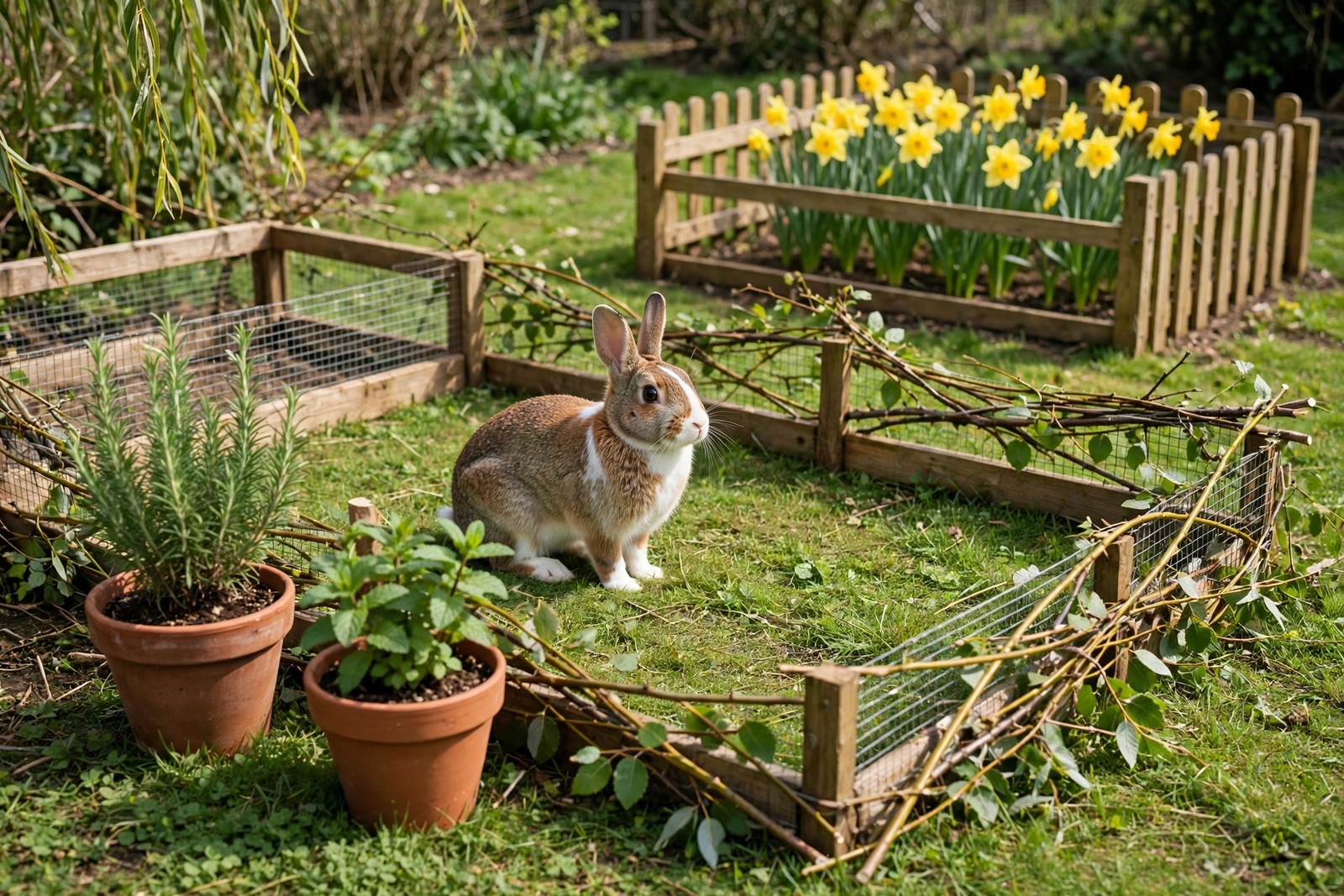
A rabbit run turns the garden border into part of the rabbit's world. Anything beside the run can be nibbled through the mesh, and anything overhanging can drop leaves and seeds into reach. Check any plant against the safer list and the known-risk list before it goes anywhere near the run. One rule sits above both lists and is stated firmly: no plant is fed from the garden unless it is identified with certainty.
Generally Safer Beside a Run
The planting most keepers regard as safer near a run is the woody, orchard-style set. Willow and hazel are commonly grown for rabbits, and their branches and wood are widely used as chew material. Apple and pear wood share that reputation, and an orchard corner planted with the run in mind gives shade in summer.
Many kitchen herbs are also generally regarded as safe neighbors for a run. Rosemary is sturdy, evergreen, and rarely troubled by nibbling through mesh, and mint holds its own but spreads so aggressively that most gardeners keep it in a pot beside the run rather than loose in the border. Safer means safer to grow near the run, not an invitation to feed handfuls of anything new without the identification rule and a gradual introduction.
Fence Off or Keep Out of Reach
The known-risk set is just as familiar, which is exactly why it catches people out. Spring bulbs, including daffodil and tulip, are a classic hazard: cheerful, common, and risky in bulb, leaf, and flower, so they belong in beds well away from the run or behind fencing the rabbit cannot reach through. Foxglove is another cottage-garden staple that keepers fence off without exception.
In the vegetable patch, the foliage is the problem rather than the harvest: rhubarb leaves, and potato and tomato foliage, should never be within reach of the run. Among shrubs and trees, laburnum and yew are the names keepers treat most seriously of all, and neither belongs anywhere a rabbit grazes or where clippings could be tossed within reach. Buttercups in quantity in the grazing area are also kept on the fence-off side of the ledger, managed by mowing and fencing rather than treated as harmless filler. A plant you cannot name is treated as risky until you can.
The Border Itself Needs a Routine
Lists alone do not keep a run safe, because gardens move. Plants lean, self-seed, and drop. Build three habits around the run. First, assume nothing within nibbling reach through the mesh is safe: if a rabbit can pull a leaf through the wire, that plant needs to be on the safer list or moved, and what touches the mesh after rain and growth spurts deserves a close look. Second, check anything overhanging the run, since overhang decides what falls in. Third, sweep fallen leaves and seeds from in and around the run regularly, especially in autumn, so yesterday's windfall never becomes today's grazing.
The firm rule bears repeating: no plant is fed from the garden unless it is identified with certainty. A look-alike leaf is not good enough, and a guess is not good enough.
Sharing the Border Plan
A run's border is rarely one person's work. Partners plant, relatives helpfully fill gaps, and children bring home seeds from school, and any of them can put a risky plant beside the run in innocence. Write the plan down once: what is planted beside the run, what is fenced off and why, what gets swept and checked, and the certainty rule for feeding anything. The household shares that planting and checking plan through the Family Sharing tools on KinsLe, so anyone gardening near the run can look up the two lists before a spade goes in, and a new planting gets added to the shared plan the day it goes in.
With the planting and checking plan held in the Family Sharing record on KinsLe, everyone who gardens near the run works from the same safe list and the same fence-off list.