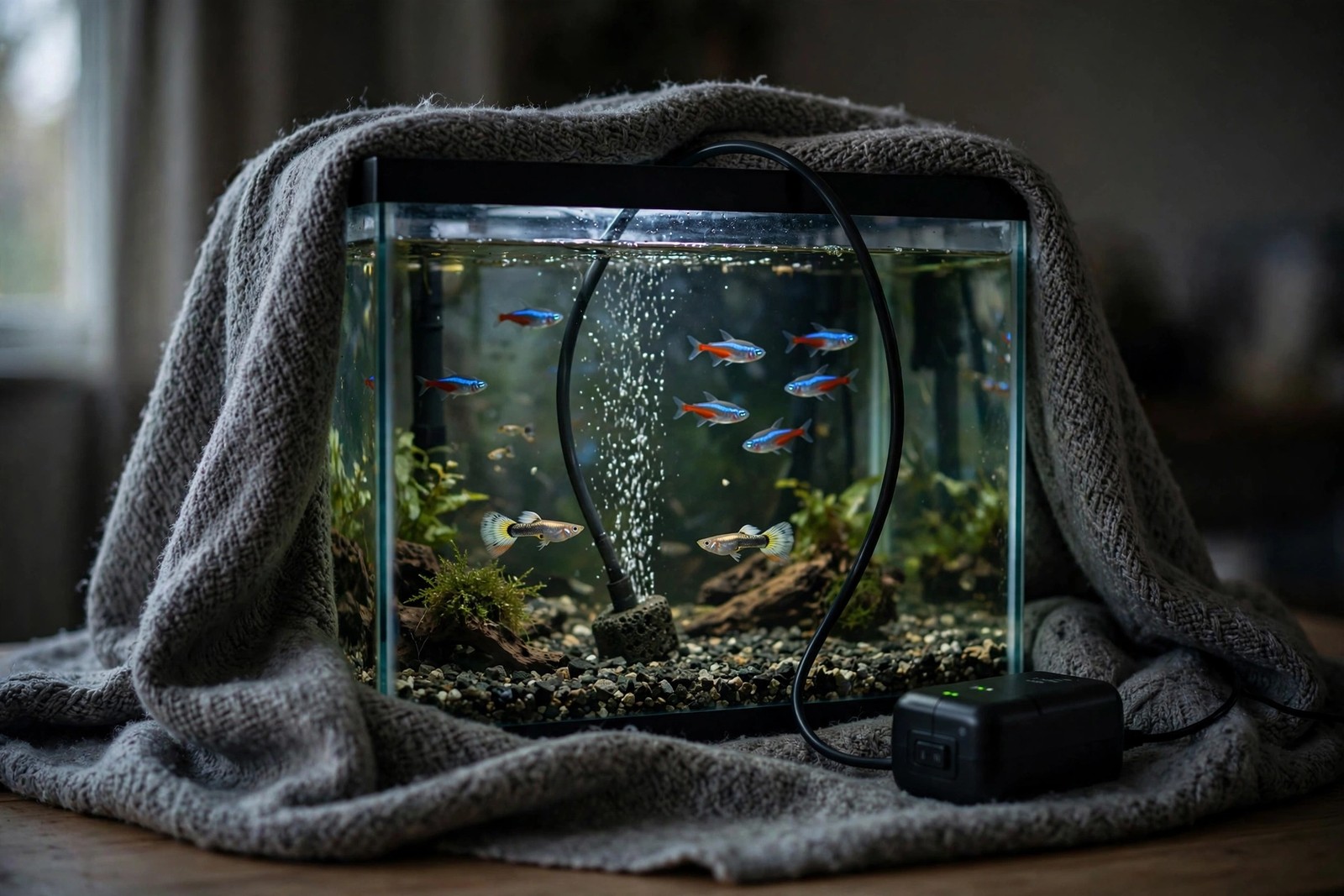
Nothing in the tank fails one piece at a time. The moment the power goes, the filter stops turning the water over, the heater stops replacing lost warmth, the lights go out and any air pump stops breaking the surface. The fish themselves are not harmed by the sudden quiet or the darkness — the risks that follow are slower, chemical and thermal, and they build over hours rather than minutes, which is exactly why calm, early action works so well.
The First Hours: Temperature and Oxygen Drift
Tank water drifts toward room temperature, so the direction of danger depends on the season: a tropical tank in a cold room loses heat steadily, while any tank in a heatwave can overheat once its cooling and circulation stop, and warm water holds less oxygen in any case. Oxygen is the tighter clock. Fish keep breathing, plants stop producing oxygen without light, and the still surface exchanges gas with the air far more slowly than a rippled one does. Heavily stocked tanks, large fish and warm water shorten the safe window; a lightly stocked tank at a mild room temperature can coast for many hours with no losses at all.
What Happens Inside the Filter
The bacteria colonising your filter media need oxygenated water flowing past them. Trapped in a still, sealed canister, they consume the oxygen around them and can begin to die back after several hours without flow. Two problems follow. The tank loses part of its capacity to process ammonia, and a filter left stagnant for a long stretch can turn foul inside, so its first returning flow pushes stale, oxygen-starved water back into the aquarium. If the outage runs long, rinse the media gently in removed tank water before restarting, and test ammonia in the days afterwards while the colony recovers.
What To Do While the Power Is Out
Stop feeding at once: uneaten food and extra waste burn oxygen the fish cannot spare, and healthy fish tolerate days without food far better than hours without oxygen. Keep the lid closed so warm air stays in and surface disturbance from opening it does not chill the water. Wrap the tank in blankets, towels or a duvet to slow temperature change — insulation buys hours in both directions. A battery-powered air pump with an airstone is the key outage tool, because it restores surface movement and oxygen directly. Without one, scooping a jug of tank water and pouring it back from a height every so often does the same job by hand. Never add hot water, ice or water from an untested source in a panic; sudden swings hurt more than slow drift.
When the Power Comes Back
Restart everything, then watch rather than relax. Check the filter is actually flowing, confirm the heater is working, and test ammonia and nitrite over the following days, because a weakened bacteria colony can let waste spike after the event looks over. Feed lightly at first, and treat gasping at the surface, clamped fins or unusual stillness in the days after an outage as a reason to test the water the same day. Tank size changes the arithmetic. A small tank swings in temperature faster and holds a smaller oxygen reserve, so it needs the blankets and manual aeration sooner, while a large, lightly stocked tank buys its owner time to simply watch and wait. Either way, note roughly how long the outage lasted and what the temperature did, because that record can explain an illness that surfaces in the following week. KinsLe's Family Sharing puts this outage routine on the fish's shared profile, where every member of the household can open it and follow the same steps in the same order.