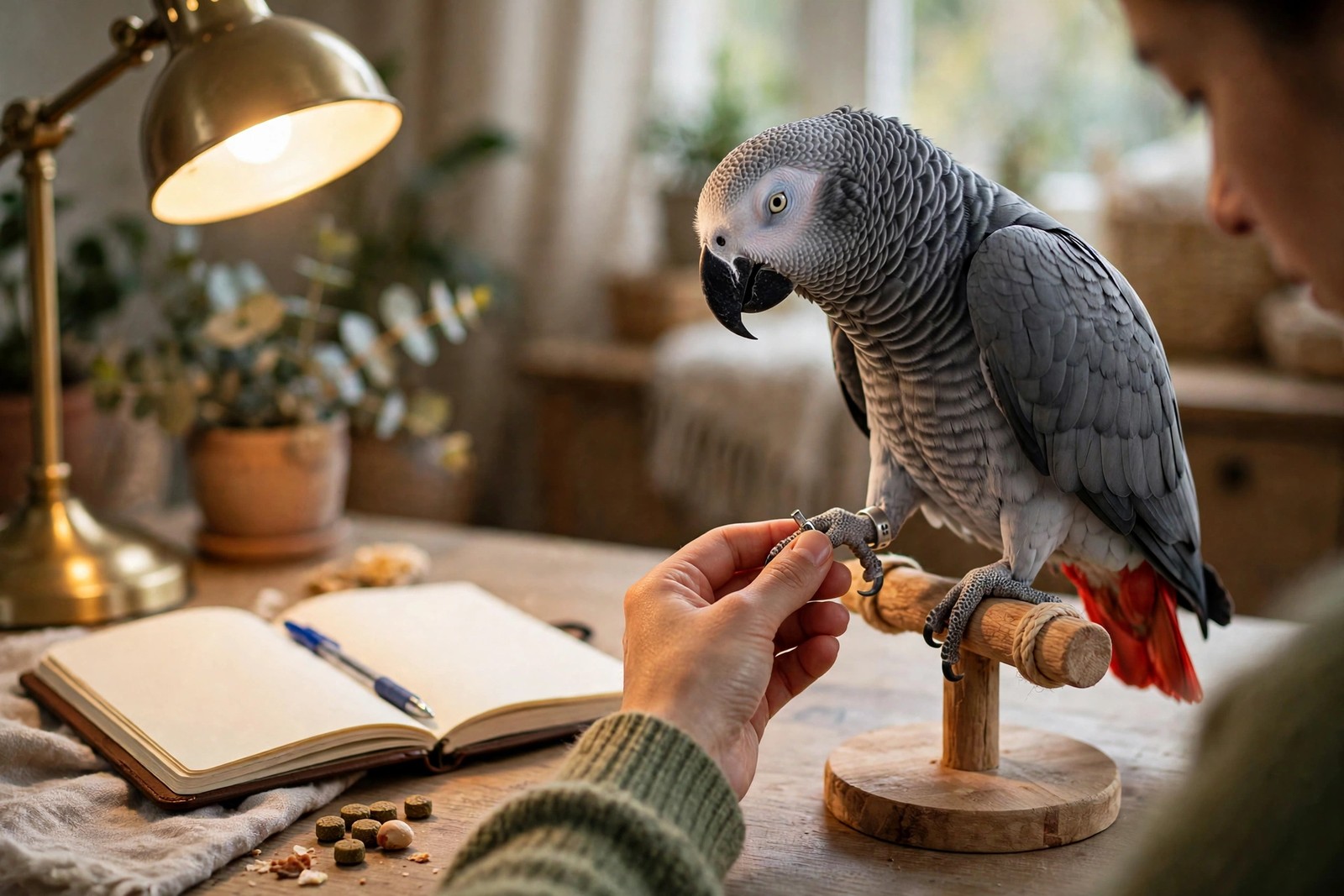
The small metal ring on your African grey's leg is not decoration. It is the bird's earliest identity document, put in place before it ever left the nest, and reading it properly matters most when your grey is about to be cared for by someone else.
What the Band Actually Records
Most African greys wear a closed band, a seamless ring slipped over the tiny foot of a chick roughly two to three weeks old, which the growing foot then cannot pass through. That closed construction itself tells a story: the bird was captive bred and banded by its breeder, not caught or fitted with a band later in life. Stamped around the ring you will typically find the breeder's initials or registered aviary code, a two-digit hatch year, and an individual number identifying that one chick within the breeder's records. Some bands add a state, province, or country code. An open band, pinched closed around the leg of an older bird, usually comes from a vet, importer, or rescue and carries less origin information.
Reading It Without Stressing the Bird
Read the band under a bright light with the grey settled on a familiar perch or held gently in a towel by someone it trusts; never chase or grab at the leg just to get the code. Rotate the ring slowly and write down every letter and number in order, exactly as stamped, including any spaces or dashes, because a transposed digit makes the record useless. Note which leg carries the band, and add a close photograph of it if you can take one without a struggle. Bands can become faint with wear over a grey's long life, so an early, careful transcription is worth far more than a squint years later.
Where to Write It Down Before Boarding
Record the band details in three places. First, your grey's main health record, alongside its weight, vet details, and any microchip number. Second, the boarding paperwork itself, so the facility can match your bird to your forms at drop-off and collection and prove identity if several greys are staying at once. Third, your own phone, so you can quote it instantly if the boarder or your vet rings you while you are away. Tell the boarder plainly that the band stays on, since removal needs a vet or experienced handler with proper cutting tools, and a tight, damaged, or swelling leg around a band is a vet matter, not a boarding task.
Why This Record Earns Its Keep
For a bird that can live for decades, the hatch year on the band anchors every age-based decision a vet makes, and the breeder code can reconnect a lost or rehomed grey with its origin records. Paired with dated photographs and vet invoices in the same name, it forms a solid identity trail. Keeping that transcription in KinsLe's Pet Passport puts the band code, the boarding dates, and the vet contacts in one packet, so whoever collects or cares for your grey can verify the bird in front of them against the record in seconds.