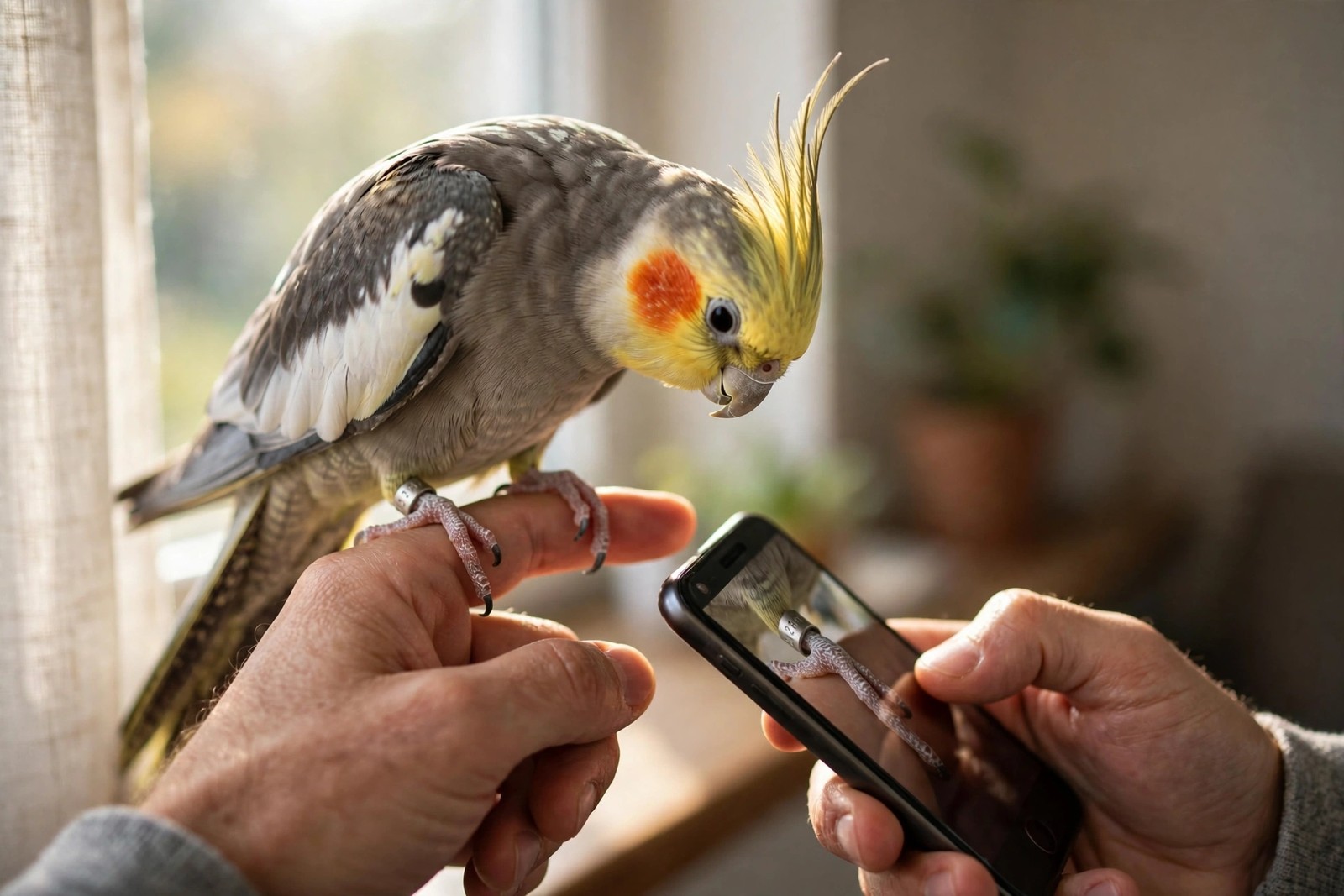
A cockatiel cannot tell anyone where it lives, and it carries no registration plate. What it does carry, if it was breeder-raised, is a tiny stamped ring whose few characters become surprisingly powerful when they sit inside a properly kept ownership file.
Decoding the Band on a Cockatiel
A closed band is a seamless ring slipped over a chick's foot in the nest, generally at around one to two weeks old, and the maturing foot grows too large to slip it off again. Reading around the ring, you will usually find the breeder's initials or an aviary or society code, a two-digit hatch year, and a sequential number identifying that individual chick in the breeder's hatch records. Because the band went on before fledging, it quietly supports the bird's age, its captive-bred origin, and the identity of the person who raised it. A split, open band was fitted later by a vet, importer, or rescue and proves less on its own, which makes the rest of your file matter more.
Why the Band Alone Is Not Proof
No central registry ties that code to your name, and the band never leaves the bird, so on the day you actually need proof, perhaps after an escape, a found-bird claim, or a dispute, you cannot produce the band itself. What proves ownership is the match: your written transcription and a clear photograph of the band, held by you, agreeing exactly with what is read from the recovered bird. That is why transcribing every letter and digit carefully, in order, and photographing the band while your cockatiel is calm matters far more than noting an approximate version from memory.
The File to Keep Alongside It
Keep the transcription in your bird's main health record, and support it with the purchase or adoption receipt, the breeder's or rescue's contact details, vet invoices that name the bird and the band number, and dated photographs showing your cockatiel's particular markings, since cheek patch shade, crest shape, and pied patterning differ between individuals. Keep one copy somewhere separate from the original paperwork, in your phone or with a trusted family member, so a lost folder does not erase the trail. If you rehome the bird one day, pass the file on and record the transfer, so the chain of ownership stays unbroken for the next keeper.
Using the Record When It Counts
If your cockatiel escapes, quote the band code exactly in lost-bird posts and to vets, rescues, and shelters, and ask finders to read the band rather than guessing from appearance. A claimant who can state the code before it is published, and describe the bird's markings from dated photos, is in a far stronger position than one working from appearance alone. Holding the transcription, photos, and receipts together in KinsLe's Pet Passport means that evidence is already assembled on the stressful day you need it, not gathered in a panic from three different drawers.