
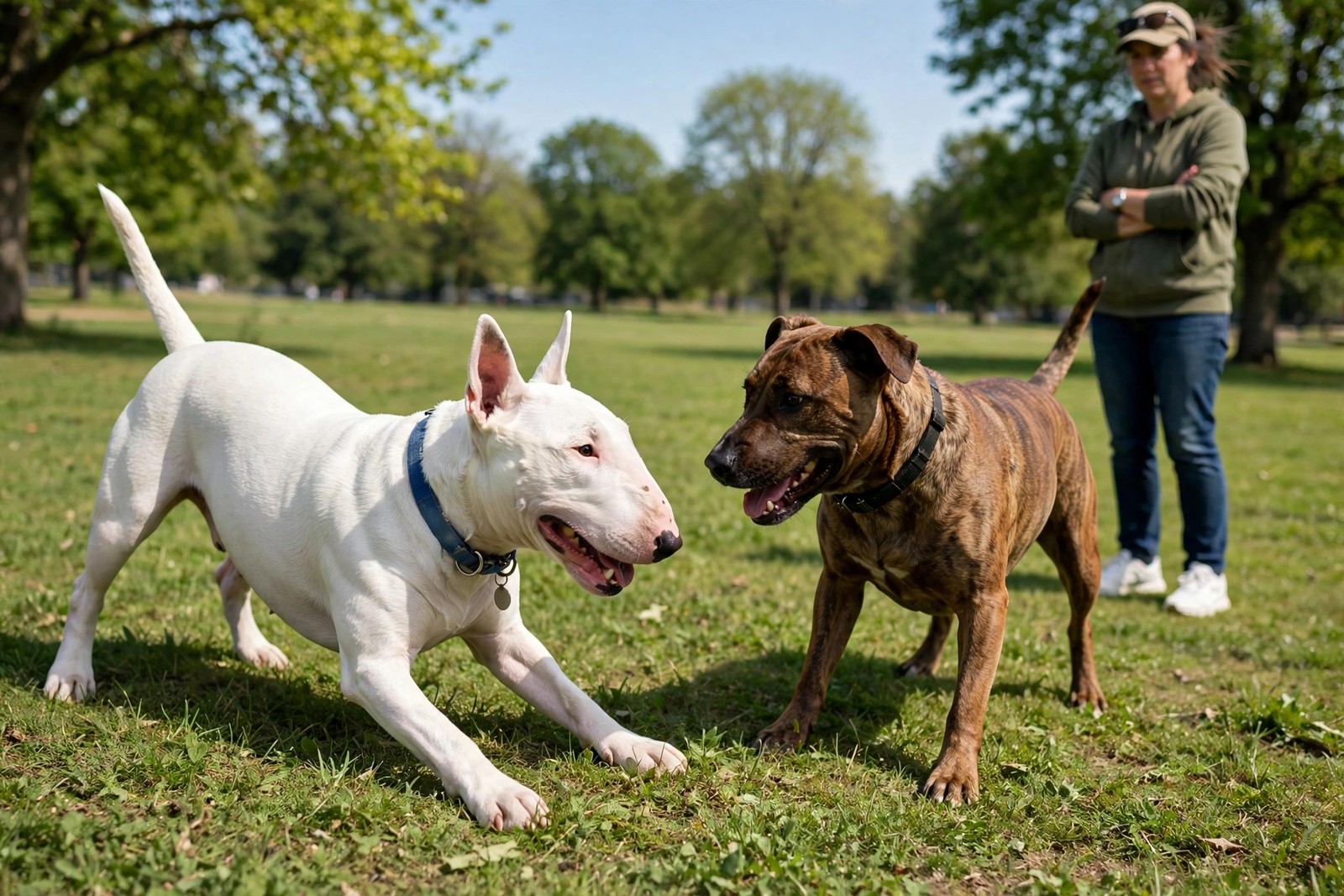
To a Bull Terrier, play is a contact sport. None of that is misbehavior; it is the Bull Terrier play style, clownish and wholehearted and built into the breed's character. The owner's job is not to sand the style down but to referee it, choosing the right opponents, reading arousal accurately, and interrupting at the moment enthusiasm starts outrunning judgment.
Full-Body Play Is the Breed's Default
Expect wrestling over standing games, body slams over polite parallel play, and a dog who uses its head and shoulders like sporting equipment. Bull Terriers often play noisily, with grumbling and theatrical growls that are part of the game rather than warnings, and they tend to fix on one play partner and pursue the game single-mindedly. With a matched partner, another sturdy, tolerant dog who enjoys the same roughhousing, this style produces the happiest, tiredest dogs on the field, both animals returning voluntarily after every pause.
Matching matters more than almost anything else. Pair a Bull Terrier with dogs of similar size, strength, and play preferences, and avoid asking small, elderly, fragile, or socially delicate dogs to absorb a style they never signed up for. Known playmates in controlled settings are the reliable recipe.
Signs a Game Is Tipping Over
Friendly play has a rhythm: bouts of intensity, pauses, role swaps, and both dogs drifting back in by choice. Fixation is the clearest early sign, a hard, silent stare locked onto one dog, with the body stiffening and the usual clownish looseness gone. Mounting that will not break off belongs on the same list; a hump during excited play is common and harmless, but mounting that continues while the other dog snaps, ducks away, or tries to leave has stopped being play for the dog underneath it.
The third sign is asymmetry of fun. One dog is having the time of its life while the other has gone quiet, keeps its tail low, hides behind legs, or makes repeated attempts to exit that get overrun. Learn your own dog's earliest tells, because intervening at fixation is a training moment, while intervening at a fight is an emergency.
Breaks, Recalls, and Matched Playmates
Owners keep games safe with structure, and the core tool is the play break. Every minute or two during intense play, call both dogs out cheerfully, reward a moment of calm attention, check that both animals are still loose and eager, then release them back to the game. Breaks do three jobs at once: they bleed off arousal before it peaks, they rehearse a recall in exactly the high-distraction setting where you need it most, and they give the less enthusiastic dog a dignified exit if it chooses your side over the game.
Call your Bull Terrier out before arousal peaks, not after, which means watching the trend of the game rather than waiting for a specific offense. Supervise always, with a person close enough to step in, and separate dogs who have tipped over for a genuine cooling-off period rather than an immediate rematch, because arousal drains slowly and a quick restart often skips straight back to the peak.
Supervision Is Not Optional
Position yourself where you can reach the dogs, keep leashes or drag lines on in early pairings, and know in advance how you will separate animals if you must: calmly, by collar or harness from behind, without reaching into the middle of aroused, mouthing dogs. Children should watch Bull Terrier play from outside the game rather than joining the wrestling, because a fifty-pound comedian at full speed knocks small people over without noticing.
Kept inside those guardrails, the breed's play is one of its great joys to witness, and the dogs come home pleasantly exhausted in a way no solo walk delivers. Record what you learn about your own dog as you go: which partners suit, which games over-arouse, which break cue works fastest. When notes travel well, KinsLe ensures the Transferrable Profiles summary tells a new owner exactly how this dog plays and when to step in.