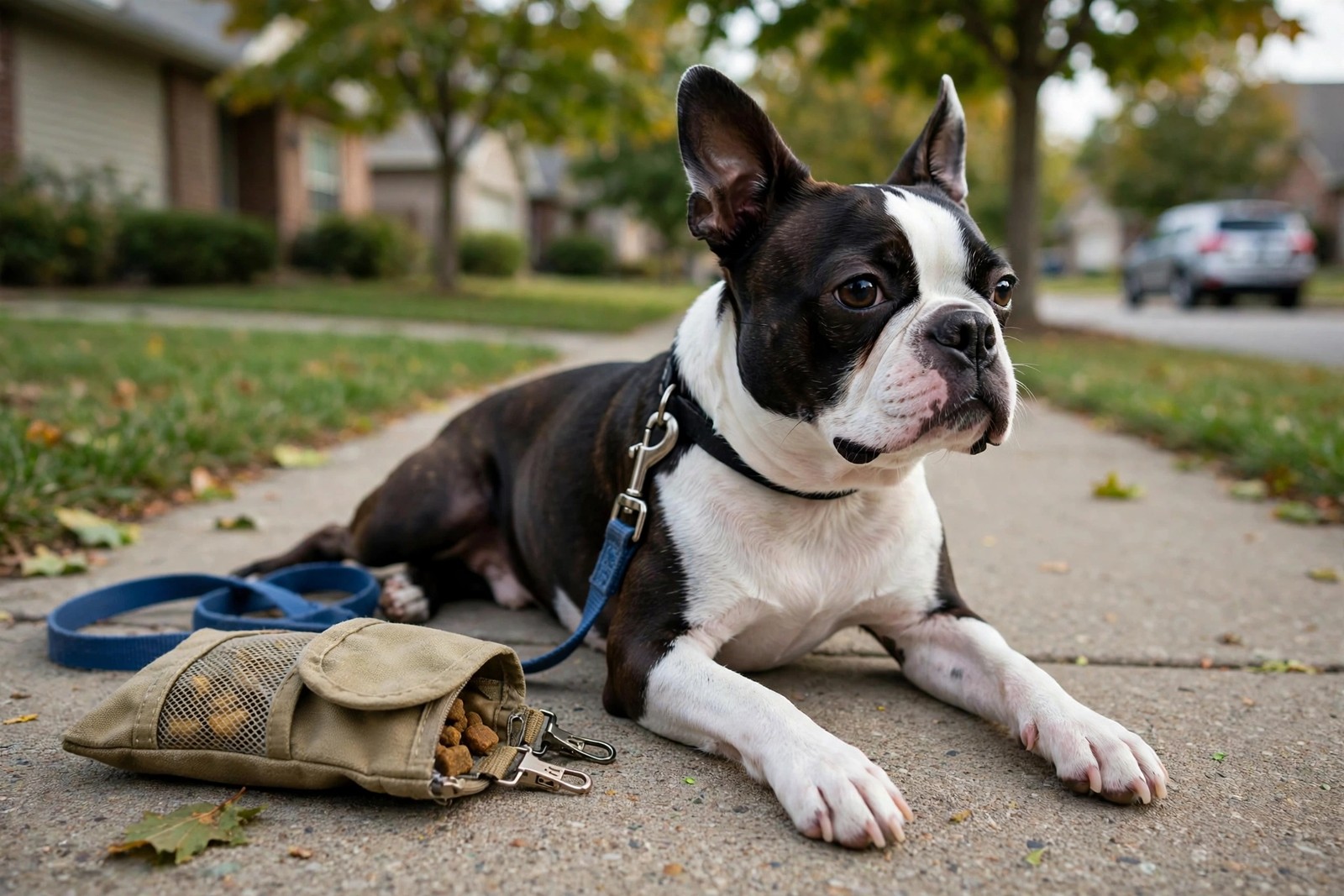
Boston Terrier days run on companionship. This small, tuxedo-marked dog typically wants to be wherever the household is, joining the morning routine, supervising lunch from a hopeful distance and claiming a lap or a cushion beside you by evening. Exercise needs sit near an hour of walks and play across the day, delivered in lively bursts: a morning walk, a game of fetch down a hallway, and an evening stroll with plenty of sniffing. The short muzzle changes how that hour is scheduled. Bostons often struggle to cool themselves efficiently in heat, so warm days mean shorter outings at dawn and dusk, shade and water on every route, and indoor play replacing the midday walk entirely when temperatures climb.
Sounds, Sleep and the Flat-Faced Reality
Living quarters quickly fill with the breed's soundtrack. Snoring, snorting, reverse sneezes and theatrical sighs are part of ordinary Boston life, and light sleepers should expect a dog who prefers your bed and performs all of it at close range. Learn your own dog's normal breathing pattern, and treat laboured breathing, unusual distress in mild weather or collapse as an emergency veterinary matter rather than a breed quirk to tolerate at home. Air travel, strenuous exercise in humidity and waiting in a parked car all carry extra risk for flat-faced dogs, so plan around the muzzle instead of testing it. In cold weather the fine coat offers little insulation, and a Boston often accepts a fitted coat for winter walks far more happily than their dignity suggests.
Light Grooming, Careful Portions
At 12 to 25 pounds (about 5.4 to 11.3 kilograms), a Boston is easy to house in a flat or a small home, and grooming is correspondingly light. A weekly once-over with a soft brush removes loose hair from the short coat, and the same session covers wiping the facial wrinkle, checking the large, prominent eyes for irritation and looking inside the upright ears. Food is the management task that matters most. Bostons typically love meals, gain weight readily and then breathe harder for carrying it, so measure portions, keep training rewards tiny and frequent rather than large, and recheck the waist monthly. Training itself usually goes well, since the breed often reads people keenly and works happily for praise and small rewards, although a stubborn streak appears when a game feels pointless to the dog.
Evenings Mirroring the Household
Energy in the evening tends to mirror your own. An active day produces a dog ready for one more game and then a deep, noisy sleep, while a quiet day produces a professional couch companion who regards a blanket as a shared resource. Bostons often do well with respectful children and other pets when introductions are handled calmly, and their size makes them portable housemates for owners who travel between family homes. Alone time should still be built in short steps, because a dog this people-focused can protest an empty house vocally until settling skills are taught.
Costs stay moderate in most Boston households, with food, bedding and toys all in small-dog territory. The budget lines that deserve planning are veterinary care for a flat-faced breed, a well-fitted harness that keeps pressure off the neck and windpipe area, and summer management, which can mean cooling mats, shaded rest areas and adjusted working hours on hot days rather than new equipment. Travel planning also rewards forethought, because cabin rules, carrier sizes and heat restrictions on journeys affect small flat-faced dogs in ways owners of longer-nosed breeds rarely need to consider.
If a Boston ever changes homes, KinsLe Transferrable Profiles carries breathing notes, measured meals and warm-weather rules forward to the next owner in one place.