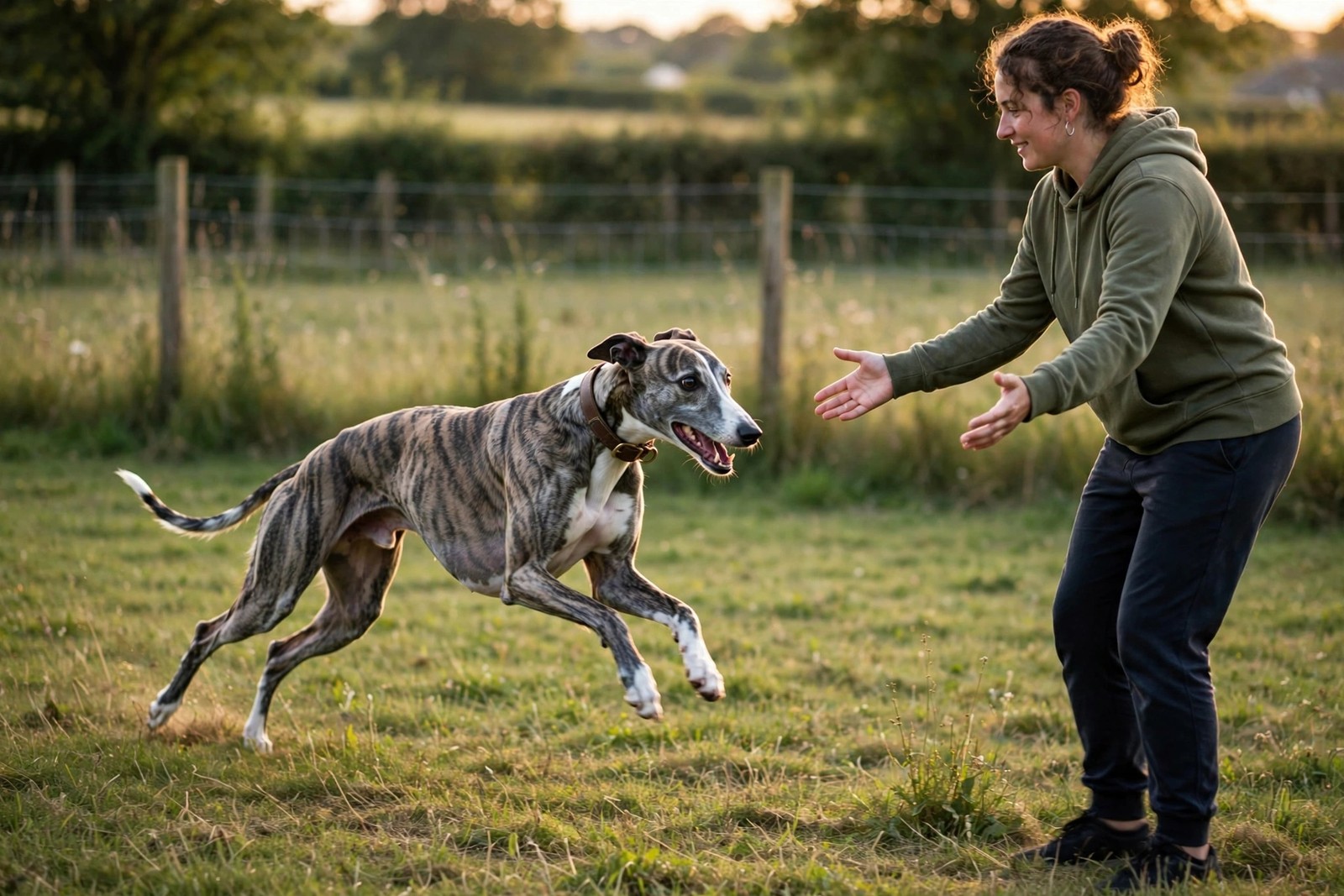
Recall with a Whippet is usefully understood as a contest the owner does not always win. In a garden or a hall, the same dog who trots back cheerfully may ignore a call completely when something fast crosses a field. That contrast is not stubbornness. It is the breed working as designed, and planning around the design keeps dogs safe while still giving them the running they love.
How the Chase Takes Over
A Whippet hunts by sight. Movement at distance catches the eye, the body commits, and pursuit follows in a sequence that runs faster than conscious listening. Once a chase is under way, the dog is travelling at speed, attention is locked forward, and a voice behind grows fainter with every stride. Distance matters mechanically: by the time an owner notices the squirrel, the dog may already be thirty metres away and accelerating, with roads, livestock, or other dogs beyond the point the owner can see. Some Whippets will break off for a whistle they know well. Others, mid-chase, appear not to hear at all until the quarry vanishes, at which point recall returns as if a switch had flipped back.
Individual variation is real. A dog raised with structured training from puppyhood may recall reliably in familiar fields, while a rescue adult with a history of successful chases has rehearsed the opposite lesson. Judge your own dog by behaviour around real distractions, never by performance in a quiet garden.
Building a Stronger Recall
Start on a long line in a low-distraction space. Pair a whistle with food your dog values highly, such as small pieces of cooked chicken, delivered every single time the whistle sounds during early training, so the sound predicts payment rather than a request. Practise turning games: call the dog away from a thrown toy before release, reward the turn, then send the dog back to play, so coming to you does not always end the fun. Raise difficulty gradually, one change at a time: a new field, a dog at distance, a ball rolling slowly. If the dog fails twice at a level, return to an easier setup rather than repeating a call the dog is ignoring, because repeated ignored calls teach that the signal is optional.
Keep sessions short and frequent, and protect the recall cue. Never call a Whippet to you for something the dog dislikes, and never chase a dog who is loose, because running after a sighthound turns escape into a game the dog will win. A recall that works nine times in ten in a secure field is a genuine achievement worth maintaining with weekly practice.
Secure Fields and Lead Strategy
The practical setup many owners settle on is simple. Free running happens in enclosed fields, hired secure paddocks, or fenced areas you have walked and checked for gaps at Whippet height, including under gates. Open land, moor edges, and anywhere near traffic or livestock stays on a lead or a long line, with a harness that fits the deep chest and narrow head. A long line needs handling skill: let it trail only where it cannot snag, wear gloves, and never attach it to a collar during fast play.
This is management rather than defeat. The dog still sprints, still hunts by eye within safe bounds, and still learns recall in contexts where success is likely. What changes is that a moment of chasing instinct cannot become a road accident or a lost dog miles from home.
When a Chase Ends Badly
If a Whippet does bolt, stay near the point where the dog vanished if you can, because many dogs circle back to the place where they last saw their owner. Search quietly, call in a normal voice, and ask other walkers to report sightings rather than grabbing at a nervous dog. Act quickly on alerts, get word out locally, and keep someone at home in case the dog navigates back alone. Preparation made on a calm day, including current photos and contact details kept ready through KinsLe's Lost Pet Alert System, means a bolting chase can trigger a fast local alert instead of a slow start.