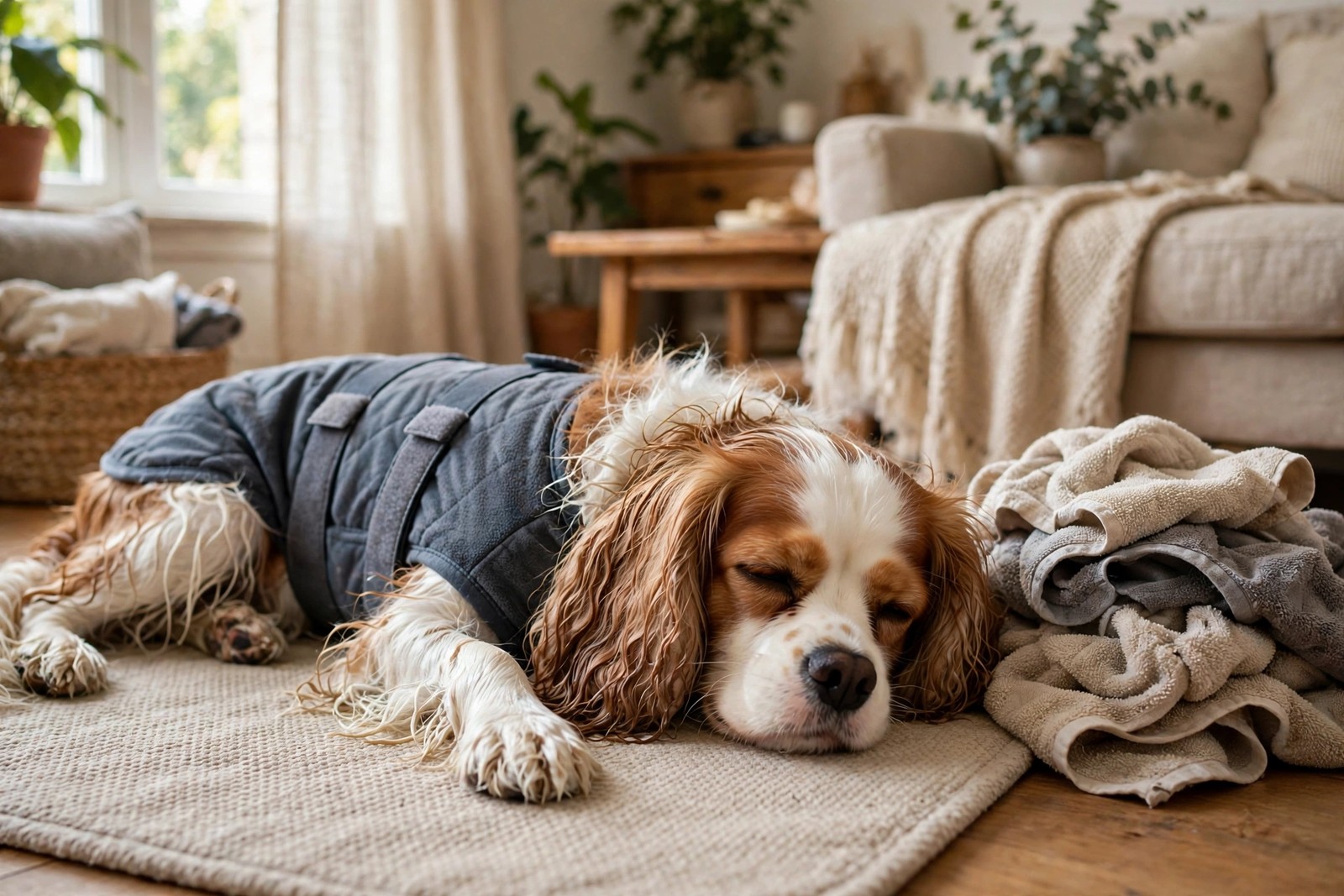
A dog who panics at the dryer is usually objecting to some mix of the noise, the hot moving air, and being held in place — and the good news is that none of those is required for a properly dry dog. Towel technique, a drying coat, and a warm room will get most dogs fully dry. The one method that does not work is doing nothing and hoping, because a coat that stays damp at the skin is where mats, odour, and sore patches start.
Layer One: Towels, Used Properly
Start before the bath ends: the more water you keep out of the coat with a good final rinse and a thorough squeeze-through with your hands, the less drying remains. Then towel by pressing and squeezing sections of coat between folds of towel, working from neck to tail. Rubbing back and forth feels faster but tangles long coats, pushes water around instead of lifting it, and winds up an already stressed dog. Swap to a dry towel as each one saturates — two or three towels for a big or thick-coated dog is normal, not excessive.
Follow with a microfibre towel if you have one. Microfibre holds far more water than cotton for its weight and pulls moisture out of the undercoat that a cotton towel skims over. Work in sections, press, hold for a few seconds, move on. Pay deliberate attention to the places air never reaches: behind the ears, the armpits, the belly, between the toes, and the thick ruff or trousers on double-coated breeds.
Layer Two: The Drying Coat and the Warm Room
A fitted drying coat — an absorbent robe that fastens around the body — is the dryer-hater's best tool. Put it on after towelling and it keeps wicking moisture while your dog does the thing that actually calms them after a bath: shaking, rolling, and settling down. Leave it on for twenty minutes to an hour depending on coat thickness, checking underneath as you go.
Set up the drying room warm and free of draughts, with a non-slip mat or bedding the dog likes. A gentle fan across the room — not aimed at the dog — speeds evaporation for dogs who do not mind it. Short, single coats are typically dry to the skin within the hour this way. Long, curly, and double coats need your hands involved to the end: keep parting the coat and feeling down to the skin, working through section by section, and brush gently as the last dampness leaves to prevent the coat felting together.
Rebuilding Dryer Tolerance, If You Want To
Drying without a dryer always works, but for a heavy double coat a dryer saves real time, so gradual desensitisation is worth trying on non-bath days. Start with the dryer running in another room while your dog gets something delicious, over several short sessions. Move it closer over days, then brief, low, cool air from a distance, always ending before your dog minds. Weeks of this, in minutes, converts many dryer-haters; a dog who still hates it has lost nothing, because the towel method above remains your routine.
If drying is a two-person production in your house, make the system explicit rather than relying on whoever is free: with KinsLe Care Teams, the bath and drying can be assigned in advance to the person this dog settles for best, and each completed session is timestamped with room to note which method worked — so the towel-and-drying-coat routine that suits your dog is the one that actually happens every bath day.