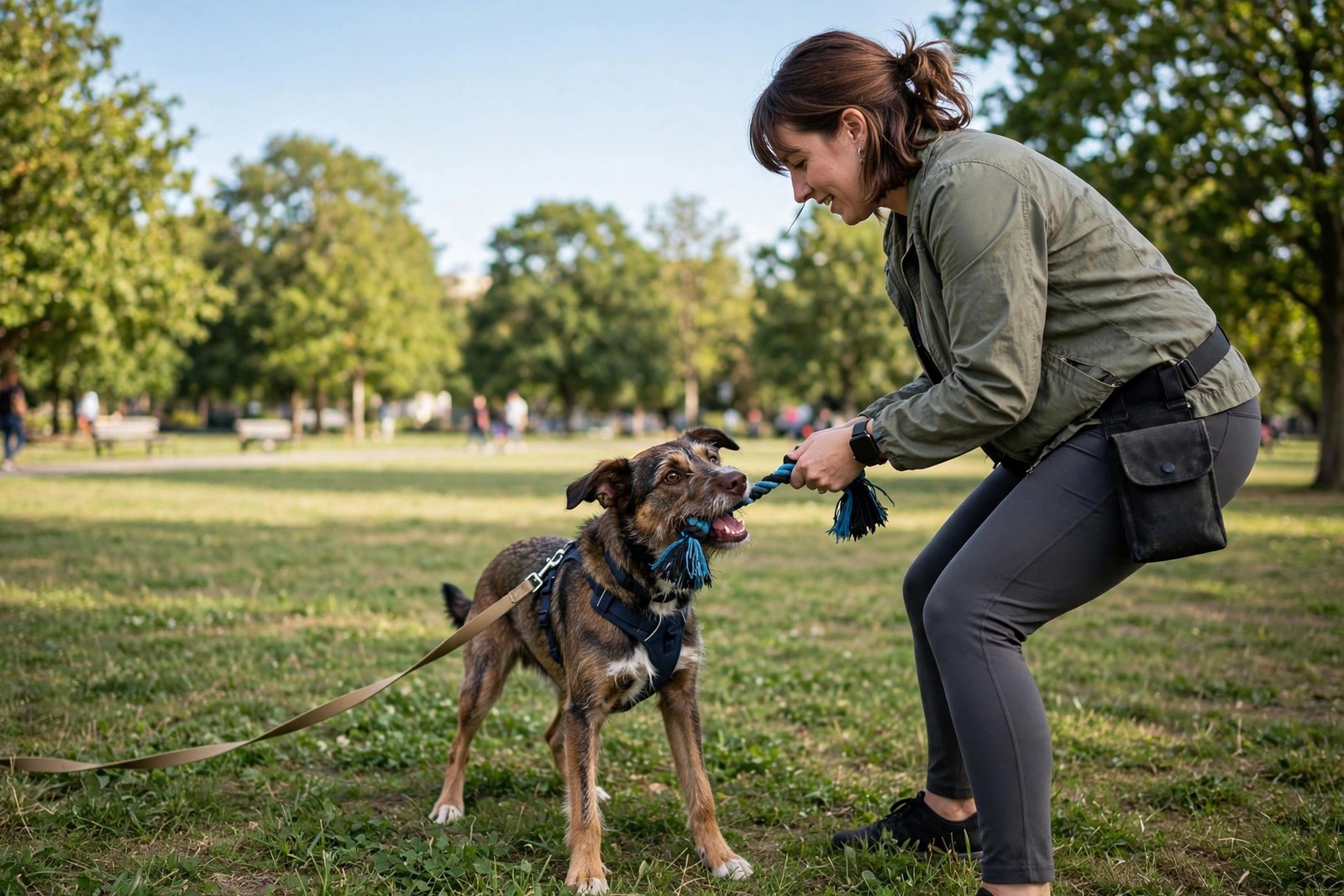
A dog who spits out treats in the park is rarely a dog with no motivation; it is a dog whose motivation you have not found yet, in a place where the motivation you brought cannot compete. Outdoors offers squirrels, scents, other dogs and open space — a rich economy — and a cube of cheese is weak currency there. The work has two halves: discover what this dog will actually work for, and lower the difficulty of outdoor places until thinking is possible again.
First, Check the Obvious Causes
Before redesigning your rewards, rule out the dull explanations. A dog fed a large meal shortly before training is simply full, so train before meals rather than after them. A dog that refuses every reward everywhere, including favourite food at home, may be stressed or unwell, and a dog who has changed in this way deserves a vet check before a training plan. And test your food honestly at home: if the dog is lukewarm about it on the sofa, it was never a training reward at all.
Build a Reward Menu Beyond Food
Watch what your dog chooses when nothing is asked of it, because free-time choices reveal working currency. Dogs that light up for play can be paid in play: a ten-second game of tug on a toy you carry, a ball thrown once, a chase game in which the dog chases you. Dogs driven by the environment can be paid in access: a sit and a moment of focus earns release to sniff the interesting verge, greet the known dog, or run the open stretch of field. Access rewards have a built-in benefit for outdoor training — the distraction itself becomes the payment, so the squirrel scent and the sniffing patch stop competing with you and start working for you.
Praise and physical fuss pay some dogs genuinely, but test rather than assume: a dog that leans in and re-engages after praise is being rewarded; a dog that tolerates stroking while scanning the horizon is merely being interrupted.
Build Skills at Home, Then Spend Them Outdoors
New behaviours are learned where thinking is easy. Teach the skill — recall foundations, loose-lead steps, a settle, a hand touch — at home and in the garden, paid with whatever your dog values there, until it is fluent and cheerful. Then move it outside in graded steps: the quiet street before the park, the edge of the park before the middle, distance from other dogs before closeness. At each new level, expect the dog to be temporarily worse and your rewards to need to be bigger; that is the environment tax, and it shrinks as the dog acclimatises.
Work well below the threshold where your dog stops responding. If the dog cannot take a reward, cannot look at you, and is straining toward something, you are too close or asking for too much — increase distance, ask for something easier, or simply let the dog watch the world from a bench until its body softens. Sessions of a few minutes, ended while the dog is still engaged, beat a long session in which arousal climbs until learning stops.
A Simple Outdoor Session Shape
- Arrive and let the dog look around and sniff on a long line for several minutes before asking for anything; orientation is not disobedience.
- Ask for one easy, well-known behaviour and pay it with the dog's strongest outdoor reward — a tug game or release to sniff.
- Practise the newer skill in its easiest outdoor form, a handful of repetitions, paid every time.
- Finish with free sniffing or play, so the session ends on the dog's favourite note rather than on a failure.
Track what worked where, because the reward that pays in the garden often fails in the park, and the pattern across locations is the real training plan. Writing that reward menu into KinsLe Care Teams, location by location, means a partner or dog walker pays your dog in the currency that dog actually accepts instead of offering treats the dog has already voted against.