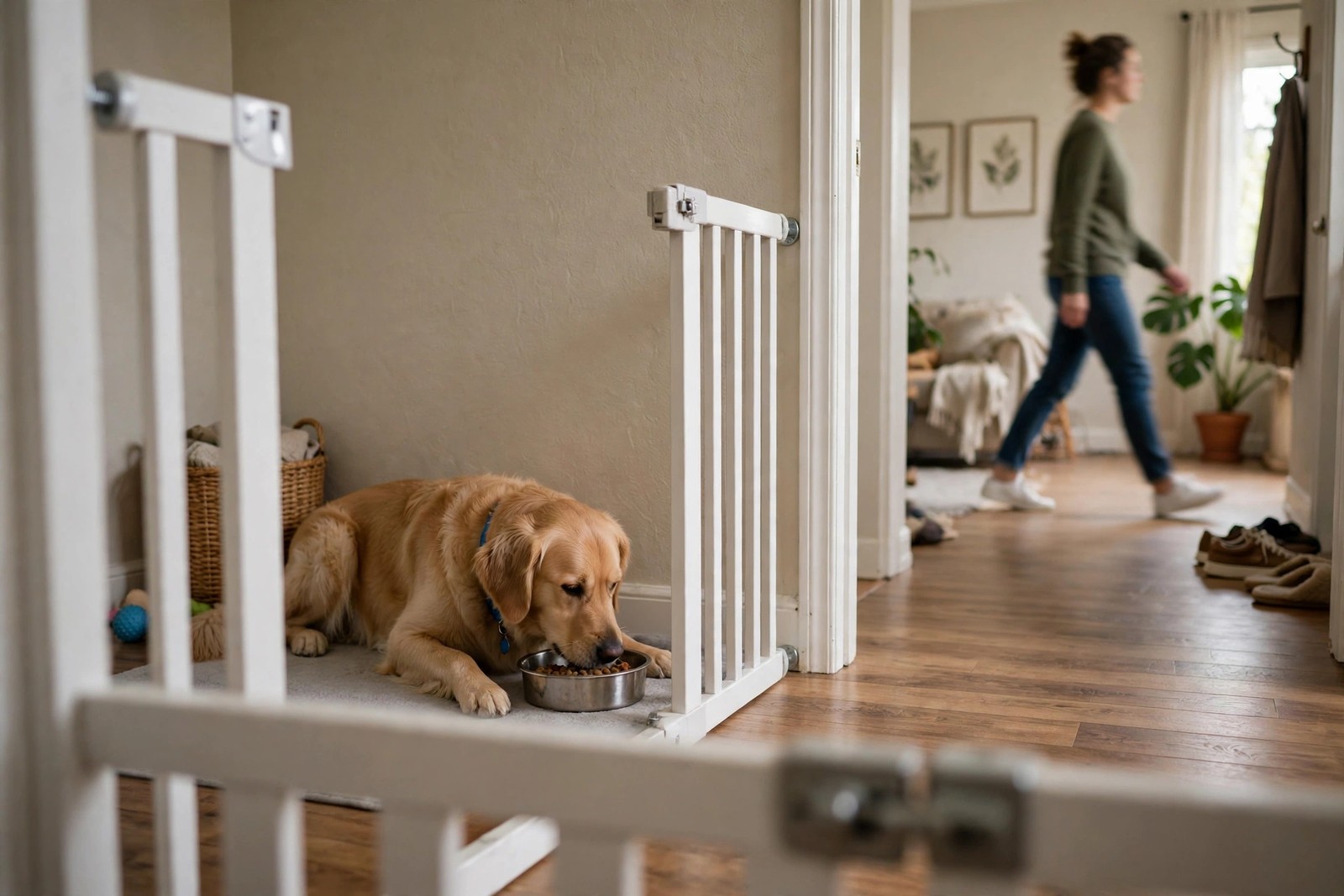
A dog who stiffens, hovers, or growls over his bowl is not being spiteful; he is a dog who believes something he values might be taken, and is saying so in the clearest language he has. The sound response is twofold: manage the risk properly from today, then change the feeling gradually, at the dog's pace, so passing people come to predict good news instead of threat.
Management First: Make Every Meal Boring and Private
Before any training, change how meals happen. Feed this dog in a quiet place where nobody needs to pass — behind a closed door or a stair gate — put the bowl down, and leave him alone to eat in peace, collecting the empty bowl when he has finished and wandered away. Children do not enter that space at mealtimes, and visitors are told plainly that the dog eats undisturbed. Nothing about this is surrender: you have removed every rehearsal of the guarding behaviour and given the dog daily evidence that meals are safe. Many dogs visibly soften within weeks on management alone, because the pressure that maintained the behaviour has gone.
Reading the Dog You Are Working With
Learn this dog's early signals, in rough order: eating faster when someone approaches, freezing over the bowl, a hard stare, showing the whites of the eyes, lip lifting, growling, and snapping. The early, quiet signals are the valuable ones, because they tell you where his comfort ends while he is still asking politely. Growling is information, not insolence — a dog punished out of growling does not stop feeling threatened; he stops warning, which makes him more dangerous, not less. Keep all practice in the loose, soft-bodied zone before those signals start; a session that produces a freeze or a stare was pitched too hard and needs an easier step next time.
The Passing-and-Tossing Programme
Work when the dog is eating an ordinary meal in his safe place. Walk past at a distance he is demonstrably relaxed about — across the room, or past the doorway — and, without stopping, staring, or reaching toward him, toss a piece of something he values more than his meal so it lands near the bowl, then keep walking away. Repeat a few times within one meal, a few meals a week. Across sessions, he learns the pattern: a person approaches, something extra arrives, the person leaves. Only when he looks up at a passer-by with a loose body and a pleased expression do you shorten the distance slightly, always ready to step it back out if tension reappears.
Do not practise taking the bowl away, swapping it, or putting your hand in it as a test, however traditional that advice sounds: from the dog's side, those drills prove that people near food really do remove it, which confirms the fear you are trying to retire. The goal is not a dog who tolerates interference; it is a dog who watches someone pass his bowl with genuine indifference because passing has only ever meant additions.
When This Is Not a Homework Problem
Bring in a qualified behaviourist — and your vet, since pain and illness can lower a dog's tolerance sharply — before running any programme if the guarding is intense, if the dog guards objects, locations or people as well as food, or has already bitten. In a household with young children, professional guidance is the plan rather than an optional extra. A behaviourist will also judge whether management alone, permanently and carefully maintained, is the honest answer for this individual dog; arranging a home where a dog can eat in peace forever is a success, not a failure.
Whichever route you take, consistency at mealtimes is what keeps everyone safe in the meantime: one set of rules, followed by every person, every day. Setting the feeding job in KinsLe Care Teams — naming the one briefed adult who feeds, the quiet place, and the rule that meals are undisturbed — makes sure your guarding dog is never fed casually by someone who has not heard the plan.