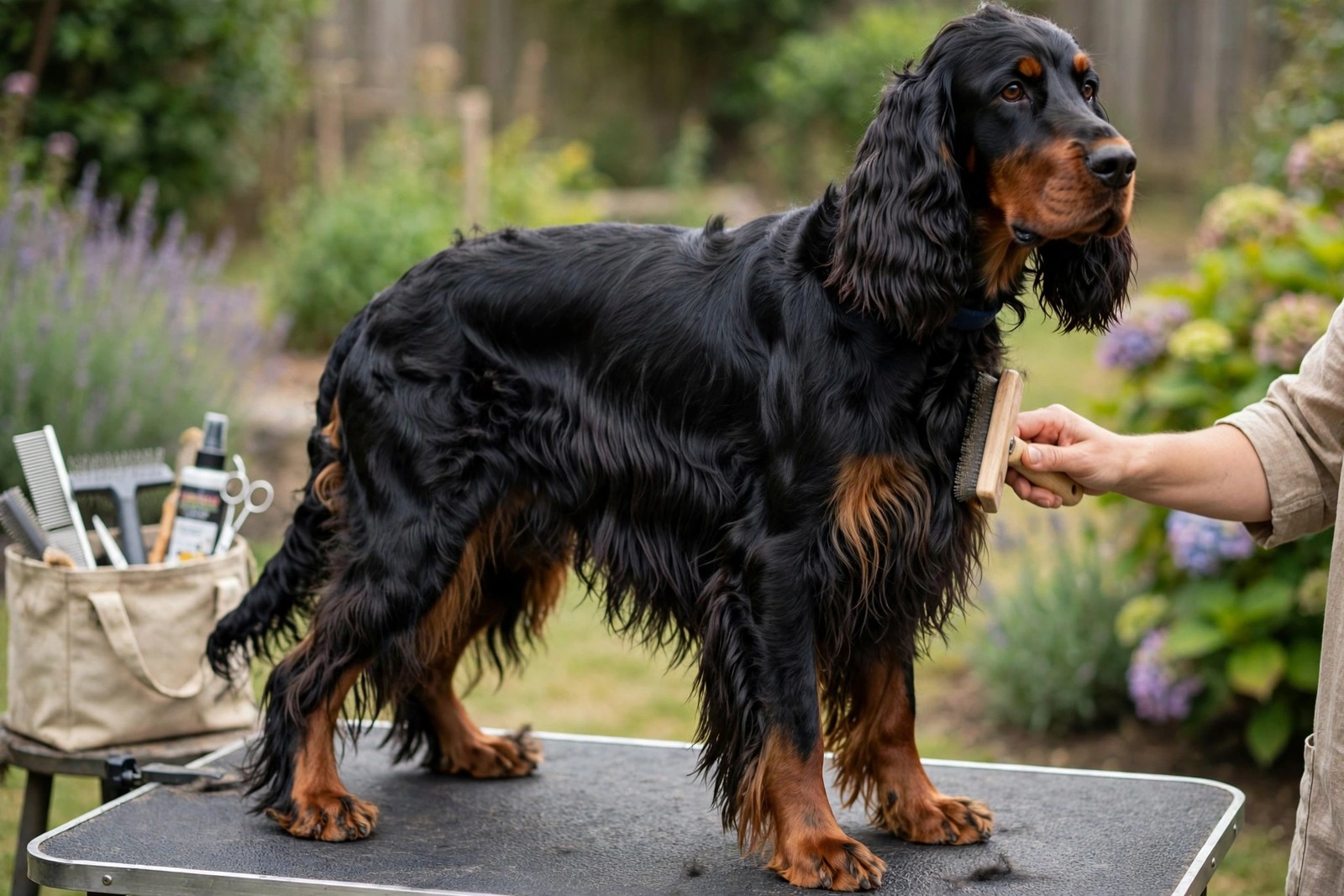
A Gordon Setter is not a starter version of the setter family. Compared with an English Setter or an Irish Setter, a Gordon brings more size, more coat, a longer adolescence, and a steadier, more deliberate working style that asks a new gundog owner for more time and more consistency. None of that makes the breed a poor choice. It makes the breed a choice to enter with a realistic diary, a grooming kit, and help in the house.
Size and Strength in Daily Handling
A Gordon typically weighs about 45 to 80 pounds, standing taller and carrying heavier bone than an English Setter, and with a build closer to substance than to elegance. That scale changes ordinary handling. A young Gordon who jumps up, pulls toward a scent, or plants four feet and refuses a direction has the weight to win a casual argument, so lead training and calm handling have to be installed early, before the dog reaches adult strength. Cars, crates, and vet visits all involve lifting or guiding a large dog, and a household should test honestly whether every adult who will walk the dog can hold the dog when a pheasant lifts from a hedge.
The Irish Setter comparison misleads new owners here. An Irish Setter is lighter in build and often quicker in manner, while an English Setter is generally smaller and softer in outline. A Gordon feels like a bigger commitment partly because the dog is, physically, a bigger animal to feed, transport, and restrain.
Coat Work Several Times a Week
The black and tan coat is long, silky, and feathered on ears, legs, chest, and tail, and it collects burrs, mud, and tangles from the ground a gundog is bred to cover. Thorough grooming several times a week is the working standard: brush through feathering, check behind ears and under elbows where mats form quietly, and rinse or dry legs after wet outings. Shedding is ongoing, bathing is a bigger job than bathing a short-coated breed, and a skipped fortnight shows up as felted knots that hurt to remove. Budget grooming time weekly in the same way you budget walks, because coat care for this breed is husbandry rather than decoration.
Slow Maturity and a Long Adolescence
Gordons mature slowly, and many owners describe a dog who looks adult at eighteen months yet behaves like a teenager well beyond that point. House training and basic manners usually arrive on schedule, but steadiness, impulse control, and reliable recall around game scent take longer to consolidate than they do in an English Setter, a breed many trainers describe as biddable earlier. The Gordon mind is thoughtful and independent: a dog who has worked out a problem alone on a moor does not always see why a novice handler's plan should replace a private one. Short, fair, consistent sessions succeed, while drilling and shouting produce a dog who switches off. A new owner should expect to still be actively training, daily, into the second and third year.
Exercise and Work Drive
Plan on one to two hours of exercise daily, with a meaningful share off lead in safe country where scent work can happen, because a Gordon was bred to range and quarter ground for hours. Lead walking alone leaves the hunting brain unemployed, and an unemployed Gordon may invent work involving fences, bins, or furniture. Gundog-style games, scent exercises, and structured retrieving give the drive a legal outlet even for owners who never shoot. Splitting long outings, coat sessions, and training blocks across the household through KinsLe's Care Teams turns a demanding weekly load into named duties that actually get done.