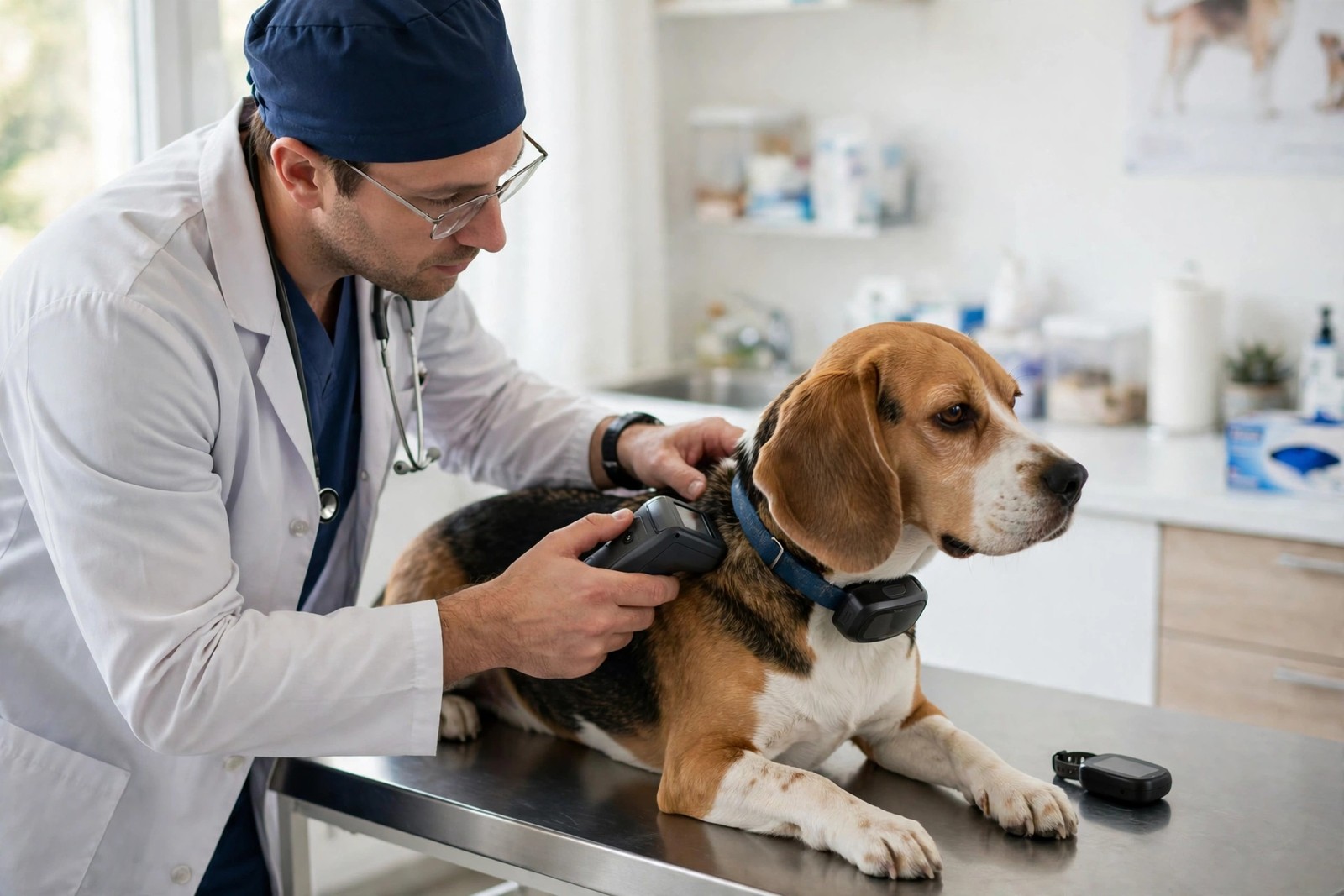
Owners often buy one of these believing it does the other's job, and the confusion matters most on the worst day, when a dog is actually lost. A microchip and a GPS tracker are not rivals. One proves who your dog is, permanently. The other shows where your dog is, temporarily.
The Microchip: Permanent ID That Cannot Track
A microchip is about the size of a grain of rice, implanted under the skin, usually between the shoulder blades, in a quick procedure at the vet. It has no battery, no GPS, and no way of knowing where it is. It carries one thing: a unique number. When a vet, shelter, or warden passes a scanner over the dog, the chip responds with that number, the number is looked up on a registry, and the registry leads to your contact details. Strengths and limits follow from that design. It cannot fall off, run flat, or be removed by a finder, and it works for the dog's whole life. But it does nothing until a lost dog is found and scanned, and it fails completely if your registered phone number is out of date, which is why checking your registry entry after every move or number change is part of owning one.
The GPS Tracker: Live Location That Needs Power
A GPS tracker is a small powered unit clipped or built into a collar. It works out its position from satellites, sends that position over a mobile network to an app on your phone, and typically offers live tracking, a history of where the dog has been, and alerts if the dog leaves a virtual boundary you set. That is genuinely powerful for a dog who bolts, digs out, or walks off lead in open country. The trade-offs are practical: batteries last days to weeks depending on model and use, so the unit must be charged like a phone; it needs satellite view and mobile coverage, which can fail in dense woods, valleys, and buildings; most services charge a subscription; and because it lives on the collar, a dog who slips the collar loses the tracker with it.
Which Dogs Need Which
Every dog should be microchipped, and in many places the law requires it, because it is the permanent backstop that reunites found dogs years later. A tracker earns its place on top for escape artists, dogs walked off lead in large areas, newly adopted dogs whose recall is unknown, and dogs staying with sitters or in unfamiliar holiday surroundings. For a sedate senior who never leaves a fenced garden, a tracker is a luxury. The two work best together: the tracker helps you find the dog today, and the chip identifies him if the collar and tracker are long gone. KinsLe's Verified QR ID Pet Profiles covers the gap between them, giving your dog a unique collar code that any finder can scan with an ordinary phone, no special scanner needed, to open his profile and contact you directly.