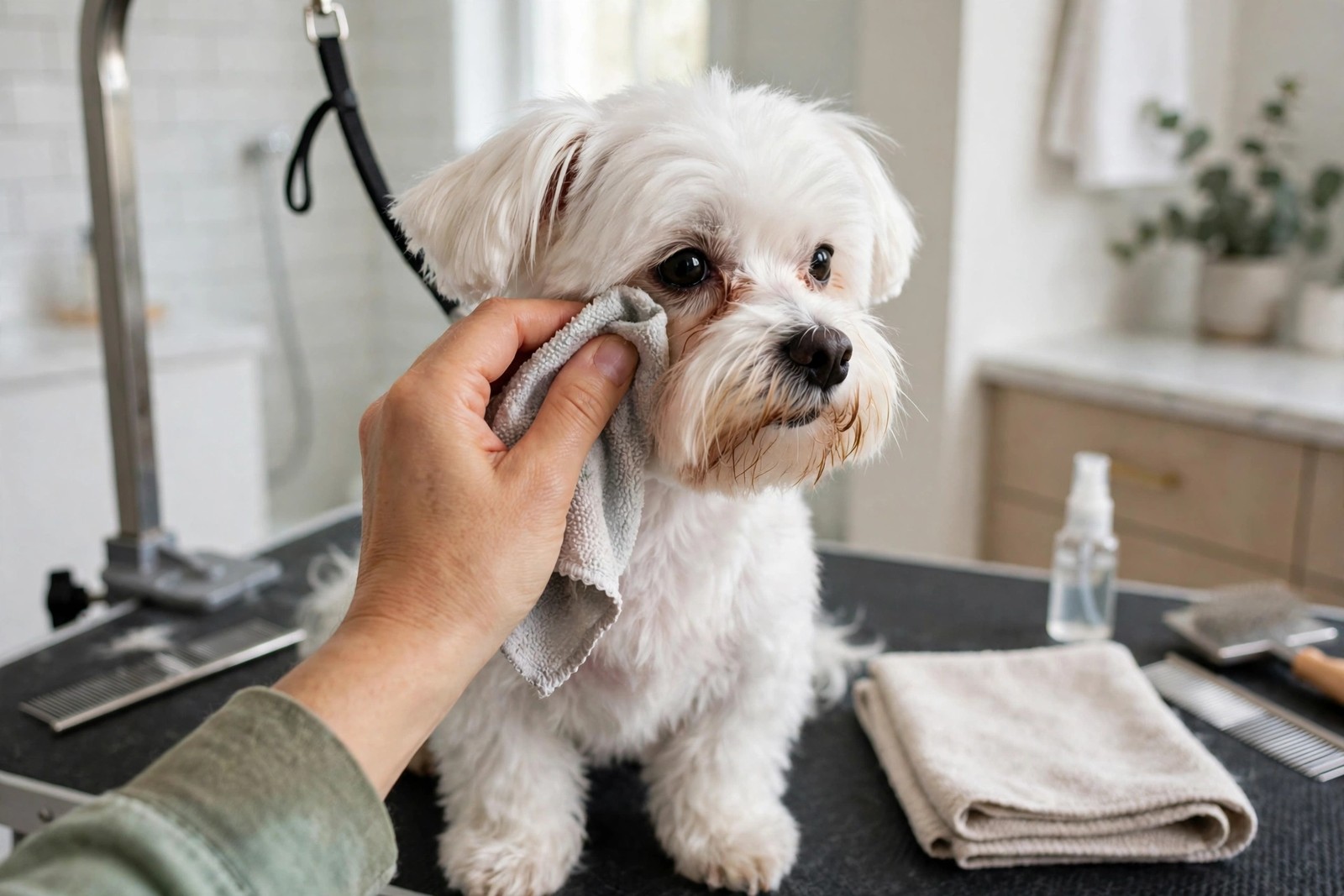
Every breed with tearing shows it; a Maltese advertises it. On a white coat there is nowhere for reddish tear staining to hide, and the same whiteness turns a damp, food-tinted beard into a visible problem within days of a groom. Between grooms the goal is not to erase staining with products — it is to keep the hair clean and dry so staining builds slowly, and to know the signs that mean the cause needs a vet.
Why the white coat shows every stain
Tears are mostly clear; staining develops as moisture sits on the hair and compounds in the tears react with light and air, which is why marks concentrate in the damp groove below the inner corner of each eye. On a dark coat the same process happens invisibly. On a Maltese, the stained hair is also long hair: it holds moisture against the skin, mats into the damp patch, and wicks wetness wider. That is the case for the daily routine below — dry hair stains slowly, damp hair stains fast.
The daily wipe, and the hair framing the eyes
Once a day, use a soft cloth dampened with clean warm water to wipe under each eye, taking a fresh cloth for the second eye so nothing is carried from one eye to the other. Wipe gently along the stained groove, lift away any discharge or debris caught in the hair, and then dry the area — the drying is half the job, because a wipe that leaves the hair damp has cleaned the surface and fed the problem underneath. Between grooms, trim the hair framing the eyes short enough that it does not poke into the eye or channel tears down the face, and keep it dry through the day with a quick dab whenever the face is wet from drinking or play.
Use nothing stronger than water near the eye. No bleaching products, no stain-removing preparations and no home remedies belong beside an eye, whatever they promise the coat; the eye they irritate will water more, and increased tearing defeats the entire exercise.
The beard: water, food and bowl choice
Beard discoloration on a Maltese is usually a drinking and eating story rather than a tearing one. That long beard dips into the water bowl, stays wet afterwards, and picks up food oils and particles at every meal; left damp and loaded, it yellows and browns and can start to smell. After every drink and every meal, dry the beard with a clean dry cloth — a brief blot, worked into a habit, prevents much of the colour from setting. Wash the beard gently with plain water when food has dried into it, and dry it fully rather than leaving it to air-dry into a damp mat.
Bowl choice helps quietly. A bowl shaped so the beard and ears stay out of the water as much as the breed allows, fresh water changed often, and feeding from a clean bowl rather than a topped-up one all reduce what the beard picks up. Where the staining concentrates tells you which routine to tighten: marks under the eyes point to tearing, marks through the beard point to the bowl.
When staining needs a vet, not a cloth
Book a vet check when tearing is one-sided, when the dog squints, paws at its face or seems bothered by light, when an eye looks cloudy, when discharge turns thick or coloured, or when staining arrives suddenly in a dog whose face was previously clean. Causes of excess tearing are possibilities a vet examines for — irritation, a blocked tear duct, eyelashes or hairs rubbing the eye, or an eye problem itself — and none of them can be diagnosed from the stain. Between grooms you manage the hair; a vet manages anything the hair is reporting.
A routine this daily succeeds only if it happens on the days you are out, too. Put the wipe and the beard-drying on the household's shared list, and nobody has to guess whether it was done: KinsLe's Care Teams duties can be assigned to whichever family member is home, with each completed wipe marked off against the day.