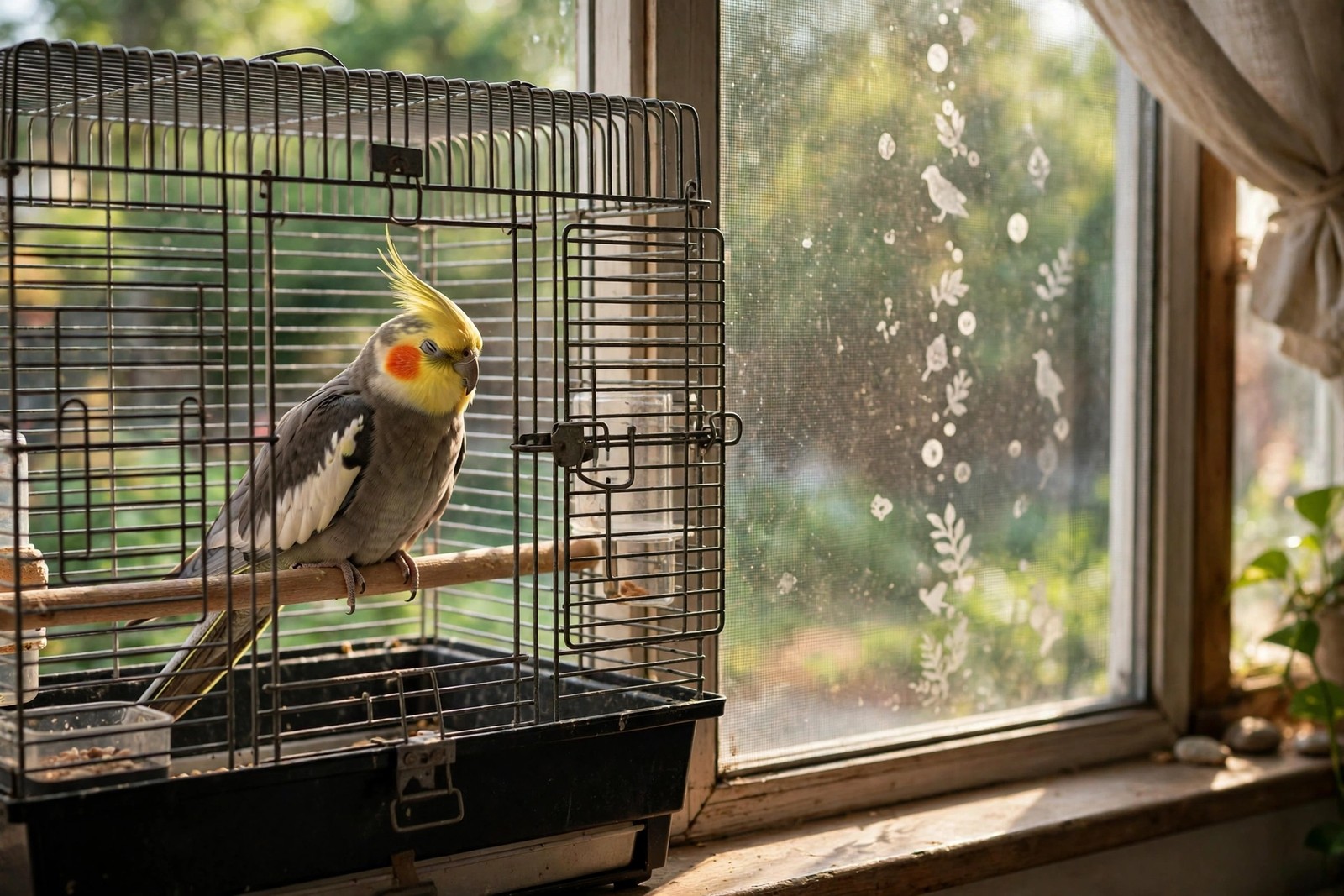
The safe order never changes: the bird is secured first, and only then does a window open. A free-flying parrot, cockatiel, or budgie can cross a room in a second when a doorbell, a dropped pan, or a hawk's shadow outside startles it, and an open window turns that one startled flight into a lost bird. Build the routine below until nobody in the house has to think about it.
Confine the Bird Before You Touch a Window
Return the bird to its cage, or settle it in a separate room and close that door, before opening any window — including windows in rooms the bird never usually enters. Do not rely on a bird seeming sleepy, bonded, or unlikely to fly; clipped birds can still glide on a gust through a doorway, and fully flighted birds need no second invitation. The same rule covers opening outside doors on a warm day, propping a door for deliveries, and opening a window just a crack to clear cooking steam. Announce it out loud — "bird is in, opening windows" — so children, partners, and visitors follow the same sequence rather than assuming someone else checked.
Fit and Test Every Screen
An opened window needs a fitted insect screen, and fitted means tested, not just present. Push firmly around the frame: the screen should sit fully in its channel with no bowed edges, no torn or holed mesh, no loose spline, and catches or pins that hold under pressure. Check sliding windows for the gap that appears when the moving pane is not fully seated, and check older screens that have warped away from the frame at the corners. Repair or replace a doubtful screen before that window joins the ones the household opens.
Know a screen's limit, too. Mesh stops a budgie or cockatiel blundering out, but a large parrot can chew through mesh or lean a light frame out entirely, and a determined bird can find the one weak corner. Screens are the second barrier; the closed cage or closed room door is always the first.
Make Closed Glass Visible as Well
Open windows are only half the hazard. A bird flying free in a bright room may aim straight at a closed window because the glass reflects trees and sky, or because a window opposite creates what looks like a fly-through tunnel to another room or the garden beyond. Break up those reflections while your bird is out: patterned decals or a light film at bird height, blinds drawn part-way, or curtains closed across the clearest panes. Keep a play stand away from large windows so take-offs do not start aimed at glass, and supervise first flights in any new room until you have seen how your bird reads its windows.
Reset Before the Bird Comes Out Again
When the fresh air session ends, close and latch each window, glance at each screen as you pass it, and only then open the cage or the spare-room door. Leaving one bedroom window open after the bird is already out is the classic household accident, so make the reset a physical walk rather than a memory test. If the worst happens and a bird does get past you, keep eyes on its landing spot, note the direction, and act while it is still nearby and calling. For exactly that moment, KinsLe's Lost Pet Alert System holds your bird's photograph and details ready to send to nearby members, so a neighbour who spots an unfamiliar cockatiel in a tree can contact you directly instead of simply watching it fly on.