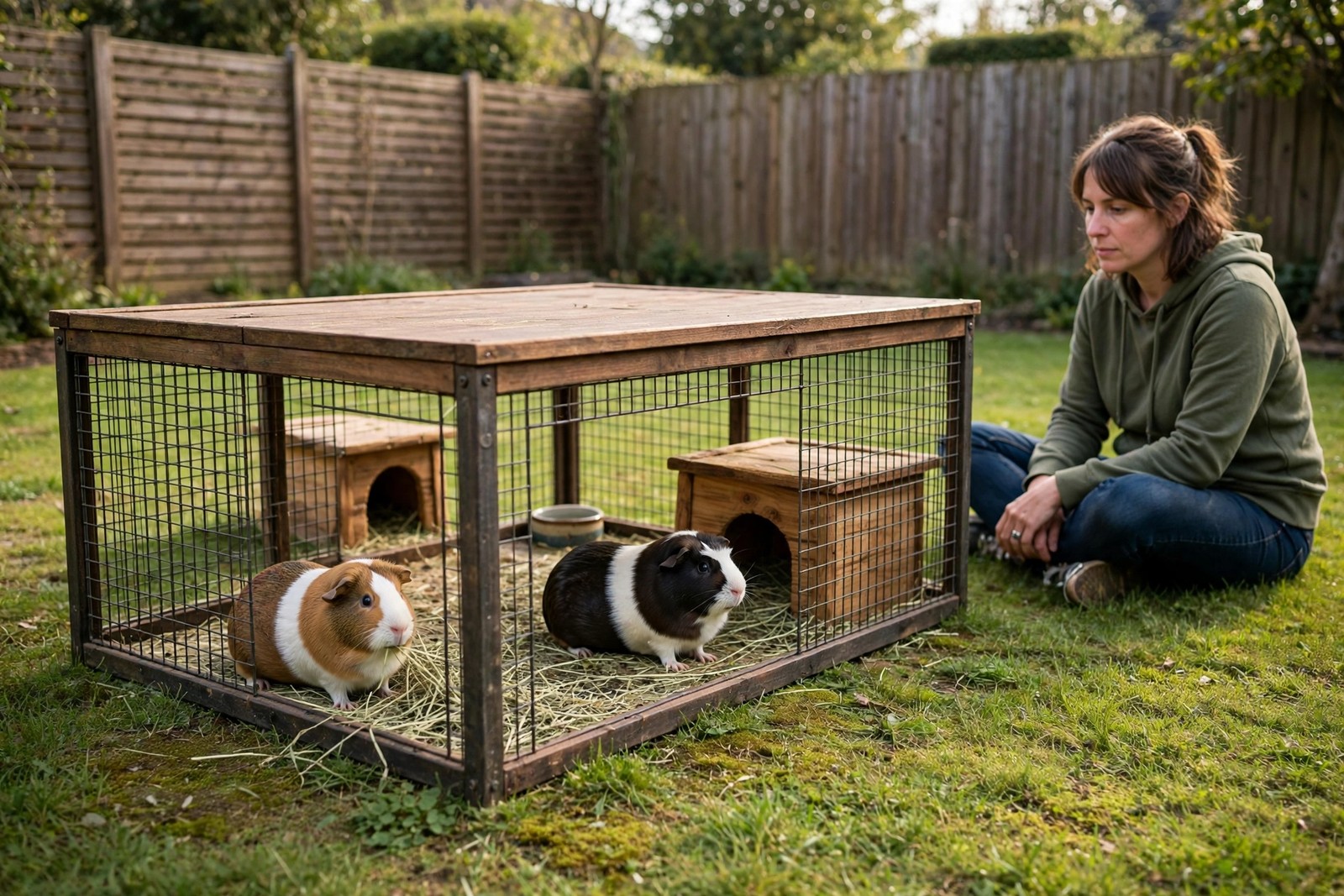
A dog repeatedly lunging, barking or digging at a guinea pig run is not a minor nuisance — it is a real risk twice over. A determined dog can tear through light mesh or tip a run in seconds, and even without contact, guinea pigs are prey animals who suffer genuine stress from a predator crashing against their home day after day: hiding constantly, refusing food, and going quiet are all signs the situation is already costing them. Act on two tracks at once — make the run physically safe today, and start the neighbour conversation while you have a record to stand on.
Make the run a fortress first
Move the run away from the shared fence if your garden allows it; distance alone lowers the dog's fixation and your pigs' fear. Where the run must stay, put a solid barrier — fence panels, boarding or dense screening — between the dog and the run so it can no longer see its trigger, and add your own fence line a short distance inside the boundary so there are two barriers, not one shared mesh. Check the run itself honestly: strong welded mesh rather than thin chicken wire, a secured lid, a base or paving slabs around the edges so nothing can dig under, and at least two solid hide houses the pigs can retreat into. Until the dog problem is resolved, supervise every outdoor session and bring the pigs in whenever you cannot be there.
Watch the guinea pigs, not just the dog
Check daily that both pigs are eating, moving and calling as usual. A guinea pig that stops eating is an emergency in its own right — their digestion depends on constant grazing — so a pig that is still hiding and off its food a day after a frightening incident should see a vet promptly, even with no visible injury. Rotate favourite foods through the run, keep handling gentle and brief for a while, and let the pigs choose the hides over the open grass until their confidence returns.
Speak to the neighbour early, and specifically
Most of these situations end at a calm doorstep conversation, which goes better before resentment builds. Go with facts, not accusations: the dates and times, what the dog did — barking and lunging at the fence, digging at the boundary, getting into your garden if it has — and the effect on your animals. Ask for the practical fixes on their side: keeping the dog supervised or on a lead in their garden, repairing their side of the fence, or working with a trainer on the fixation. Follow up in writing if you agreed anything, so the agreement exists outside memory.
Document, then report if it repeats
Keep a simple dated log from today: each incident, what happened, photos or short video of damage, digging or the dog at the run, and notes of your conversations. If the behaviour continues after a fair conversation, or the dog actually gets into your garden, report it to your local animal control, council dog warden or non-emergency police line — the exact body varies by area — and hand over the log. A pattern on paper carries weight that a single complaint does not, and officials can usually require the owner to control the dog. Throughout, keep everyone helping you in the loop: KinsLe Messenger works as the communications hub for your guinea pigs, keeping messages with family, sitters and your vet about the dog, the run and the pigs' stress in one place you can reopen whenever the next incident needs the full story.