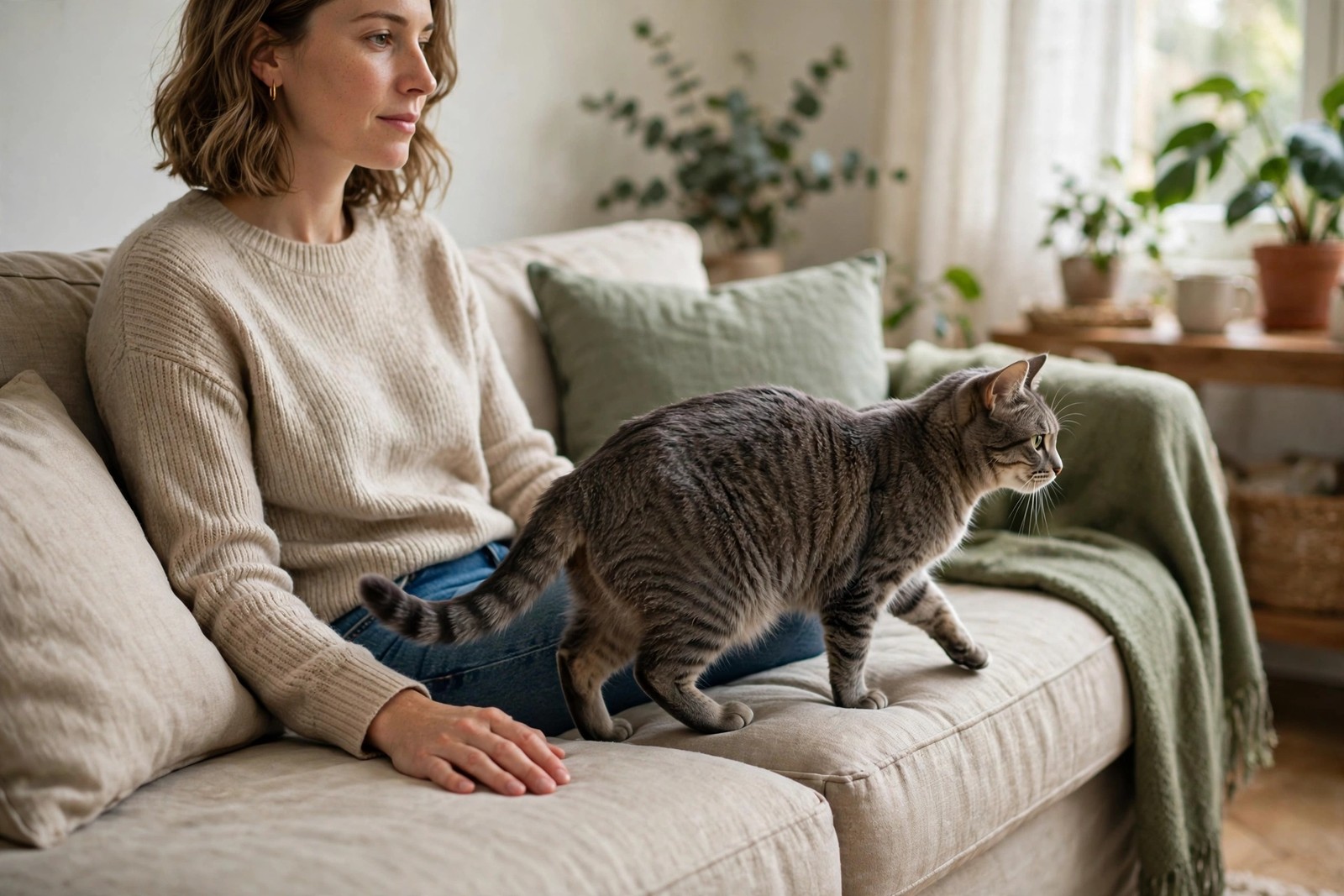
It feels like a betrayal in miniature: she head-butts your hand, rubs against you, settles in purring — and then her teeth are suddenly on your skin. In her terms nothing contradictory has happened. She requested contact, enjoyed it, reached her limit, and ended the session the only way left once earlier, quieter signals went unnoticed. What you do in the next two seconds, and how you restructure stroking afterward, decides whether biting becomes her standard way of ending things.
In the Moment: Go Still, Not Backward
The instinctive yank is the worst available move. A hand snatched away reads to an aroused cat as escaping prey and as a provocation at once, and it commonly triggers a harder grab, bunny-kicking, or a chase after the retreating hand. Instead, freeze. Let the stroking hand go completely still and slightly soft, say nothing sharp, and give her a moment to register that the stimulation has stopped. If her teeth broke the skin, wash the wound promptly and get medical advice the same day; cat bites puncture deeply and deserve respect even from a beloved indoor cat. What never belongs in the moment is punishment — no shouting, spraying, or tapping her nose — since punishing a cat for reaching her limit only teaches her that people become frightening exactly when she is already overwhelmed.
Rebuild Stroking as Short Sets With Pauses
The pattern that prevents repeats treats stroking like intervals rather than an open-ended session. Stroke her for a short run — a handful of strokes along the cheeks, chin, and back of the head, where most cats welcome touch longest — then pause with your hand resting nearby or withdrawn. If she leans into your hand, rubs her cheek against your fingers, or nudges you, she is re-asking, and another short set is genuinely welcome. If she stays still, turns her head away, or gets up, the answer was no, and the session ends with goodwill intact. Over days, this rhythm also reveals her personal threshold: perhaps she is happy for two minutes of cheek strokes but done after thirty seconds of back stroking. Stop at half her known limit, not at its edge, and sessions start ending with a contented cat walking away instead of a bite.
Learn Her Map, and Respect the Hot Zones
Every cat keeps a private map of where touch is welcome, and hers is written by experience, not by what cats in general enjoy. For many cats the belly and flanks overload first — those areas carry a strong defensive sensitivity, and even a cat who flops over and shows her stomach is usually offering trust, not requesting a belly rub. Shorter, slower strokes on the head and shoulders, in the direction of the fur, with a lighter hand than feels natural, suit most cats far better. A cat whose biting suddenly changes pattern — new irritability, new sensitivity in one spot, a threshold that has halved — should see her veterinarian, because pain is a common reason a tolerant cat starts ending contact sharply.
Everyone Who Strokes Her Gets the Same Briefing
She does not bite one person; she bites whoever runs the session too long, which is often a different family member or guest each time. Family Sharing solves the briefing problem by holding her stroking profile in one place the whole household reads: her freeze rule, her safe zones, the hot zones to spare, and her current happy session length, updated as those change. A shared log of incidents is genuinely useful here — two lines noting how long the session ran and where the hand was when she bit will show her threshold shrinking or holding steady across a month. Guests get the short version from the same page: short sets, pauses, belly off limits, and the cat decides. When the notes live in the Family Sharing file on KinsLe, a visiting friend can learn her limits before she ever has to enforce them herself.