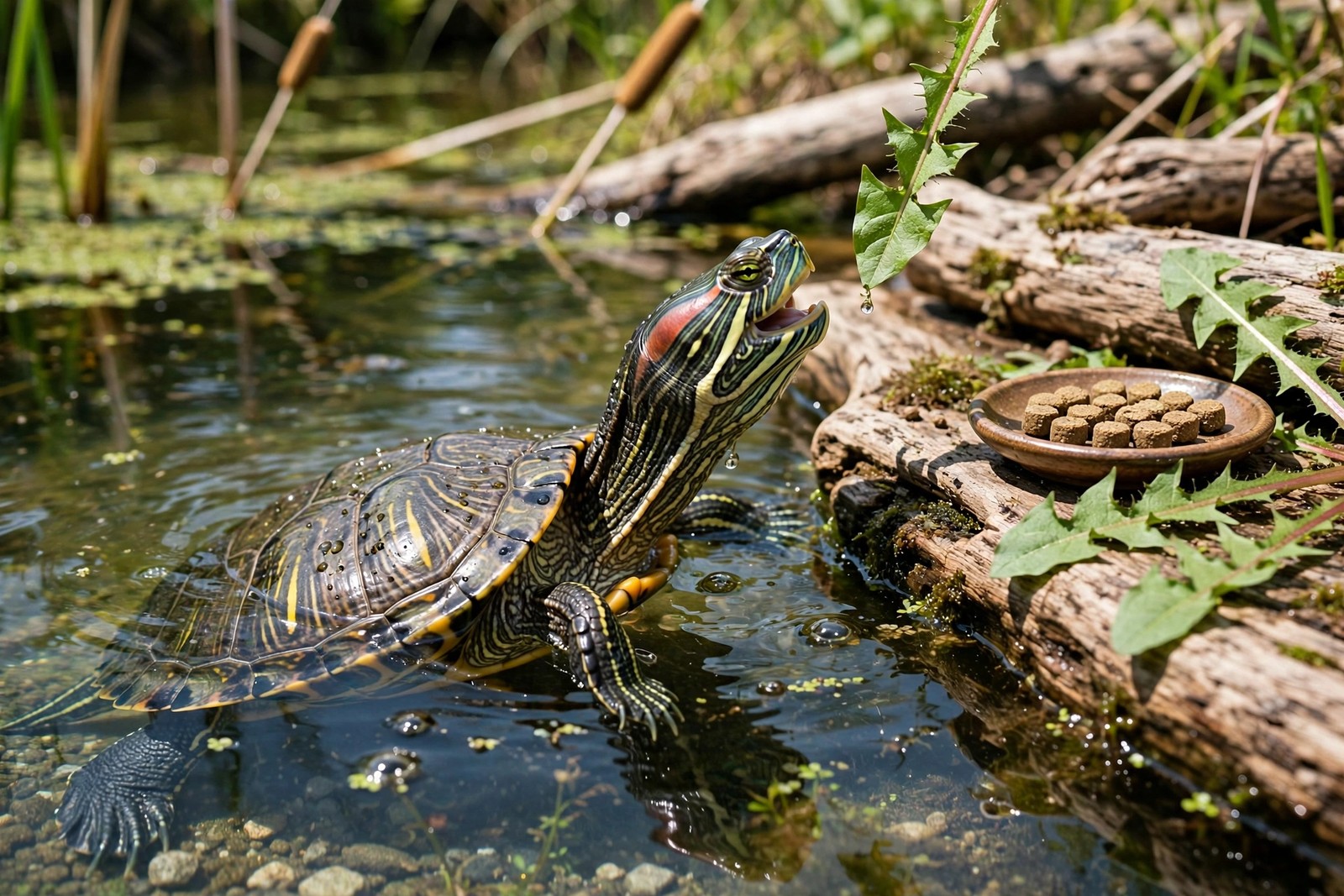
A red-eared slider is an omnivore whose balance point moves across its life. A hatchling hunting in the wild eats a protein-heavy diet of insects, small fish and worms, and grows fast on it; an adult grazes far more plant material, with animal food as an occasional catch. Feeding an adult like a hatchling is a frequent home mistake: the richer diet can drive fast, uneven growth and fouls the water quickly, while feeding a hatchling like an adult starves its growth. Match the plate to the age, and the diet mostly runs itself.
The Staple: Measured Pellets and Daily Greens
A quality commercial turtle pellet is the reliable staple because it carries balanced protein, vitamins and minerals in a form you can measure. A practical portion guide is roughly the amount that would fit inside the slider's hollow head, offered once on a pellet day — a guide, not a licence to scatter extra. Leafy greens are the other daily constant at every age: dandelion greens, turnip greens, collard greens, red-leaf or green-leaf lettuce and aquatic plants such as duckweed all suit. Serve greens loose in the water so the slider can graze through the day. Keep iceberg lettuce off the menu — it is mostly water with little nutrition — and treat spinach and fruit as occasional items rather than staples, spinach because it binds calcium when fed heavily, fruit because its sugar adds up fast.
Protein: Daily for the Young, Occasional for Adults
For a young slider in its first year or so, offer protein daily alongside its pellets and greens: earthworms, small shrimp, feeder insects and small pieces of plain cooked fish are all taken eagerly, in a portion similar in size to the pellet portion. As the slider matures, step the protein down deliberately — pellets on alternate days and a protein portion once or twice a week is a sound adult pattern, with greens available every single day. Sliders beg convincingly at the glass regardless of hunger, so feed by the schedule and the body condition, not by the performance. A slider that is gaining folds of flesh bulging around its legs when it tucks in is telling you the protein and pellet days have crept too close together.
Calcium, Variety and Feeding Hygiene
Sliders need generous calcium for shell and bone, and the simplest supply is a cuttlebone left floating in the tank, which many sliders gnaw at will; replace it as it is consumed or fouls. Dusting greens lightly with calcium powder on pellet-free days is another way keepers keep intake steady — ask your vet which pattern suits your animal if you are unsure. Feed in the water, because sliders use water to swallow, and consider a separate shallow feeding tub for messy protein meals: it keeps the main tank cleaner and lets you see exactly what was eaten. Remove uneaten fresh food after a few hours, vary the greens week to week, and never build the diet on dog or cat food, raw processed meats or wild-caught prey from pesticide-sprayed ground.
Keeping the Rotation Honest
The adult pattern only works if someone remembers which day is which. Write the week down — greens daily, pellets on alternate days, protein once or twice a week — and review the slider's weight and shell shape monthly, adjusting portions in small steps rather than overhauling the diet at once. KinsLe's Care Teams puts each feeding duty on your slider's task list, so the person feeding on a protein day and the person feeding greens the next are following one shared rotation, with every completed feed marked complete with a timestamp.