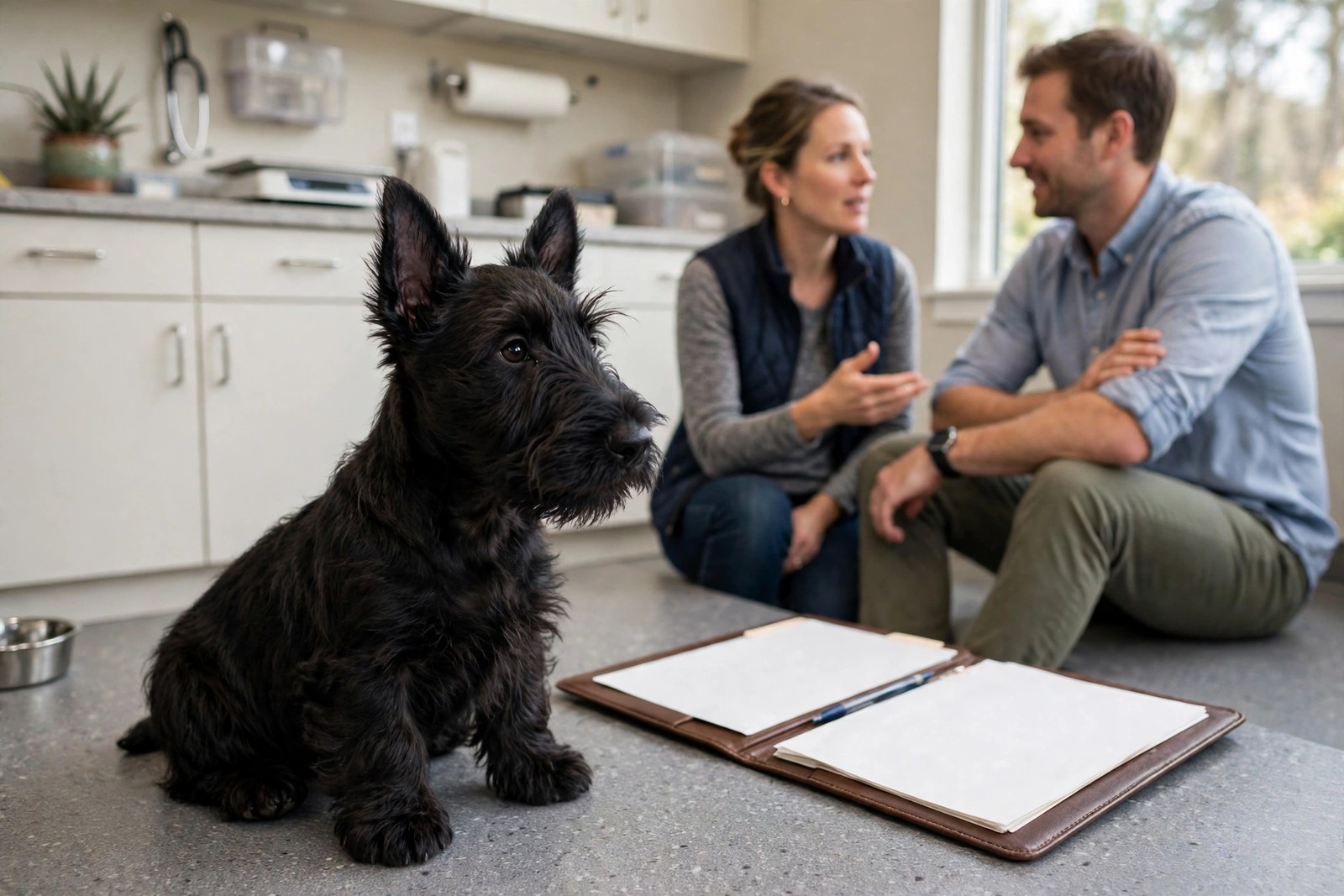
Health screening questions are not an accusation; they are how a buyer learns what a breeder knows about the dogs behind a puppy. Scottish Terriers have several well-recognized inherited conditions, and a responsible breeder can discuss each one plainly, show what testing exists, and describe honestly what has appeared in their lines. Frame every topic below as a question with a record attached, and note how comfortably the breeder answers.
Von Willebrand's Disease: Ask About Testing
Von Willebrand's disease is a bleeding disorder known in the breed, in which the blood's clotting ability is reduced. Ask whether both parents have been tested, what kind of test was used, and whether you can see the results naming each dog. A breeder who tests can usually produce the paperwork without delay and explain what the result means for the puppies in practical terms. A breeder who has never heard of the condition, or who waves the question away, is telling you something important about the whole breeding program.
Ask also whether any dog in the puppy's recent family has had unusual bleeding, after surgery, injury, or whelping, because family history adds context that a single test result cannot supply on its own.
Scottie Cramp: Ask What Has Been Seen
Scottie cramp is a movement disorder known in the breed: an affected young dog may, after excitement or exercise, develop episodes of stiff, exaggerated movement, sometimes stumbling or briefly unable to walk normally, then recover. It is a condition a veterinarian diagnoses, and there is no simple screening test a breeder can show you in the way a laboratory result can be shown. The screening question is therefore about honesty and observation: has the breeder ever seen episodes like that in the parents, in previous puppies, or in relatives, and what did a veterinarian say at the time?
Listen for a specific, unembarrassed answer. A breeder who describes what an episode looks like and how buyers are told about it is demonstrating exactly the candor this condition requires, while a blanket denial that the breed has any such issue should lower your confidence in every other answer too.
Craniomandibular Osteopathy in Young Dogs
Craniomandibular osteopathy is a painful jaw-bone condition that appears in young, growing Scotties, typically while the puppy is still in the first year or so of life. Affected puppies may resist chewing, resent having the jaw handled, or eat reluctantly during flare-ups, and a veterinarian investigates those signs to reach a diagnosis. Ask the breeder directly whether it has appeared in their puppies, how it was confirmed, and whether the parents or siblings of this litter have any history of it.
As with Scottie cramp, the record to ask for is the breeder's account backed by veterinary notes where they exist, and the quality signal is detail: when it appeared, how the puppy was managed under veterinary care, and whether the breeder stayed in contact with that buyer afterward.
Bladder Trouble in Older Scotties
Scotties are also known to face a higher risk of bladder trouble in later life, including serious bladder disease in older dogs, so ask what the breeder knows about the older relatives of this litter. How long did the grandparents live, and were there bladder problems, repeated urinary infections, blood in the urine, or straining that a veterinarian investigated? No breeder can promise an individual puppy's old age, but a breeder who tracks their dogs into old age can answer from knowledge rather than optimism.
That long view is also a reason to keep the answers: the Transferrable Profiles record on KinsLe carries the parents' screening results and the breeder's accounts of these conditions with the puppy, so the questions you asked before buying remain answerable years later when a veterinarian asks you what was known.
Transferrable Profiles, set up through KinsLe at the sale, turns a breeder's screening folder into the opening pages of the puppy's permanent health record.