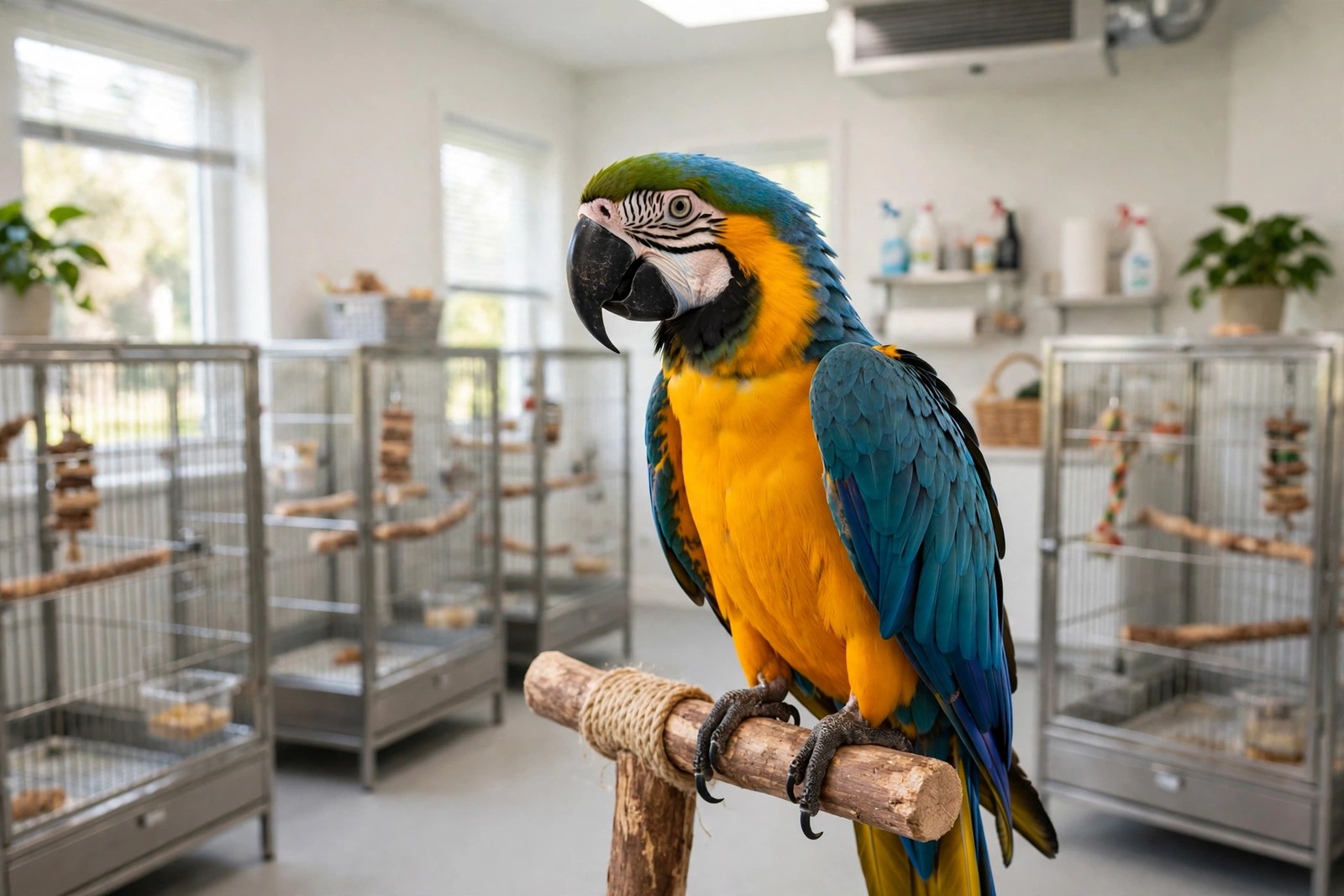
Parrots are the hardest common pet to board well. They bond tightly, stress visibly, catch airborne disease from neighbours they never touch, and may refuse unfamiliar food in an unfamiliar room. A service that boards parrots alongside general pet care, without bird-specific systems, is a risk even when the people are kind.
Avian Experience You Can Verify
Ask who on the staff has kept or worked with parrots, which species and sizes they board, and how many birds are in at once. Large macaws, cockatoos, African greys, and small conures have different noise, diet, and handling needs, and a good service groups and houses them thoughtfully rather than lining cages along one wall. Ask how birds are handled, whether staff will respect a bird who should not be stepped up by strangers, and whether you can visit the bird room before booking. Look for confident, specific answers about screaming, biting, and plucking under stress, because those are the everyday realities of boarding parrots.
Health Screening, Quarantine, and Airspace
Ask what health screening is required of every boarder, including your bird: many avian boarders require a recent examination by an avian vet and testing for serious contagious diseases such as PBFD and psittacosis, under their written policy. A service that requires nothing protects nobody. Ask how new arrivals are separated, what happens if a bird shows symptoms mid-stay, and how the bird room is ventilated, since shared air is the route many avian diseases travel. Cages should be spaced, cleaned with bird-safe products, and the room kept free of scented sprays and smoke, all of which parrot lungs tolerate badly.
Routine, Diet, and Sleep Kept Intact
Ask whether your parrot can board in its own cage, and if not, what size cage is provided and whether familiar perches and toys can come along. Bring your bird's exact food, because a stressed parrot may refuse a different pellet or mix, and ask how staff monitor that each bird is actually eating, not just being served. Confirm daily out-of-cage or social time where safe, human contact at roughly your bird's usual level, and a covered, quiet sleep period of around ten to twelve hours. Ask how often you will get updates, and whether photos or video are included.
The Emergency Plan
Ask which avian vet the service uses, how far away they are, who transports a sick bird, and how treatment is authorised and paid for if you are unreachable; a general small-animal clinic without avian experience is a weaker answer. Agree what happens if your return is delayed. KinsLe's Care Pass hands the boarder temporary access to your parrot's diet, routine, quirks, and avian vet details for the stay itself, so the bird's normal day survives even though you are not the one delivering it.