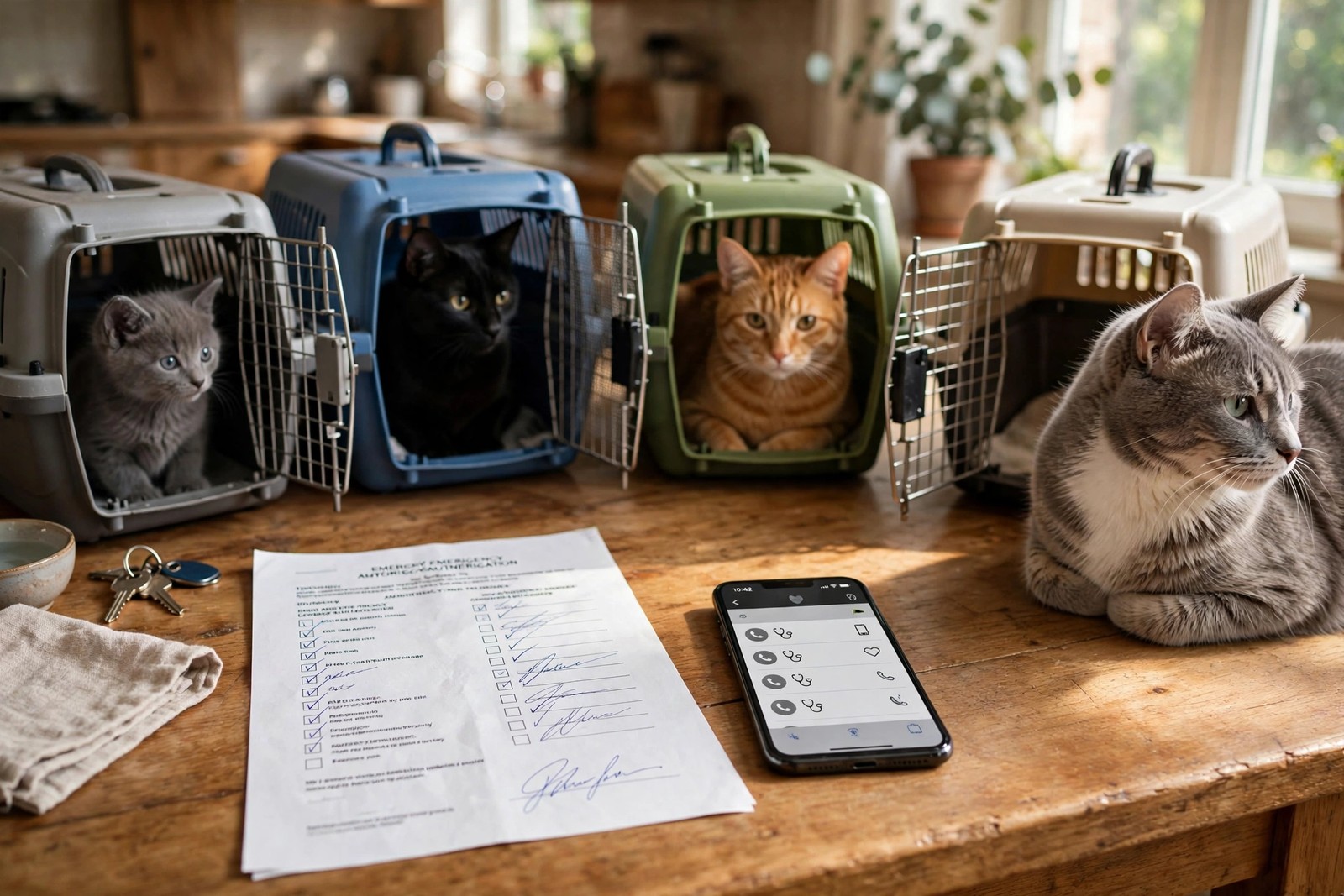
An emergency authorization earns its keep at the worst moment: a cat is hurt or suddenly ill, the owner is on a plane or asleep in another time zone, and the person holding the cat needs a clinic to act without a delay spent proving permission. In a household with four cats of very different ages, the document has to do two jobs at once, granting real authority for urgent care and fencing off the decisions only an owner should make.
Who Is Authorized, and Which Cats
Open with names, stated plainly. The document names the person authorized to act, with a phone number, and names a backup if the first person cannot be reached. Then list the cats separately, all four, each with a short identifying note and the per-cat details a clinic will need: age, known conditions, any medication given exactly as prescribed, handling cautions, and where that cat's carrier lives. Ages and needs differ widely in a mixed household, and an authorization that treats the four as one generic cat fails the kitten and the senior in opposite ways.
Add the owner's own contact details and the order in which people should be called. A caregiver who knows the sequence, caregiver first to the clinic, then the owner, then the backup, loses no time deciding who phones whom while a cat waits in a carrier.
The Veterinarians, Written Down in Full
Name the regular veterinarian and practice, with the address and phone number, and name the after-hours emergency clinic the same way, because the regular practice may be closed when the document is needed. A caregiver searching for an emergency number at midnight should be reading the document, not searching the internet. Confirm before you travel that both numbers are current and that the emergency clinic knows the regular practice's details for records and follow-up.
Note where carriers, medication, and feeding instructions are kept, and where the signed document itself lives. Copies go to the caregiver and to the regular veterinary practice ahead of the trip, so the clinic is never asked to trust a photocopy produced for the first time during a crisis.
What May Be Authorized, and What Stays Reserved
Draw the line in words a tired person can apply. Give a clear spending ceiling, chosen by you, up to which the caregiver may approve care without waiting for your reply. The permitted ground is stabilizing care: examination, urgent tests, pain relief as the veterinarian judges, and whatever keeps a cat safe until you can be reached. Beyond that line sit the decisions reserved to you alone, and the document should name that reserved ground outright, major surgery and end-of-life choices among it, because no caregiver should carry those alone on your behalf.
Consider the unreachable case honestly, because flights and remote travel create real gaps. Say what should happen if neither you nor the backup can be contacted and a veterinarian advises that delay would cause suffering; whatever you decide, write the decision down now, calmly, rather than leaving a caregiver and a clinic to improvise around silence. Sign and date the document yourself, and renew signatures and details whenever cats, caregivers, clinics, or limits change.
Access That Matches the Permission
Paper permission works only if the caregiver can also reach the information behind each cat's name. Care Pass on KinsLe is structured for that pairing, because the Care Pass access on KinsLe opens each cat's record, contacts, and care notes to one named caregiver, scoped to a defined stretch of time, such as an absence or an emergency window, and no longer. Set the access window through the Care Pass arrangement on KinsLe to close when you return home, and the emergency permission never lingers past the trip.