
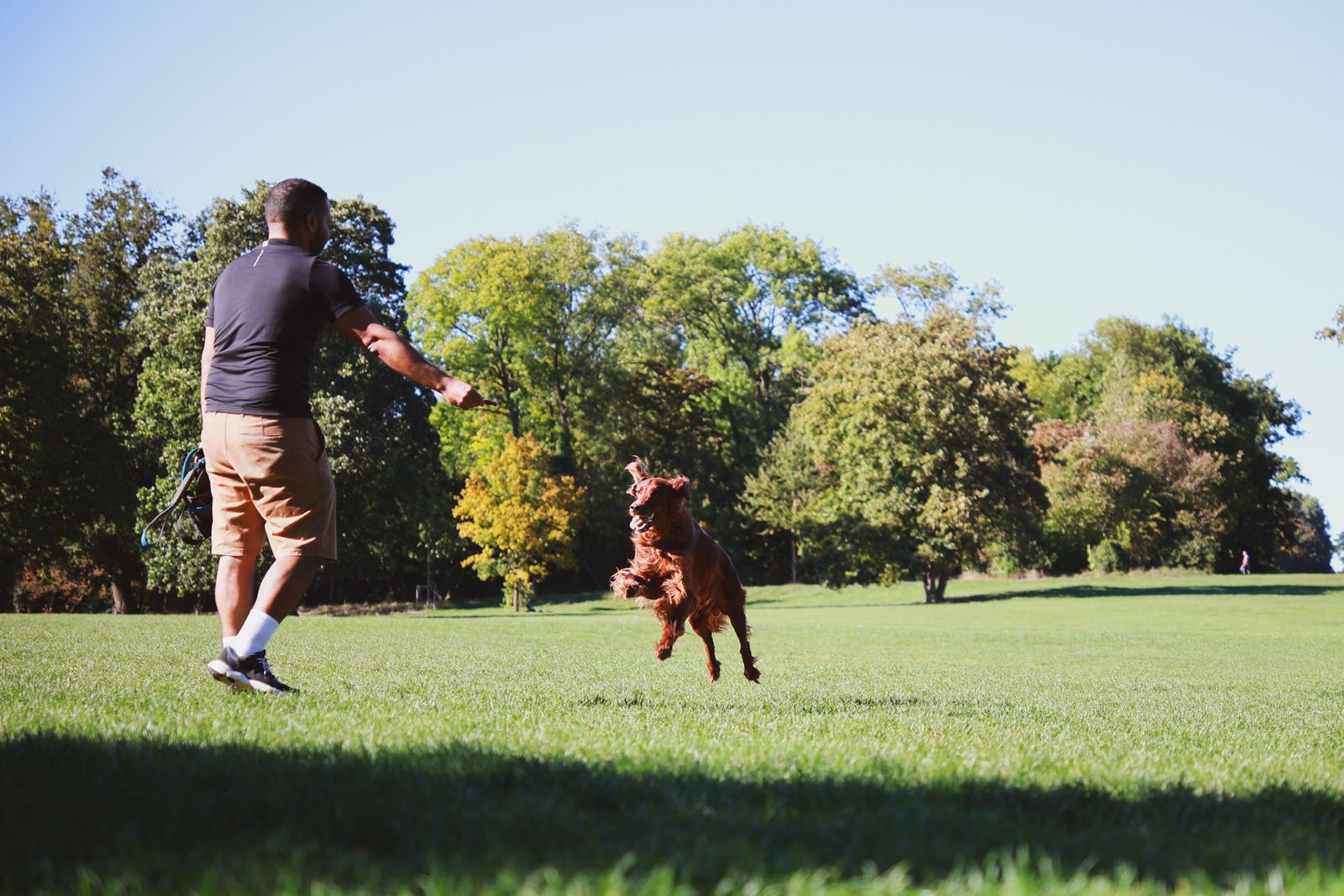
Before children play with your dog, they should learn to read his body language, handle him gently, and choose games that keep everyone calm — because most childhood dog incidents don't come from "bad dogs" but from kids who never learned that a wagging tail can mean arousal, that a growling dog is communicating, and that hugging is a primate habit most dogs merely tolerate.
Lesson one: dogs talk with their whole bodies
Teach kids to look for a loose, wiggly body, a soft open mouth, and a tail sweeping in wide, relaxed arcs — that's a dog happy to engage. Then teach the signals that mean "please stop": yawning when not tired, licking lips, turning the head away, showing the whites of the eyes, tucking the tail, freezing, or simply walking off. Walking away is the one kids violate most, so make it a hard rule: a dog who leaves is done, and following him is never allowed. Practice by watching videos together and narrating what each dog is "saying" — kids become remarkably fluent remarkably fast.
Lesson two: hands that dogs trust
Show children the consent test. Pet for three seconds — chest or shoulder, never a pat on top of the head — then stop and take hands away. If the dog leans in or nudges for more, continue. If he stays neutral or moves off, playtime with hands is over. No hugging around the neck, no kissing faces, no picking up, no ear or tail touching, and never disturb a dog who is eating, chewing, sleeping, or resting in his safe spot. These aren't fears to install; they're manners, the same as not grabbing a friend's toy.
Lesson three: games that build the friendship
The best kid-and-dog games have structure and an off-switch:
- Fetch with two identical balls, so there's never a tug over the one in the dog's mouth
- Hide-and-seek: the child hides with a treat, the dog "finds" them on cue
- Treat treasure hunts — kids scatter treats in the grass and let the dog hunt
- Trick training, where kids give simple cues like sit, paw, and spin and deliver the rewards
- "Statues": everyone freezes when the dog gets jumpy, which teaches calm on both sides
Skip wrestling, chasing, and teasing games. They reward exactly the arousal and mouthiness you're trying to avoid, and a game that's fun with a puppy becomes unmanageable with a 60-pound adolescent.
Age matters — scale the responsibility
Toddlers get proximity and gentle touching under hand-over-hand adult control, nothing more. Five-to-eight-year-olds can learn the consent test and run simple training games with supervision. Older kids can take real roles — measuring meals, joining walks, reading to the dog — which is where the deep bond forms. Whatever the age, an adult owns the outcome: if play gets loud, fast, or silly, the adult ends it kindly and early.
Making sure every grown-up teaches the same rules
The rules unravel when a grandparent allows face-kissing or a babysitter plays chase. KinsLe's Family Sharing keeps your dog's play rules and care details visible to everyone in his care circle — grandparents, sitters, and family alike — with roles for each person, so your child hears one consistent message everywhere. Family Sharing on KinsLe puts the consent-test notes and the gentle-game list where grandparents, sitters, and relatives can all read them, so his play rules stay the same whoever is supervising.