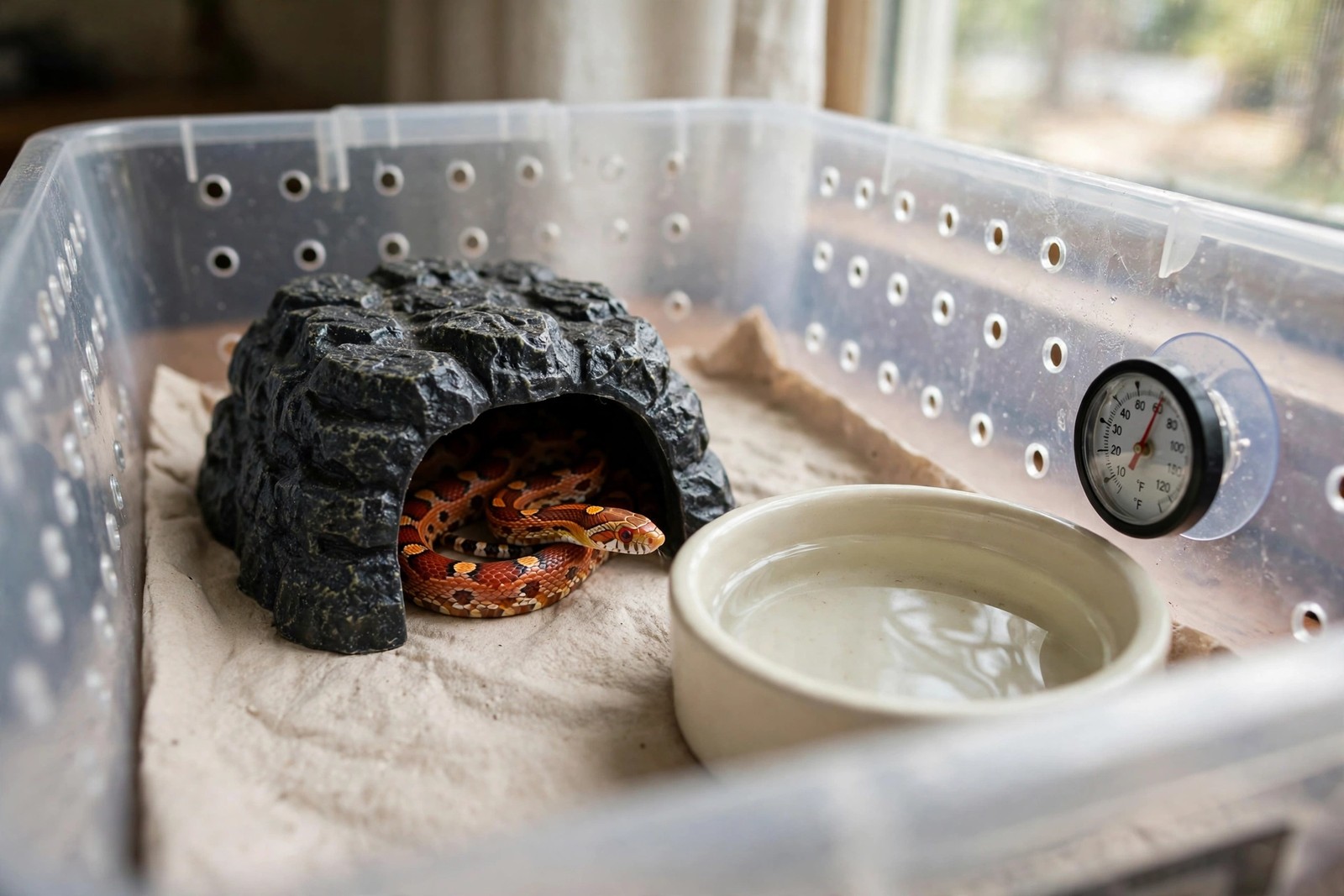
Start a hatchling snake smaller than your instincts suggest. For most commonly kept species, a secure ventilated tub of about 6 to 15 quarts, or a 10 to 20 gallon enclosure, suits the first months: a hatchling corn snake, king snake or ball python is typically only 10 to 18 inches long and weighs very little, and it needs to find warmth, water and food without crossing a wide, exposed floor. Fast-growing or larger species, such as a young boa, start toward the bigger end of that range and move up sooner.
Why Small Works Better
In the wild, a hatchling survives by staying hidden. A small enclosure with two snug hides — one over the warm end, one at the cool end — recreates that security. A hide should be small enough that the snake touches its sides when coiled inside; a cavernous hide in a huge tank leaves it feeling on display. Snakes that feel exposed commonly refuse food, and a feeding hatchling is the clearest early sign that the setup is right.
A compact enclosure also makes your job possible. You can find the snake quickly for a health check, see whether a meal was taken or left, spot droppings and shed skin, and hold a steady temperature gradient — a warm spot for digestion and a cooler area to retreat to — without large cold corners. In an oversized tank, a hatchling can sit in the wrong temperature zone simply because the right one is far away.
Security and Fit-Out
Hatchlings escape through gaps adults cannot. Choose a tub lid that latches firmly on all sides or a tank with a locking screen top, check the cable holes for probes and thermostats, and never rely on a book balanced on a lid. Line the floor with paper towel at first so feeding, droppings and any mites are easy to see, add a water bowl heavy enough not to tip, and place a simple thermometer at each end so the gradient is measured rather than guessed.
When to Move Up
Upgrade when the snake outgrows the logic of the small start: when it no longer fits its hides, when its length approaches the combined length and width of the enclosure, or when you cannot maintain a warm end and a cool end with room to move between them. Many keepers step up in stages rather than jumping straight to the adult enclosure, keeping hides snug at every stage. Growth in the first year can be quick, so measure the snake at each shed and plan the next size before it is urgent. Logging feeds, sheds and enclosure changes in KinsLe Care Teams gives everyone caring for the snake the same record, and a missed feed is spotted as a pattern rather than a memory.