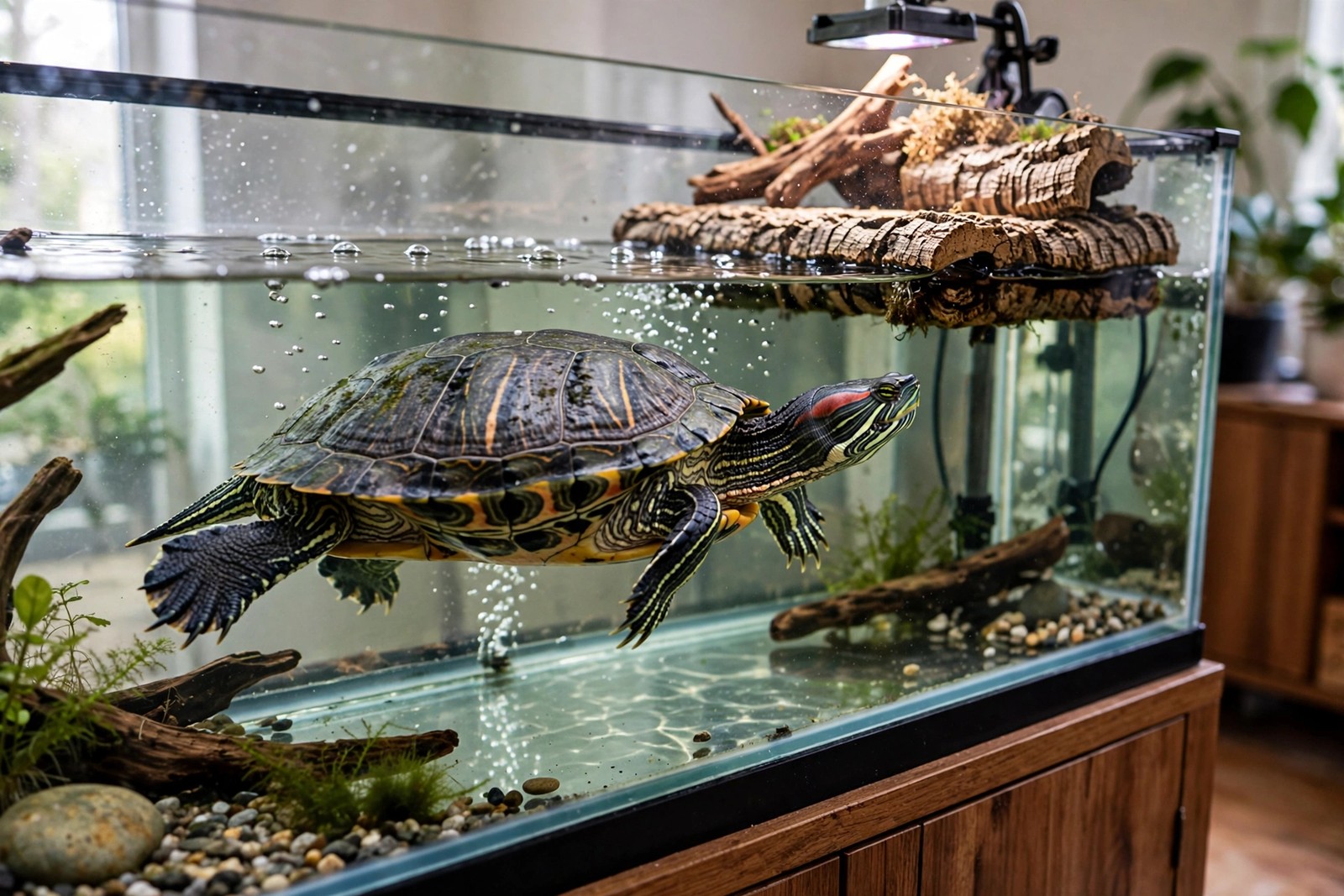
The tiny hatchling paddling in a small plastic tub is a misleading sight in the pet trade. A red-eared slider grows steadily for years, females commonly reaching ten to twelve inches of shell, and every inch of that growth multiplies the space, water volume and filtration it needs. Sizing the tank for the adult, not the baby, is the whole answer — and a simple rule of thumb makes the adult size easy to work out before you buy anything.
The Ten-Gallons-Per-Inch Rule
Allow roughly ten gallons of tank capacity for every inch of shell length, measured in a straight line from the front to the back of the shell. Run the rule at adult size: a slider that will reach ten inches needs about 100 gallons (about 379 litres), and a twelve-inch female needs about 120 gallons (about 454 litres). A smaller adult male of seven to eight inches works out to roughly 70 to 80 gallons, which is why a tank of around 75 gallons is often quoted as a working minimum for one adult. A two-inch hatchling in a 20-gallon tank fits the rule today and breaks it within a couple of growing seasons, which is why starting small means buying the same equipment two or three times.
Why Footprint Beats Height
Sliders are horizontal swimmers and surface breathers, so the floor area of the tank does more work than its depth. A long, wide tank gives a swimming lane, room to turn without scraping the shell, and space for the water and land areas to sit side by side. Water depth should let the slider swim freely and right itself easily if it flips — as a guide, deeper than the shell is wide — while the basking dock above the waterline takes up surface area that must be counted in the layout, not stolen from the swimming space. Long stock tanks and pond-style tubs serve this footprint logic well and are a legitimate alternative to a glass aquarium, provided the sides are high enough that a determined climber at the basking dock cannot get out.
The Rest of the Space Budget
Size is not only about the shell. A slider is a heavy waste producer, and a larger water volume dilutes waste between cleans and holds temperature steadier than a small one, which is part of why the per-inch rule errs generous. Leave room in the plan for a filter sized for turtle waste, a basking platform the animal can climb onto fully and dry off on completely, and a guard around heaters and lights. Females also need somewhere to dig when they carry eggs, even without a mate, so a household planning for a female should think about a separate laying area as part of the adult setup rather than an afterthought.
Buying Once, Not Three Times
Work backwards from the adult: choose the 100- to 120-gallon home for a female, or around 75 gallons and up for a smaller male, place it where its filled weight — water alone in a 100-gallon tank weighs over 800 pounds — is properly supported, and furnish it once. Keepers who start with the adult tank also skip the repeated stress of moving a growing turtle into new surroundings. KinsLe's Family Sharing shows your slider's profile, including its current shell length and the adult tank size it will need, to everyone in the household, so the upgrade plan is shared knowledge long before the growth makes it urgent.