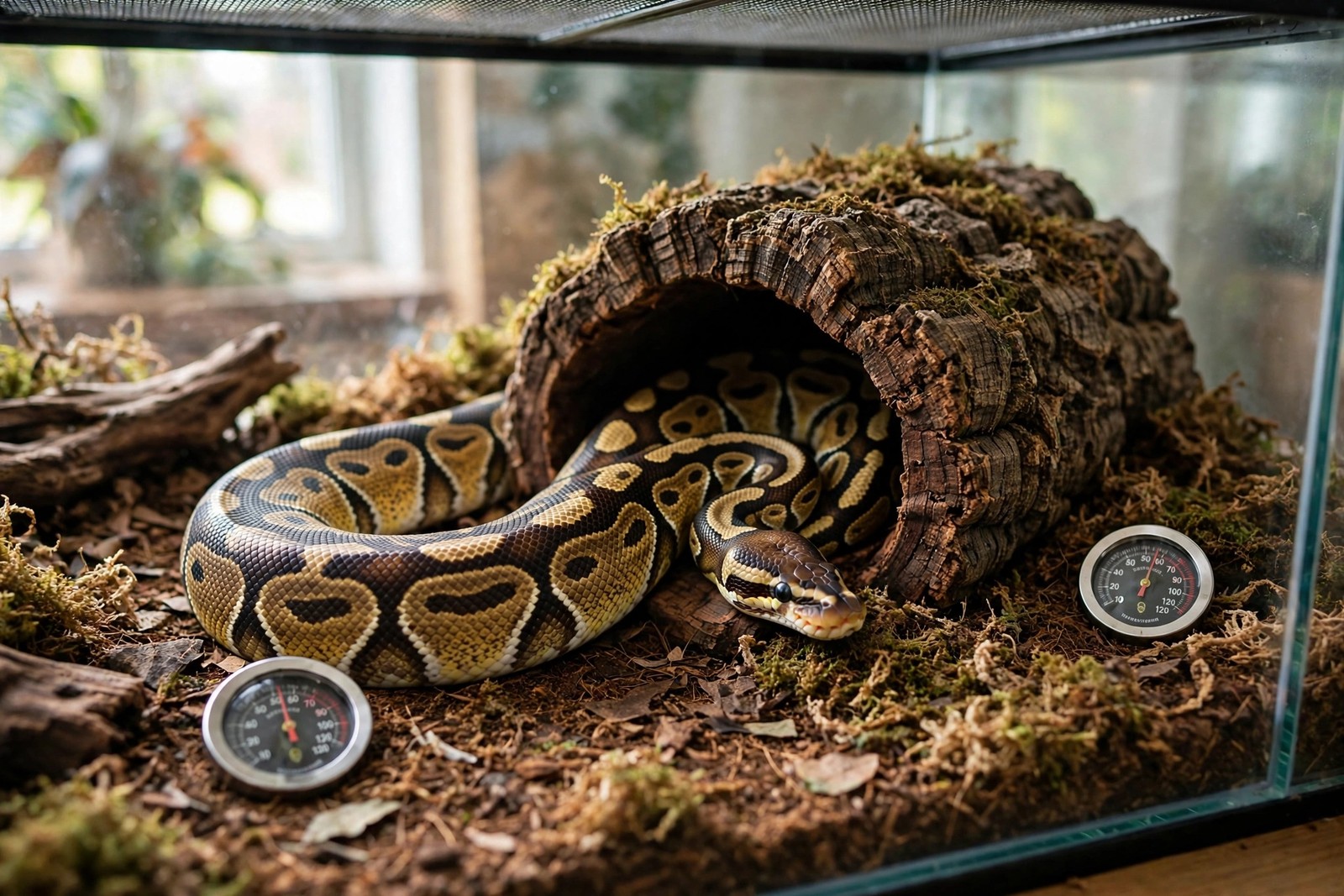
A ball python cannot make its own body heat, so its enclosure has to offer two temperatures at once and let the snake choose. Keep the warm side around 88 to 92°F (about 31 to 33°C), measured at floor level where the snake lies over or near the heat source, and keep the cool side around 78 to 80°F (about 26 to 27°C). That spread, roughly ten degrees from end to end, is the working gradient: the python warms up on the warm side to digest a meal, then retreats to the cool side to avoid overheating. A single uniform temperature, even one in the middle of the range, removes the choice and quietly undermines digestion, immunity and feeding response.
Controlling Heat Safely
Whatever produces the heat, an under-tank mat, a radiant panel or a ceramic emitter, it must be plugged into a thermostat with its probe placed where the snake rests, because unregulated heat sources can climb far past the target and burn a snake that will not move away from a too-hot surface quickly enough. Never use a heat rock inside the enclosure; its surface temperature is uneven and it is a well-known source of belly burns. Read the results independently of the thermostat: one thermometer at floor level on the warm side and one on the cool side, checked against the snake's actual lying spots. Room temperature matters too. In a cold room, even a good heater may hold the warm hide correctly while the cool side falls well below 78°F, so insulate the enclosure or warm the room rather than simply turning the heater higher.
Reading What Your Python Is Telling You
Behaviour is the daily audit of your numbers. A python that spends every hour in the warm hide may be too cold overall, or may simply be digesting; a python that never uses the warm side, soaks constantly in its water bowl, or stays pressed against the cool end may be too warm, though persistent soaking can also signal mites or low humidity, so look at the whole picture. After feeding, expect the snake to settle on the warm side for a day or two while it digests, and avoid handling during that time. Refused meals are the classic ball python complaint, and incorrect temperatures are one of the first causes to check before assuming pickiness, especially a cool side that has drifted down in winter or a warm side that has crept up in a summer heatwave. If feeding, shedding and activity stay normal, your gradient is doing its job.
Holding the Gradient Steady Over Time
Check both ends twice a day, morning and evening, and write the readings down rather than trusting memory, because slow drift is invisible without a record. Recheck after every change: a new heater, a moved probe, a different room, or the turn of a season. Keep a hide at each end of the enclosure so the snake never has to choose between feeling secure and being the right temperature, and keep the water bowl on the cool side where it stays fresher and raises humidity gently. A python that stops eating for weeks, breathes with its mouth open, or shows blistered or discoloured belly scales needs a vet promptly, not another adjustment to the thermostat. With the routine shared, KinsLe's Care Teams lets you split those twice-daily temperature checks between the people who care for your ball python, and each logged, timestamped reading builds the record that makes slow drift impossible to miss.