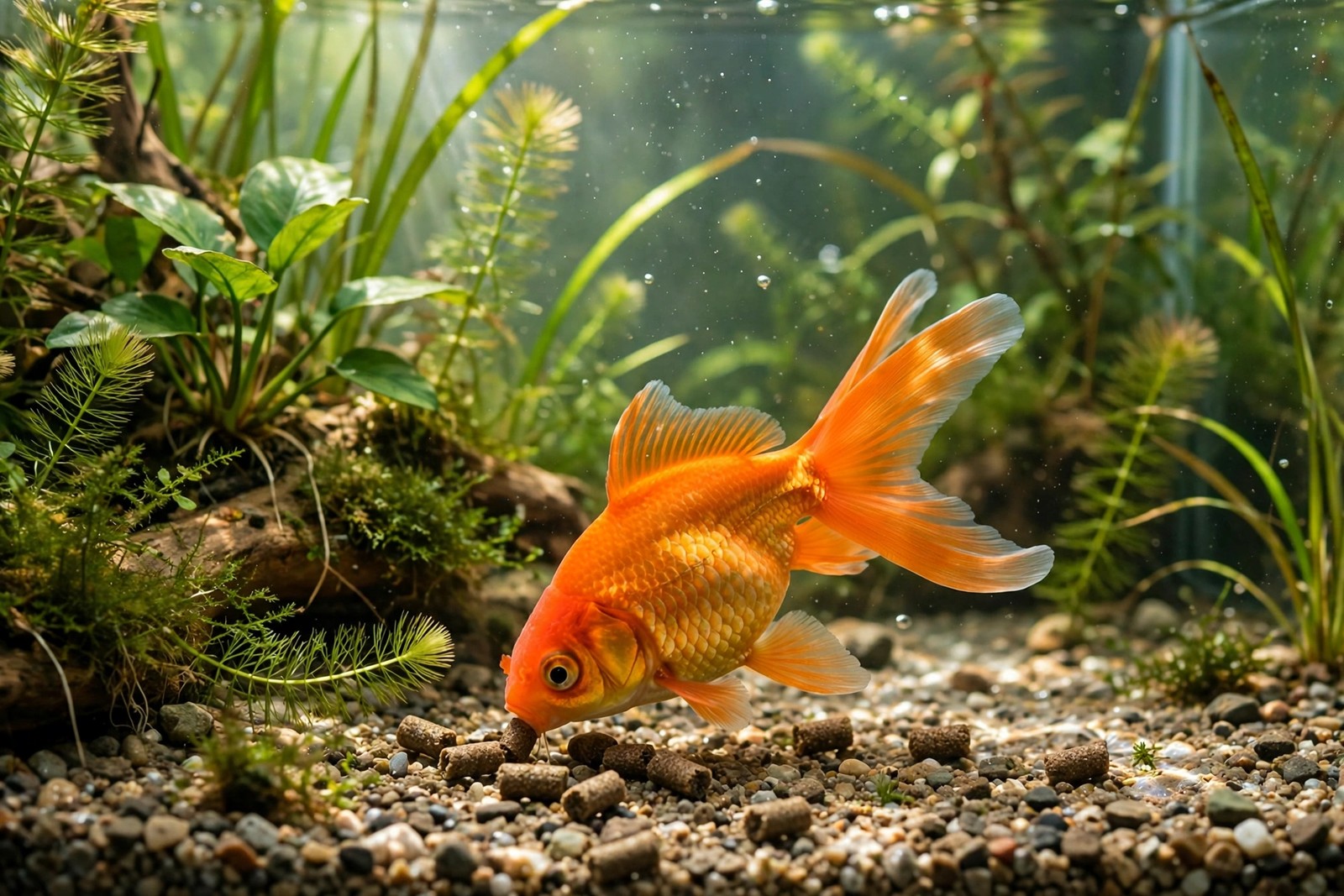
Feed goldfish a staple made for goldfish: sinking pellets or a gel food formulated for their needs, in a size the fish can take in one bite. Goldfish are omnivorous grazers with no true stomach, built to pick through food across the day rather than bolt one large meal, and their food should match that design. A good goldfish pellet carries a balance of plant matter and protein suited to growth and colour without the richness that fouls water quickly.
Why Sinking Beats Floating
Goldfish naturally forage downward, sifting at the bottom. Floating flakes and floating pellets train them to feed at the surface, where they gulp air along with food. Swallowed air is a particular problem for fancy varieties — the round-bodied fantails, orandas and ranchus — whose compact shape already makes buoyancy control delicate, and keepers have long linked surface gulping with the floating and tipping problems those fish are prone to. Sinking food, softened briefly in a little tank water before serving so it is not eaten dry and expanding, keeps feeding where the fish is built to do it.
Tropical flakes are the common wrong answer in the cupboard. They are formulated for tropical species with different protein needs, they dissolve and drift before a slow fancy goldfish reaches them, and they encourage exactly the surface feeding described above. Using them up is a false economy paid for in water quality.
Variety: Greens and Occasional Extras
Add plant variety a few times a week. A blanched, deshelled pea — squeezed from its skin and chopped if the fish is small — is the traditional offering and most goldfish take it eagerly; use it as part of the rotation rather than a daily cure-all. Leafy greens such as a blanched spinach leaf or a piece of courgette, clipped in the tank for a few hours and then removed, give grazing fish something to work at. Small amounts of frozen-then-thawed bloodworms or daphnia make an occasional protein extra, not a staple.
Amount and Water Quality
Overfeeding, not underfeeding, is the routine goldfish mistake. Offer only what the fish finish in about two minutes, once or twice a day, and remove leftovers; uneaten food rots, clouds the water and loads the filter. Young, growing fish eat at the generous end of that guidance, adults at the lean end, and a weekly lighter day does healthy adults no harm. Judge by body condition — a smooth, rounded profile without a pinched belly or a bloated outline — and by water tests, not by the hopeful behaviour at the glass, which goldfish perform for anyone who walks past. Putting the feeding schedule, portion and pea days into KinsLe Care Teams stops the most common household error, three people each feeding a full meal, because completed feeds are timestamped for everyone to see.