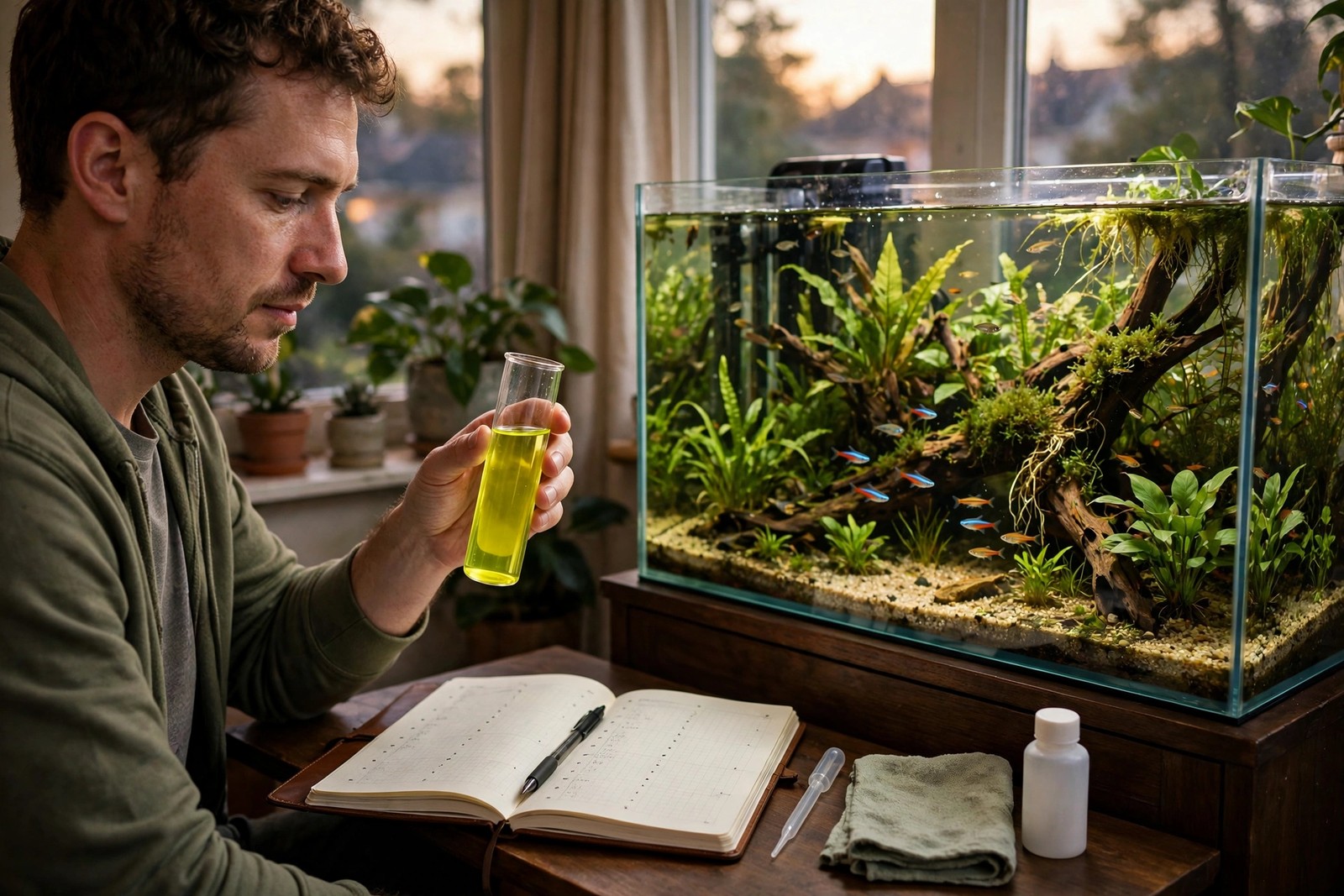
The parameters worth recording for a freshwater tank are temperature, pH, ammonia, nitrite and nitrate, together with KH and GH, and a marine or brackish tank adds salinity to that list. Recording them on a schedule, in the same format each time, turns a box of test kits into an early-warning system: many tank crises announce themselves in the numbers days before the fish show it. A single perfect test tells you little; a dated column of results shows drift, and drift is what you can still fix cheaply.
The core readings: temperature, pH, ammonia, nitrite and nitrate
Temperature deserves a daily glance and a recorded value at each test, because heaters fail in both directions and a slow overnight fall can stress fish before anyone notices; tropical tanks are commonly kept around 75 to 80°F (24 to 27°C), while coldwater tanks simply need to stay stable at room conditions. Record pH alongside temperature, since the two together describe the water your fish actually live in, and a pH that moves between tests is more worrying than a steady pH slightly outside a textbook range. Ammonia and nitrite are the toxic pair produced by fish waste and uneaten food: in an established, cycled tank both should read zero, and any positive result, however small, is a finding to act on and to record with the date. Nitrate is the end product of the filter's work and rises steadily between water changes, so its recorded level tells you whether your change routine is keeping pace; many keepers aim to keep it low, often under 20 to 40 ppm depending on the livestock.
KH, GH and salinity: the stability readings
KH, or carbonate hardness, measures the water's buffering capacity, which is what holds pH steady; a falling KH in your log warns that a pH swing may be coming before it arrives. GH, or general hardness, records the mineral content that matters for species such as livebearers, many shrimp and snails, and for plants. Record both whenever you test, and always when you change water source, add remineralising salts or start using rainwater or reverse-osmosis water, because those changes move hardness first and pH later. Marine and brackish keepers should also log salinity at every test and every top-up, since evaporation quietly concentrates a tank between checks.
How to record so the log stays useful
Give every entry the same shape: date, tank name if you keep more than one, the readings, the percentage of water changed that day, and a short note of anything new, such as added fish, a filter clean, a medication used or a missed feed routine. Test weekly in a settled tank, more often in a new tank that is still cycling, after adding livestock, and whenever fish behave oddly, flashing, gasping at the surface or refusing food. Percentages and amounts belong in the log too: recording that you changed roughly a quarter of the water weekly lets you connect a rising nitrate trend to a routine that has quietly slipped to fortnightly.
Reading the trend and acting on it
Review the log monthly and look for direction rather than perfection: nitrate climbing faster than it used to can signal overfeeding, an overstocked tank or a filter that needs maintenance, while a KH that falls a little more each week points at a buffering problem to solve with water changes or mineral additions. A sudden ammonia reading in a mature tank should send you back through the recent notes for a dead fish, a blocked filter or a well-meant deep clean that removed too much filter bacteria. Keep the log where everyone who cares for the tank can see and add to it. KinsLe's Pet Passport keeps those dated readings together with your fish's other records in one portable packet, so a sitter, a shop adviser or an aquatic vet can read the whole history at a glance.