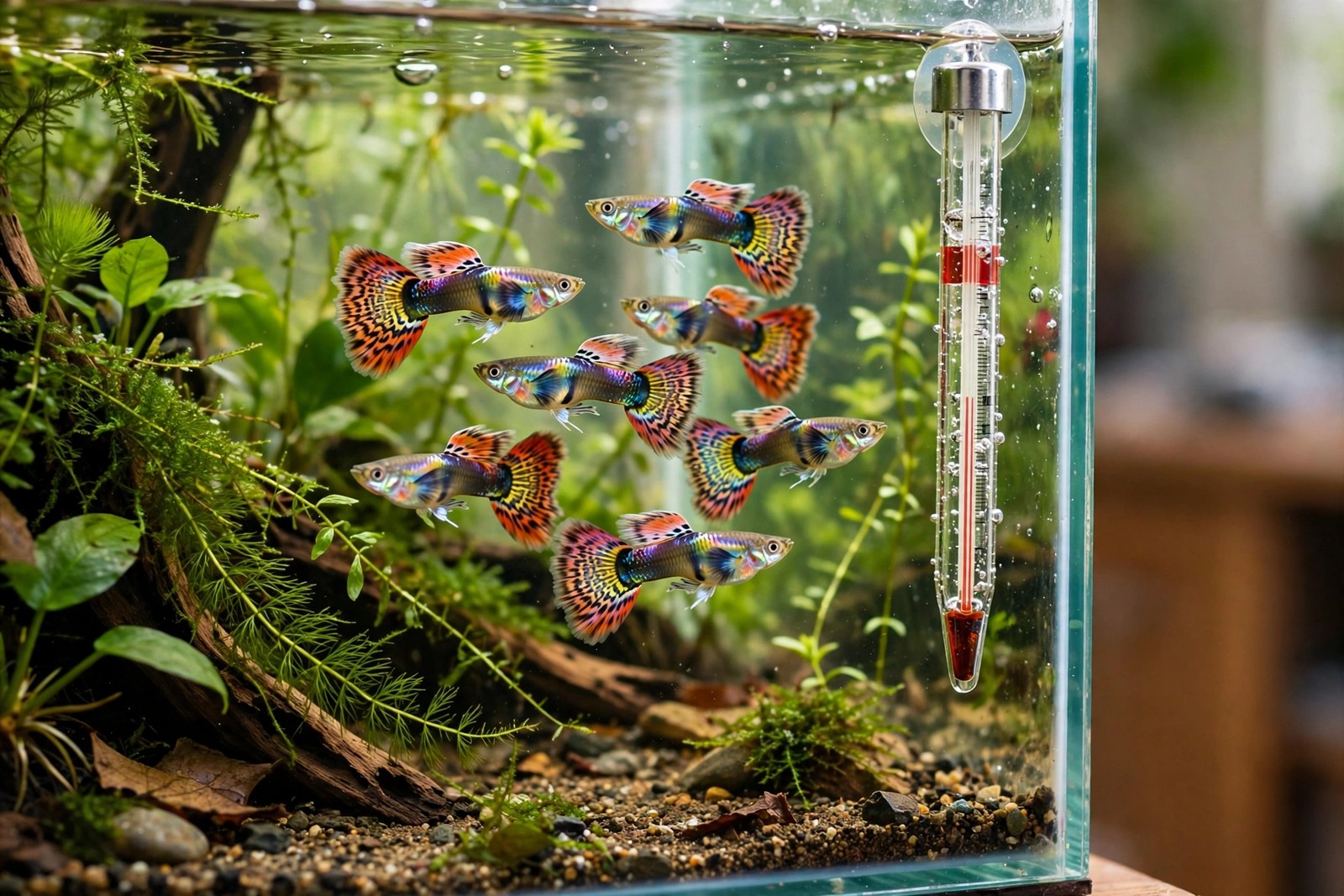
Guppies come from warm, slow-moving waters in northern South America and Trinidad, and their home aquariums need to copy that warmth deliberately. In a heated house the tank may sit comfortably in range through summer and slide below it overnight in winter, so guppies rely on a heater and on you checking a thermometer rather than trusting the room. Temperature drives nearly everything for this species: appetite, growth, breeding pace, immune response and how much oxygen the water holds.
The Range to Hold
Keep guppies at 24 to 28 degrees Celsius, about 75 to 82 degrees Fahrenheit. Aim for a steady point inside that band — many keepers settle near the middle — instead of letting the tank drift from one end to the other across each day. Within the range, life runs faster at the warm end: fry grow quickly, females produce broods more frequently and algae grows faster too. At the cooler end, guppies stay active but grow and breed more slowly, and long periods below the range leave them sluggish and more vulnerable to common infections such as white spot and fin rot.
Short dips during a water change or a brief power cut rarely harm healthy adults, provided the temperature returns gradually. What damages guppies is a sudden large swing — several degrees within an hour — or weeks spent quietly below range because a heater failed unnoticed.
Setting Up Heating You Can Trust
Fit a heater rated for your tank volume, positioned where filtered water flows past it so warmth spreads evenly instead of pooling in one corner. Set it to your chosen point, wait a full day, then read a separate thermometer placed at the opposite end of the tank. Heater dials are approximate, and the dial setting and the true water temperature can differ by more than a degree, so adjust the dial in small steps until the thermometer holds your target across a morning and an evening reading.
Place the thermometer where you can read it during feeding, and glance at it daily. Note the readings for the first week after any heater change, after moving the tank, and at the start of colder weather, because those are the moments drift appears. A tank near an exterior door, a window with direct sun or a radiator can swing even with a working heater; relocating the tank to an interior wall often steadies it more than a bigger heater does.
Warming and Cooling Without Shock
When you adjust temperature on purpose — for a hospital tank, a new arrival or a seasonal correction — move it slowly, roughly a degree or two over several hours, and let the heater do the work rather than adding warm water by the jug. Refill water for changes should match the tank temperature closely so each change does not deliver a small shock of its own. If a heater fails, float a sealed container of warm water only as a short bridge while you source a replacement, and prioritise keeping the tank stable rather than chasing the exact number hour by hour.
Watch behaviour as your second thermometer. Guppies huddled near the heater, sitting on the substrate or refusing food are often telling you the water feels cold before a casual dial check does, while fish gasping at the surface in warm weather may be short of oxygen, since warmer water holds less of it. Increase surface movement from the filter outflow or an air stone during heatwaves instead of dropping the temperature sharply.
Keeping the agreed set point and the latest thermometer readings visible to everyone through KinsLe's Family Sharing stops one person adjusting the heater against another person's setting, and gives the household a single shared record when a reading starts to drift.