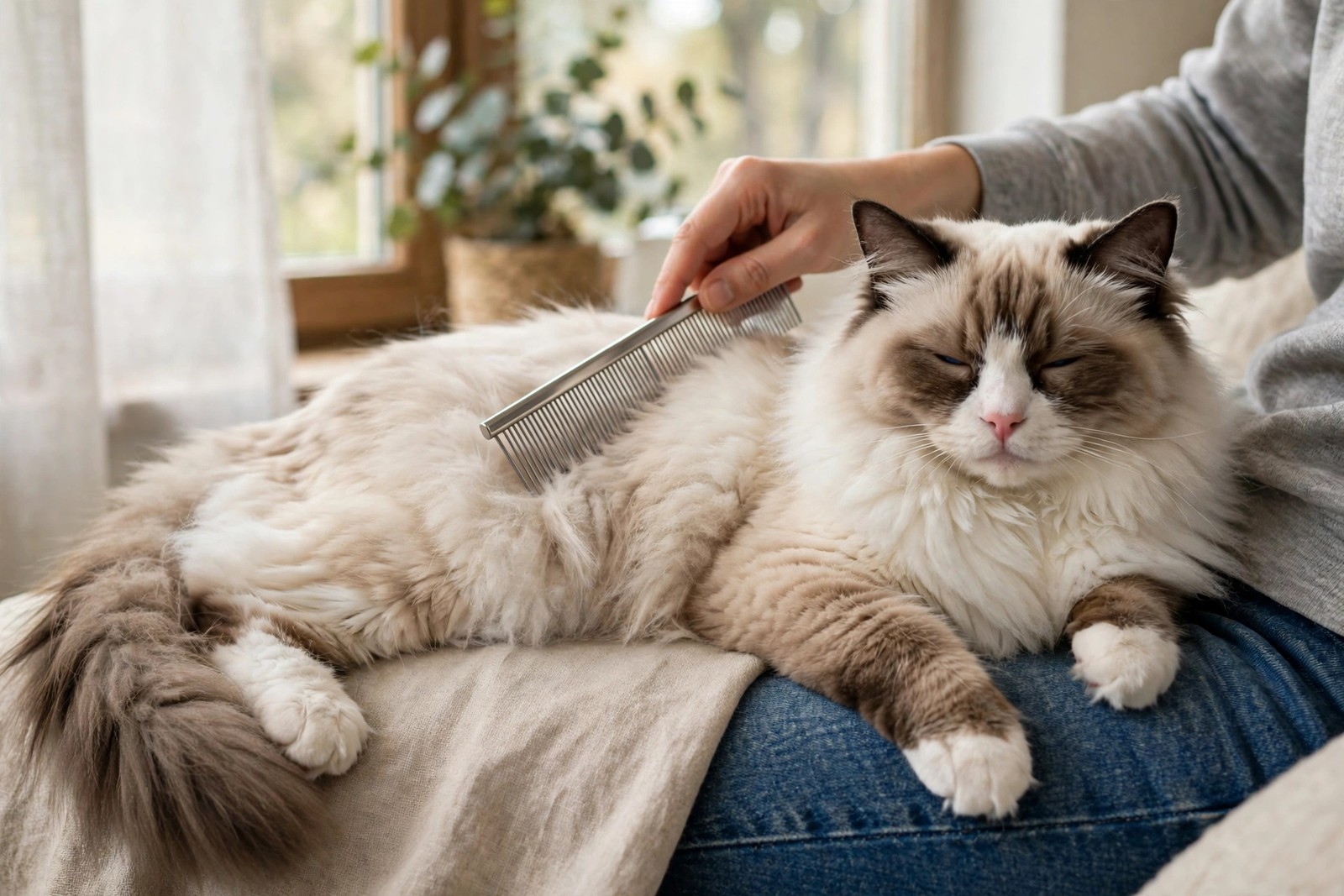
The Ragdoll coat is the forgiving end of long hair. Silky and semi-long, with less dense undercoat than the heaviest long-haired breeds, it mats less readily than denser long coats — which tempts owners to skip weeks, right up until the first real tangle announces that less readily never meant never. A short, regular combing rhythm matched to this specific coat keeps it flowing and knot-free with far less drama than rescue grooming.
Two to Three Comb-Throughs a Week
Comb the whole coat through two to three times a week. Use a steel comb rather than relying on a brush alone: a brush skims the surface and leaves the deeper layer untested, while a comb that travels from skin to tip proves the coat is actually clear. Work in sections, lifting the coat and combing in the direction of growth, and let the cat's tolerance set the session length — two shorter sessions beat one long battle, and a Ragdoll that learns combing predicts treats and lap time will present itself for the next round.
Keep the rhythm weekly and unbroken. The tangle-free state is maintained by frequency, not by effort: ten calm minutes three times a week outperforms an hour once a month, because a forming snarl caught at day three teases apart with fingers, while the same snarl at week three has recruited its neighbors.
The Friction Zones Get the Attention
Most of a Ragdoll's coat can go a week untouched without consequence; four areas cannot. The armpits rub with every step and felt first. The belly coat is finer, longer, and drags across bedding and laps. Behind the ears the hair is soft and thin and knots against collar edges and during head rubs. The breeches — the long britches on the hind legs — catch litter, debris, and each other. Give those four zones a deliberate pass at every session, combing gently and checking with fingertips as well as the comb, because a fingertip finds the pea-sized start of a mat before any tool does.
Shedding Weeks and Honest Tangles
In the heavier seasonal shedding weeks, when loose coat comes away on every stroke, add an extra session rather than lengthening the usual ones. Shed hair left sitting in the coat is the raw material of tangles, and clearing it promptly is the whole game during a molt.
When a tangle does form, never pull it out. Pulling hurts, tears skin on a firm mat, and teaches the cat that grooming predicts pain. Tease a loose snarl apart with fingers, working from the ends inward, and comb through the freed strands. A mat that is tight to the skin is a job for a groomer or a veterinarian to clip away safely, not a test of household determination.
Everyone Grooms to the Same Pattern
In a household where more than one person grooms the cat, consistency is the difference between a maintained coat and three people each assuming another did the armpits. Family Sharing on KinsLe holds the shared grooming notes for the household — which zones were done, which session found a starting snarl behind the left ear, and when the extra shedding-season session falls — so the pattern survives whoever picks up the comb. A note takes twenty seconds and saves the coat a week of duplicated effort in one spot and neglect in another.
Family Sharing on KinsLe keeps a short grooming log in common view, so an extra session in shedding season is noticed rather than doubled.