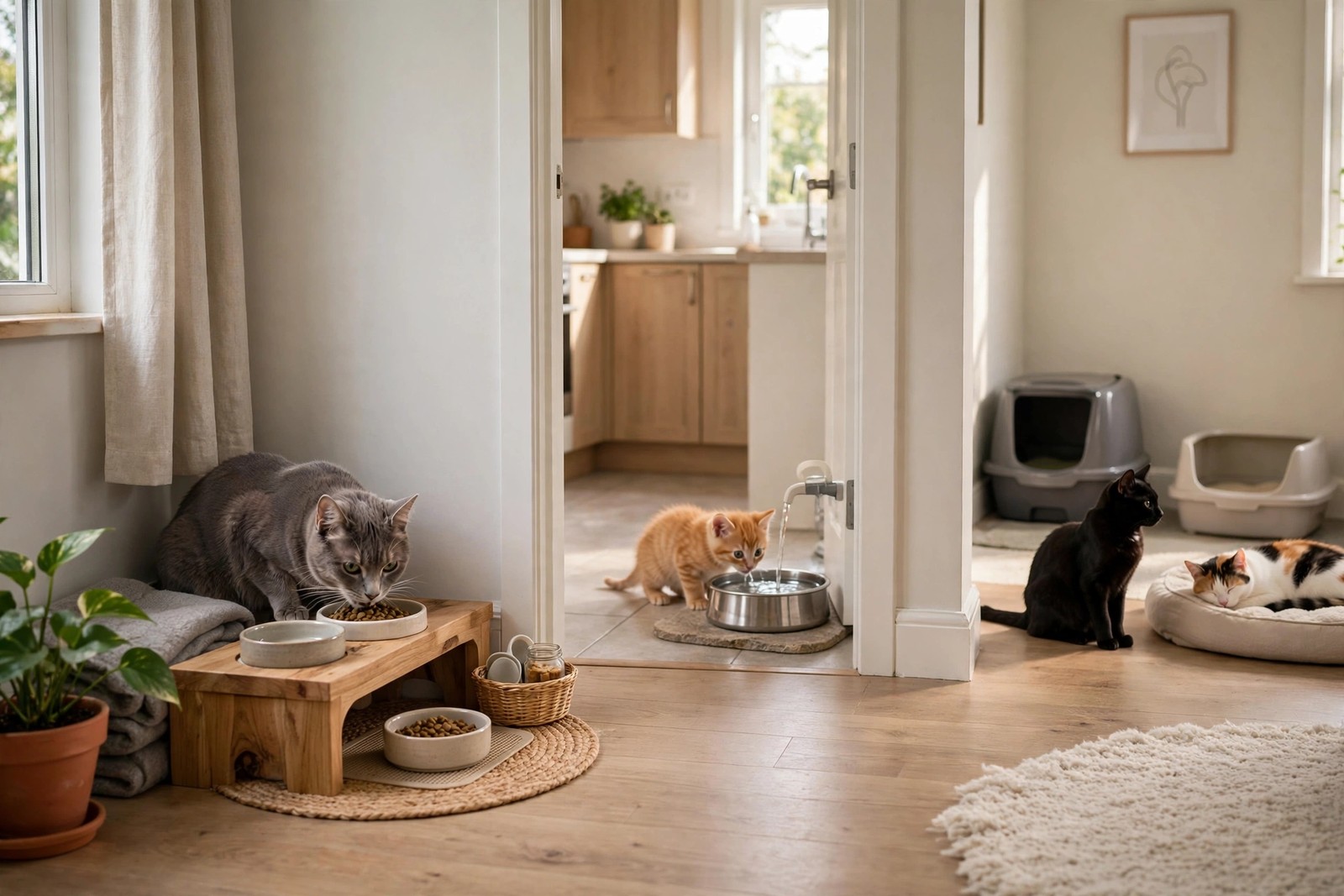
Four cats of very different ages will accept a home's feeding, water, and litter arrangement only when the arrangement respects what cats are: solitary eaters, fussy drinkers, and territorial about toilet spots. Most fights over resources in a multi-cat home are design problems wearing the disguise of behavior problems. A senior bullied away from the only water bowl, a kitten fed on a counter it can barely reach, or litter boxes lined up beside the food will each produce stress that looks like stubbornness. Zone the home properly and most of that friction never starts.
Separate Zones for Eating, Drinking, and Litter
Food and litter sit at opposite ends of the arrangement, always. Cats strongly prefer not to eat near where they eliminate, and a cat forced to do both in one corner often solves the problem by avoiding one of them, usually the litter box, in a place you like even less. Drinking water earns its own logic. Many cats drink more willingly from water placed away from food, and every cat drinks more when water exists in more than one spot, so a cat avoiding one room still has an unguarded option elsewhere. Place stations in quiet, low-traffic areas where a cat can eat, drink, or use a box without being ambushed by a housemate, a dog, or a passing child. Corners with two escape directions beat dead ends, because a station a cat can be cornered in is a station the lowest-ranking cat will quietly stop using.
Enough Stations, Matched to Each Age
Count is the second half of the design. Common guidance for multi-cat homes is one station per cat plus a spare, for litter boxes and feeding spots alike, and the reasoning is practical rather than generous: with stations spread across more than one location, no single confident cat can guard the whole supply, and a shy cat always has a second choice. Then match each station to the ages using it. The senior gets step-free, ground-level access to food, water, and a low-sided box, because arthritis turns a raised feeding platform or a high box entry into a daily negotiation. The kitten gets the opposite consideration in reverse: nothing essential placed only somewhere it cannot yet reach, and no station where bigger cats can trap it mid-meal. Adult cats in their prime will use most of what is offered, which is precisely why the extremes of age should set the design. Spread stations across rooms and floors where the home allows, rather than clustering the full set in one utility corner that recreates the guarding problem at scale.
The Roster That Keeps Zones Working
Zones fail quietly when upkeep depends on memory. Water bowls go stale, a box gets skipped, and the senior's ground-level station is the first thing moved during cleaning and the last thing put back. The Family Sharing roster on KinsLe keeps the upkeep explicit, with named turns for topping up every water spot, scooping each box, and checking that the senior's and kitten's stations are where the plan says they belong. Anyone in the household can see at a glance which zones are done and which are waiting, so the arrangement the cats accepted is the arrangement they keep getting. Keep the station plan current in KinsLe through the Family Sharing roster, with named turns for topping up water and cleaning boxes across all four age groups.