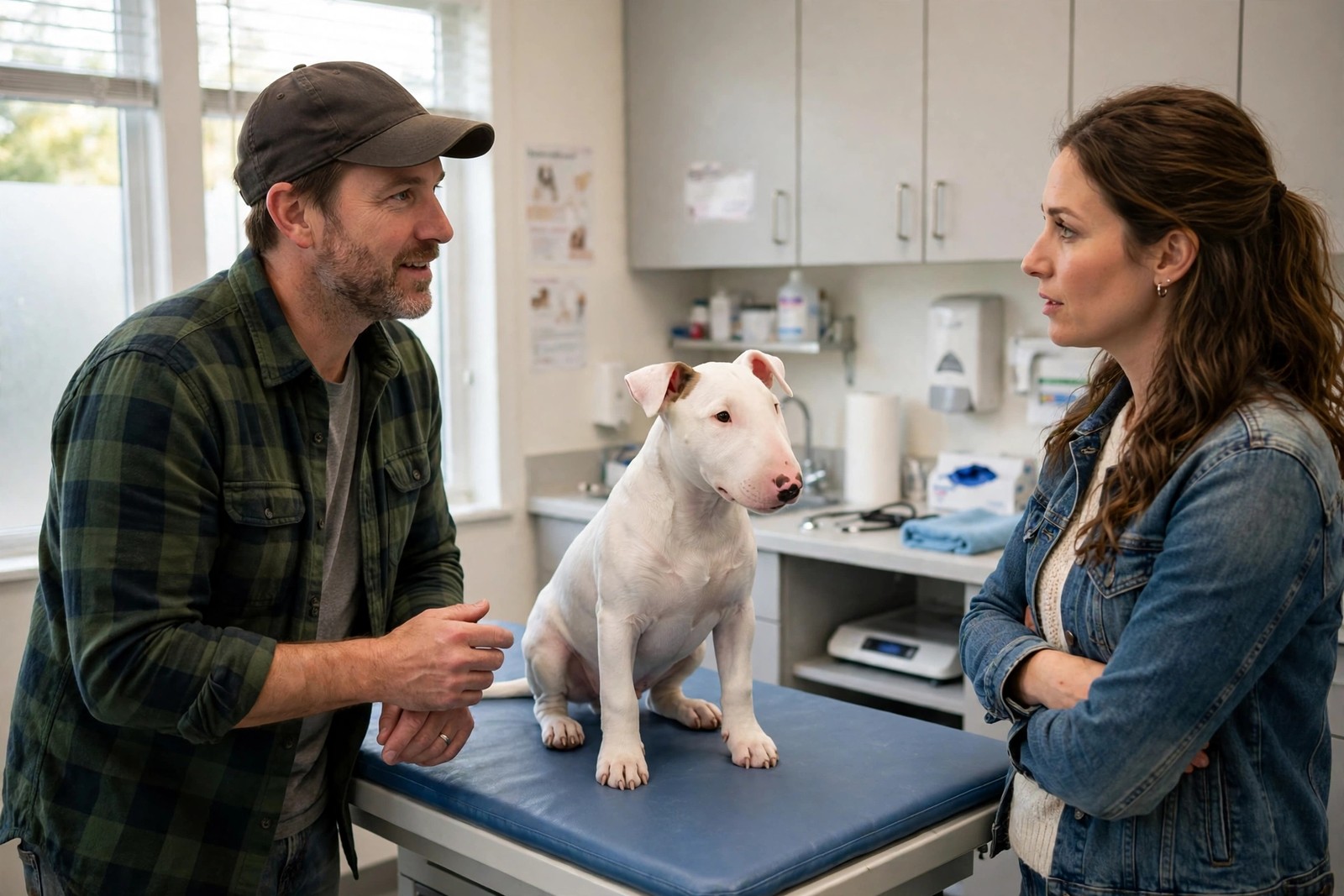
Choosing a Bull Terrier puppy well means asking health questions before you fall completely for one particular clownish face, and asking them in a form that produces evidence rather than adjectives. Hearing, kidneys, and skin are the three areas this breed's history puts on your list. Each requires you to ask the breeder, and the veterinarian behind the litter, what has actually been checked, what the results were, and what the parents' record shows, then to keep those answers where they cannot be lost.
Hearing: Ask About BAER Testing
Deafness is the Bull Terrier's known hearing issue, particularly associated with the white coat in the breed's history, and it can affect one ear or both. A puppy who is deaf in one ear behaves almost normally at home, which is exactly why casual observation at the breeder's kitchen table settles nothing: puppies follow siblings, respond to vibration and visual cues, and cover for a missing ear so well that experienced breeders test rather than guess.
Ask whether the puppy's hearing has been tested, and ask about BAER testing by name, since the brainstem auditory evoked response test is the objective hearing check used for puppies, typically performed once puppies are old enough for reliable results. Ask which ears passed, ask to see the result recorded rather than summarized, and ask what the breeder knows about hearing status in the parents and in earlier litters from the same pairing.
Kidneys: Ask What Checks Were Done
Kidney disease sits on the Bull Terrier predisposition list, so the kidney questions are about the checks behind the reassurance. Ask what kidney checks the breeder or the litter's veterinarian has done on the parents, since breeding animals are where meaningful screening happens, and ask whether kidney problems have appeared anywhere in the puppy's close family, including in grandparents and in puppies from earlier litters. Ask, too, what the veterinarian found at the litter's own health examinations: steady growth, good hydration, and normal findings at each check are the baseline you want described specifically.
Breeders who screen can usually tell you when the parents were last checked, what kind of checks were run, and what the results showed, and they answer family-history questions without changing the subject.
Skin: Ask About Both Parents
Skin trouble is the third Bull Terrier theme, ranging from irritation and itchiness to recurrent problem patches that need veterinary help to sort out. Ask about both parents' skin history in plain terms: has either dog needed veterinary treatment for itching, recurring ear or paw irritation, or skin infections, how often, and how well did it settle? Ask the same about the puppy itself: any scratching, redness, flaky patches, or treatment needed in its first weeks, and what the litter's veterinarian made of it.
Part the coat along the belly, armpits, and between the toes, and look for redness, crusting, or a strong odor, and check ears for redness or dark debris. A perfect puppy on one afternoon proves little, and a mild, disclosed, treated irritation with a clear explanation is no scandal either. What you are grading is the combination of the puppy's skin today, the parents' history over years, and a breeder whose answers get more specific the longer you talk, not less.
How to Ask, and What to Do With Answers
Ask these questions early, before deposits and decisions harden, and ask them of every breeder you seriously consider, so the answers can be compared like with like. Write answers down at the time, note who said what, and ask for copies of test results and examination records to take to your own veterinarian at the puppy's first visit.
Remember what these checks can and cannot do. Testing and history lower your uncertainty and catch known problems early; they do not guarantee a trouble-free dog, and an honest breeder will say so. Starting a puppy right means KinsLe files the Transferrable Profiles record early, so test results and breeder answers never rely on memory.