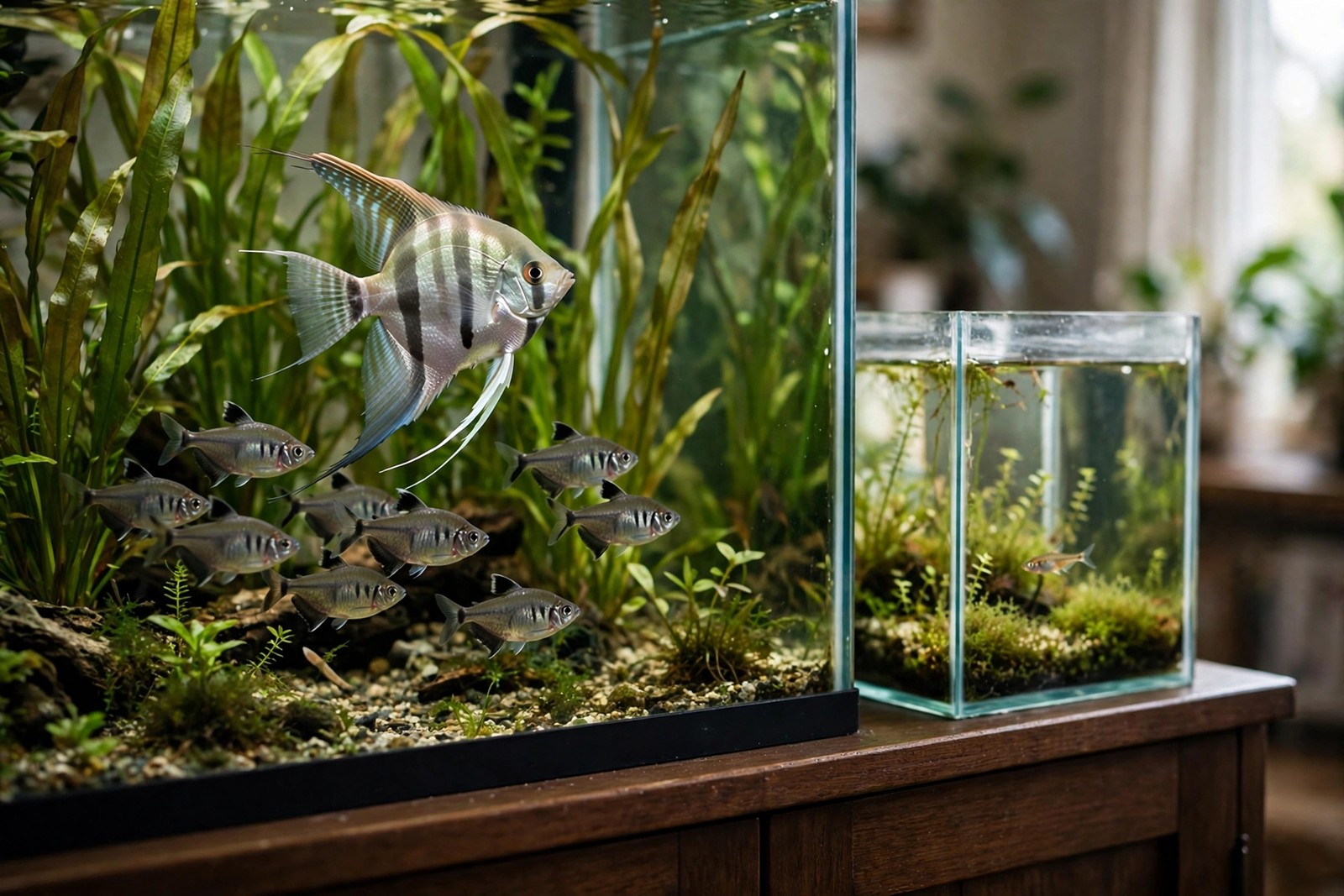
Angelfish eat smaller fish because they are predatory cichlids. In their home waters they drift among submerged roots and stems and pick off small fish, fry and invertebrates, and a home aquarium does not remove that wiring. The working rule in an angelfish tank is blunt: any fish small enough to fit into the angelfish's mouth is at risk of being eaten, and the risk grows as the angelfish does. Owners are often caught out because a young angelfish the size of a coin ignores its tankmates for months, then reaches adult size and begins taking them, frequently at night.
Why juveniles seem peaceful and adults do not
A juvenile angelfish simply cannot swallow the fish it lives with, so the tank looks harmonious while everyone is small. Angelfish grow into deep-bodied adults, commonly around six inches tall including finnage, with a mouth that opens wider than its narrow front profile suggests. As the mouth grows, the category of food quietly expands to include tankmates that were safe at purchase size. Slim, torpedo-shaped fish are especially vulnerable because they slide down easily; neon tetras and similar small tetras, young guppies and endler males, guppy fry and small freshwater shrimp are common losses in mixed tanks. Deep-bodied fish of similar length are far harder for an angelfish to swallow, which is why shape matters as much as length when you judge a pairing.
It is instinct, not hunger or spite
Well-fed angelfish still hunt. Owners sometimes respond to a missing tetra by feeding more heavily, and the predation continues because the trigger is movement and size, not an empty stomach; overfeeding then damages water quality without saving a single small fish. Nor is the angelfish being aggressive in the territorial sense, although angelfish can be territorial with their own kind, especially pairs guarding eggs. Eating a small tankmate is feeding behaviour, which is why rearranging plants, adding hiding places or scolding the tank by tapping the glass changes nothing lasting. Dense planting may let a few quick small fish survive longer, and fry will hide in floating plants, but cover delays the outcome rather than removing the risk, because the angelfish hunts patiently in the same planting.
Stocking an angelfish tank that works
Choose tankmates by their adult size and body depth, not their size in the shop bag. Larger, deep-bodied tetras, peaceful medium-sized barbs, corydoras and other robust bottom dwellers, and similarly sized peaceful fish generally live alongside adult angelfish without incident, while any species that stays slim and under roughly two inches should be treated as food unless you have seen a specific pairing thrive. Add the smaller species first and the angelfish last, and buy young angelfish so they grow up regarding mid-sized tankmates as scenery, though this never protects genuinely tiny fish. If you want to breed guppies or keep a colony of small shrimp, give them their own tank; a breeding net inside the angelfish tank is a short-term measure, not a home. When a fish disappears, check the water and look for a body before blaming the angelfish, since disease and jumping also remove fish, but a pattern of the smallest fish vanishing one by one overnight points firmly at predation.
Deciding what to change when losses start
Once an adult angelfish has taken a tankmate, it will take more, so decide promptly: move the remaining small fish to another tank, return them to the shop, or accept a species-only direction for this tank. Splitting the community early keeps both groups calm and avoids weeks of nightly losses. Write the outcome into the tank's stocking notes so the lesson survives the next tempting shop visit. KinsLe's Family Sharing keeps that stocking list and the do-not-add notes on the shared profile, so every member of the household shops from the same information rather than from memory.