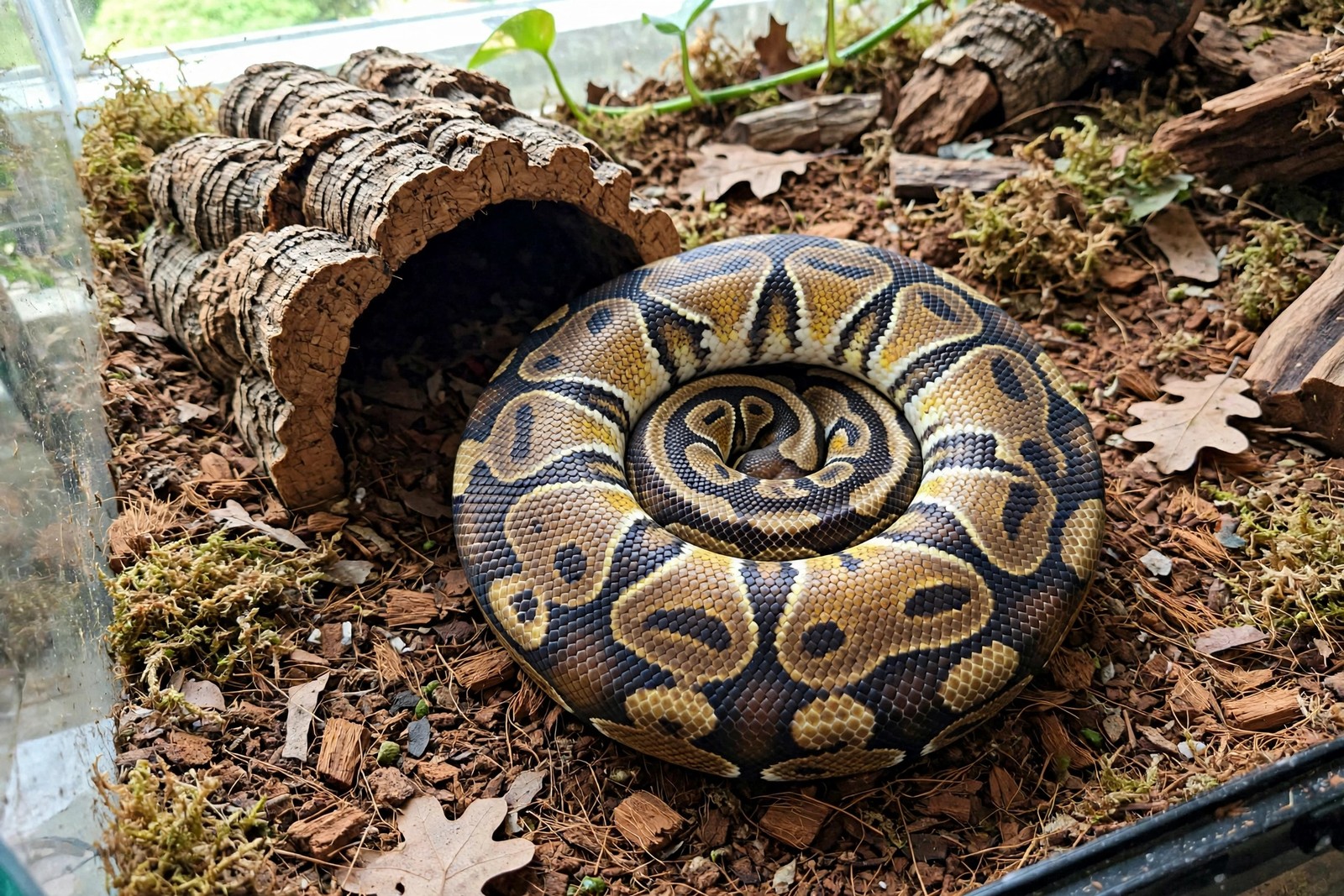
Ball pythons are named for exactly this behaviour. Unlike fast species that flee or bold species that stand their ground, a ball python's first defence is to become a ball: the snake coils tightly, tucks its head into the protected centre and presents only thick, muscular outer coils to the world. The head — the part a predator would target and the part the snake can least afford to lose — sits deep inside, while the exposed body can absorb investigation or a glancing strike with far less risk. In the wild this pairs with their habit of sheltering in burrows and termite mounds: a tight, still ball in a dark crevice is hard to see and hard to extract.
What Triggers the Ball
Balling is a stress signal with recognisable triggers. A new arrival commonly balls during its first handling sessions, because every hand, smell and movement is unfamiliar. Sudden movements above the enclosure, a hand approaching from overhead — which resembles a predator's approach — loud vibration, being lifted when the snake expected cover, and handling during the two days after a meal can all prompt it. Some individuals ball whenever they are first picked up and then relax and begin exploring once they register that nothing is attacking; others stay balled for the whole session, which is the snake telling you the session should end.
Learn to read what follows the ball. A snake that uncoils after a minute or two, tongue-flicking and moving slowly, has decided the threat has passed. A snake that stays locked tight, squeezes harder when touched, breathes fast or musks is still frightened — return it to its hide and leave it alone rather than persisting, because forcing a balled snake to uncoil teaches it only that hiding does not work.
Reducing How Often It Happens
Frequent balling usually points to an enclosure or routine problem, and it is fixable:
- Cover on both sides of the gradient — a snug hide at the warm end and another at the cool end, small enough that the snake touches the walls when coiled inside. Open glass on several sides leaves many ball pythons feeling permanently exposed.
- Settling time — leave a new snake largely undisturbed for the first week or so, and wait until it has eaten a few meals reliably before beginning regular handling.
- Short, calm sessions — handle for brief periods, support the whole body, move slowly, approach from the side at the snake's level, and end while the snake is still relaxed rather than after it balls.
- No handling after feeding — give at least two full days after a meal before handling, because disturbance then can trigger both balling and regurgitation.
Check temperatures and humidity alongside handling changes: a snake that cannot reach its preferred warmth, or one kept too dry, is already stressed and will ball at provocations a settled snake shrugs off. Juveniles ball more readily than confident adults, and many individuals grow bolder over months of predictable, gentle contact.
When Balling Deserves a Closer Look
Occasional balling is normal for this species and needs no intervention. Pay closer attention if a previously relaxed snake starts balling at every approach alongside other changes — refusing meals repeatedly, wheezing or bubbling at the mouth, retained shed, mites visible as tiny moving dots around the eyes and chin, or weight loss. Illness lowers a snake's tolerance for everything, and those combined signs warrant a reptile veterinarian rather than more handling experiments. A snake that stays balled for very long periods without ever exploring at night may also be telling you the enclosure feels unsafe, so review hides and cover before assuming temperament.
Recording handling sessions, feeds and balling episodes in KinsLe's Care Teams lets everyone in the household see which approaches calm your python and which still overwhelm it, so handling stays consistent and the snake is not re-frightened by a different technique each time.