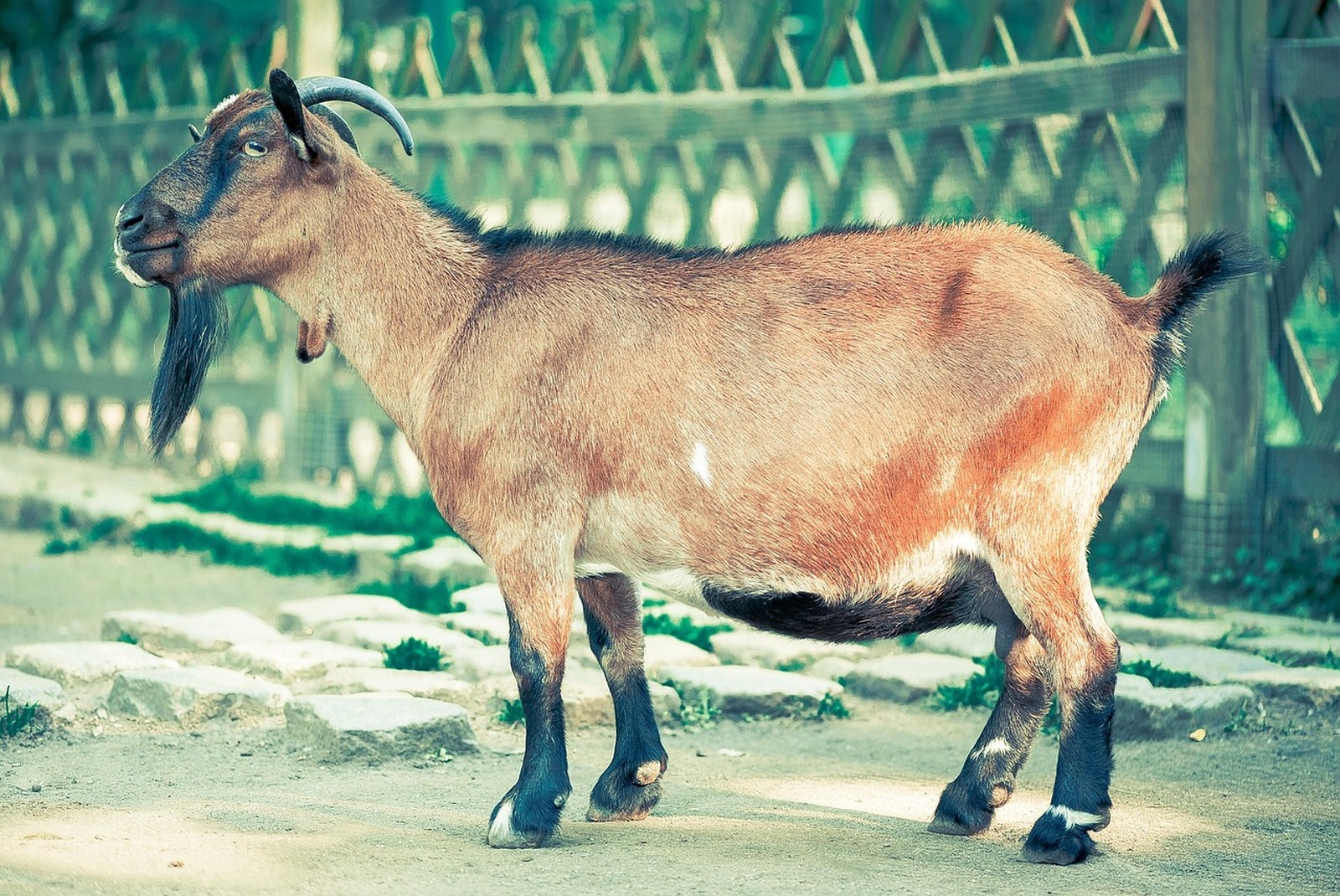
Goats that appear to faint when startled are not losing consciousness at all. They carry an inherited condition called myotonia congenita, found in the breed commonly known as fainting goats or Tennessee fainting goats, in which a sudden fright makes the skeletal muscles contract and then release abnormally slowly. The goat stiffens, often with its legs braced wide, and if the stiffness catches it mid-step or on a slope it may topple onto its side. Within seconds the muscles relax and the goat gets up and carries on, fully aware throughout the episode.
What actually happens in the muscles
In a typical goat, a startle triggers a brief muscle contraction followed by immediate relaxation, which is what allows a fast escape. In a myotonic goat the relaxation step lags, so the muscles stay locked for a short period, often somewhere around ten to twenty seconds, before softening. The goat remains conscious, can see and hear what is happening, and is not having a seizure; its brain is working normally while its legs are temporarily unable to respond. Younger goats often stiffen more dramatically and fall more often, while many adults learn to brace, spread their legs and ride out mild episodes standing. The trait is inherited and varies between individuals, so littermates can differ noticeably: one may fall several times a day in a busy yard, while another only stiffens when genuinely surprised.
Is it painful or harmful?
The locking itself is not considered painful, and goats resume grazing the moment they recover, which tells you a great deal about how the episode feels to them. The real risks are secondary: falling onto hard or uneven ground, toppling into a water trough or through a weak fence, or being unable to move away from a dog or another goat at the wrong moment. Repeated deliberate startling is also a welfare problem in its own right, because the goat experiences the fright each time even though the fall looks comic to human watchers. Keep these goats on ground with good footing, avoid steep banks and cluttered corners in their pen, and think carefully before housing a strongly myotonic goat with boisterous animals that charge around at feeding time. A goat that truly loses consciousness, paddles its legs, trembles for minutes, seems disoriented afterwards or shows weakness without a startle is showing something different, and that goat needs a veterinarian rather than a fainting-goat explanation.
Handling and daily care that keep episodes rare
Predictability is the kindest management tool. Approach these goats in view rather than from behind, speak as you come, open gates and doors the same way each time, and keep sudden noise near the pen to a minimum where you reasonably can. Dogs should meet a myotonic goat under control and learn that chasing is never allowed, since a chase combines maximum startle with maximum fall risk. Warn visitors, and especially children, that jumping out, shouting or opening an umbrella at the goat to make it fall is not acceptable; children usually respond well to being told the goat's legs lock and it cannot help falling. During hoof trimming, loading or vet visits, work slowly and let the goat stand and settle between steps, because a mid-procedure stiffen is easier to manage when nobody is pulling against it. Note roughly how often episodes happen in a busy week, so you can tell your veterinarian whether the pattern is stable or changing.
Telling helpers what they need to know
Anyone who feeds, leads or cleans for a myotonic goat needs three facts in advance: the goat may stiffen and fall if startled, it is conscious and should be left to recover rather than hauled upright, and calm, announced movements prevent many episodes. Written down once, those facts stop a new helper from panicking or from testing the trait out of curiosity. KinsLe's Care Teams lets you attach exactly those handling notes to the goat's assigned feeding and cleaning duties, so every helper reads them as part of the job rather than hearing them second-hand.