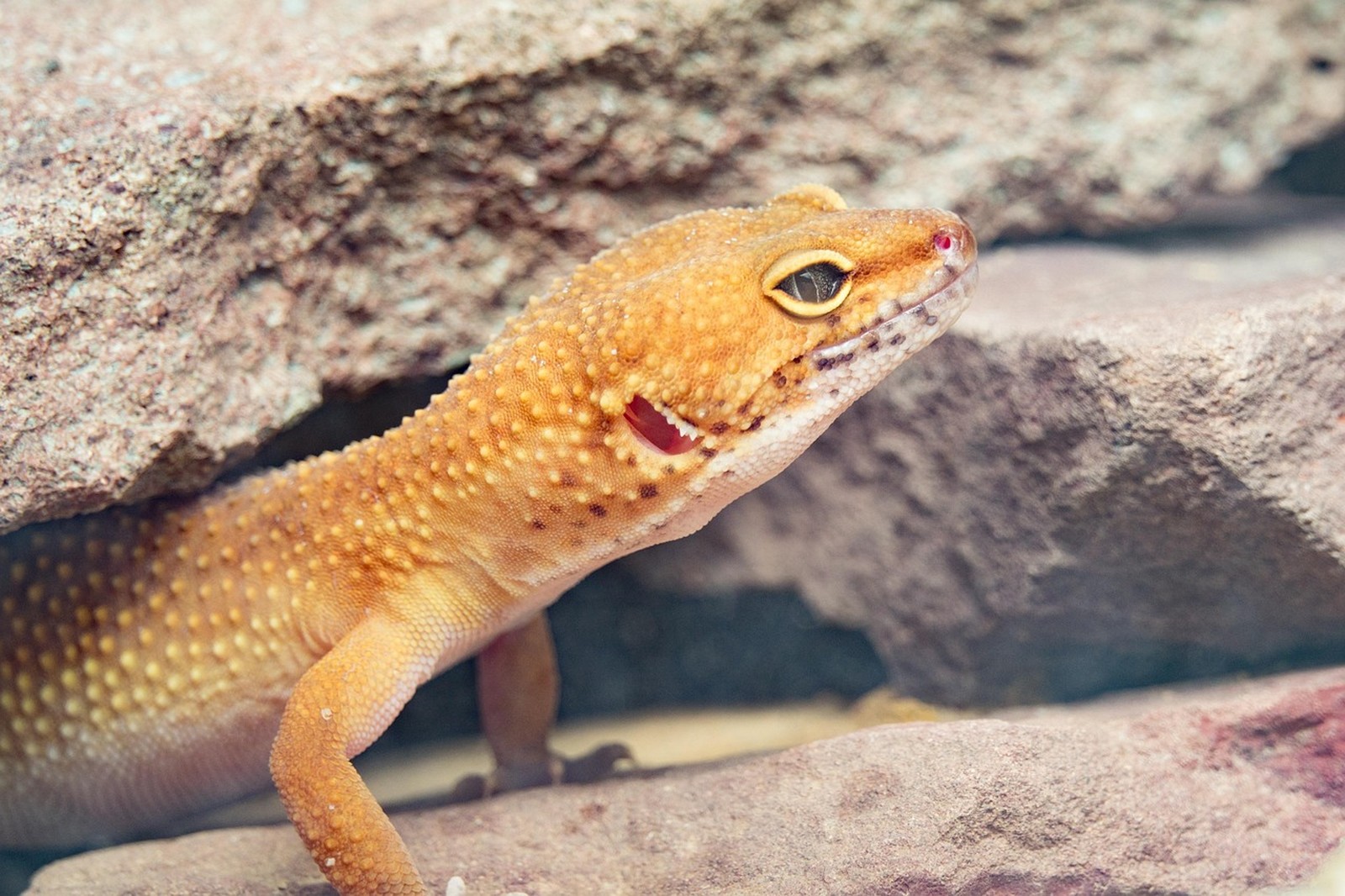
Owners who set up a leopard gecko enclosure with a basking platform often wait weeks for a photograph that never comes: the gecko under the lamp, stretched out like a bearded dragon. It does not arrive because leopard geckos are built for the opposite routine. They are crepuscular to nocturnal ground dwellers from dry, rocky country, emerging at dusk when the air cools but the ground still holds the day's heat — and that stored ground heat, taken up through the belly while the body stays concealed, is how they warm themselves.
Belly Heat From Cover, Not Sunbathing From Above
A leopard gecko practises what keepers call cryptic basking. It slides into a warm hide, under a flat stone or beneath a piece of slate positioned over the warm end of the enclosure, and presses its underside flat against the heated surface. Heat transfers directly into the belly, warming the digestive system after a meal, while from outside the enclosure the gecko appears simply to be hiding. Many individuals expose only a flank, a leg or the tail tip from cover while warming — enough to gather heat, never enough to feel exposed to a predator watching from above.
This is why the warm hide is the functional basking spot in this species' enclosure. It needs to sit over or against the heat source — typically a heat mat or similar under-enclosure or deep-heat arrangement managed by a thermostat — so the floor of the hide reaches the warm-end surface temperature the species needs, in the low thirties Celsius on the warm side with a clear gradient down to a cooler end. A gecko that can warm only by sitting in the open under a bright lamp faces a choice between heat and safety, and it will usually choose safety and run cold.
What Normal Looks Like Across the Day
Expect long, still daytime hours in a hide — often the warm hide after eating, the humid hide around shedding time — then emergence as lights dim: slow patrols of the enclosure, hunting behaviour, drinking from the water dish and licking at the calcium dish many keepers provide. A healthy gecko may shift hides a few times across twenty-four hours as it regulates temperature, and those quiet movements between hides are thermoregulation working, not restlessness. Checking with a surface thermometer or a probe at floor level inside the warm hide tells you far more than watching for sunbathing ever will.
Judge the setup by outcomes rather than sightings. A gecko that warms properly eats willingly in the evening, digests without passing undigested food, sheds in complete pieces rather than leaving stuck skin on the toes and tail tip, and stays a good weight with a plump tail. Those four signs together confirm the hidden warming routine is doing its job.
When Invisibility Is a Problem Instead
Never emerging at all is different from never basking openly. Investigate if your gecko stops coming out even at dusk for several nights running, refuses food it usually takes, loses tail thickness, keeps its eyes closed through its active hours or leaves shed stuck repeatedly. First verify the warm-hide floor temperature and the gradient with a thermometer — a failed heat source leaves a gecko too cold to hunt or digest, and an overheated warm end drives it permanently to the cool side. Persistent appetite loss, weight loss or lethargy alongside correct temperatures warrants a reptile veterinarian, because parasites and other illnesses commonly present as a gecko that simply stays hidden.
Offer what the species actually uses before concluding anything is wrong: a snug warm hide with correct floor heat, a humid hide, low evening light for viewing and patience at dusk. Logging feeds, sheds and warm-hide occupancy in KinsLe's Care Teams turns an apparently invisible routine into a readable record, so the household can confirm at a glance that your gecko is warming, eating and shedding on schedule without ever needing to catch it in the open.