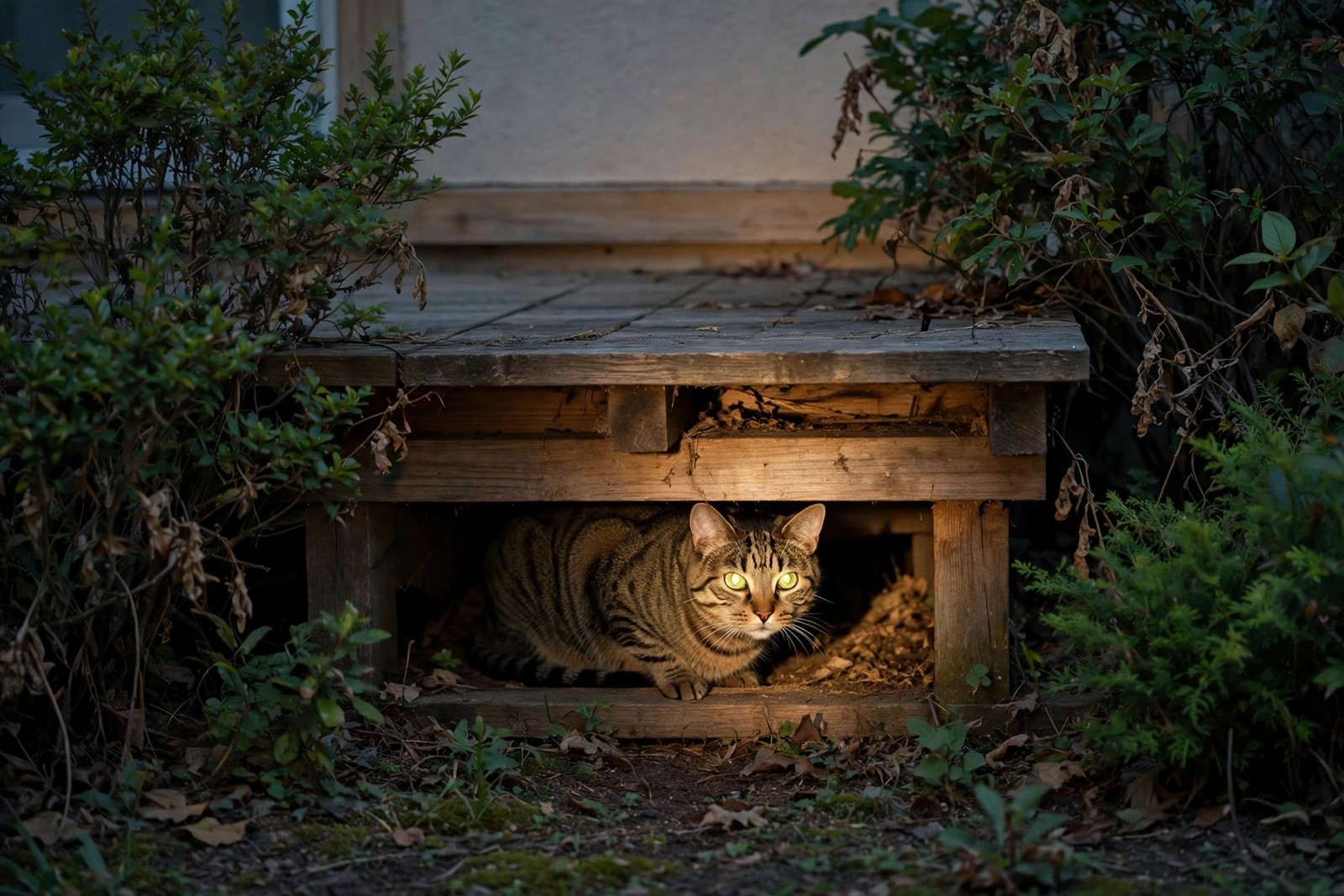
An escaped indoor cat rarely behaves the way owners expect. It does not usually streak for home, answer its name, or meow for rescue. Instead, most lost indoor cats are found astonishingly close to the point where they got out, hidden so thoroughly that their owners have walked past them several times. Fear explains the whole pattern.
A Fear Response, Not a Homeward Journey
Indoors, your cat knows every room, scent, and escape route. Outdoors, none of that map applies. An indoor cat has never marked the garden, never learned which neighbour's dog barks through which fence, and never built the mental territory that lets an outdoor cat navigate calmly. Overwhelmed by unfamiliar smells, sounds, and open sky, the cat's survival programming takes the safest available option: get under cover immediately and become invisible. Running means crossing open ground while frightened and disoriented, which is exactly what a small prey animal is built to avoid. Hiding a short distance away is not confusion; it is the strategy working as designed.
Why a Hidden Cat Stays Silent
Owners often assume a nearby cat would cry out on hearing a familiar voice. A frightened cat does the opposite. Calling advertises a location, and a cat that feels hunted will not risk it, even for its own person. Many stay silent and still for days, leaving their hiding place only in the quietest hours to look for food and water nearby, then returning to the same tight spot. This is why a calm physical search finds indoor cats that hours of calling never will, and why a cat may ignore food left in the open while eating readily from a dish placed right beside its cover.
Where They Actually Wedge Themselves
Think like a cat looking for a space its body barely fits. Under decks, porches, sheds, and house crawl spaces are classic choices, along with dense shrubs, woodpiles, garages left ajar, storm drains, and the engine bays of parked cars. The hiding place is usually within a few houses of the escape point in any direction, and cats strongly favour the first suitable cover they reach over a long search for a perfect one. Knock on the bonnet and listen before cars on the street are started, because a cat asleep in an engine bay may not wake or move until the engine is already running. Search that small radius on hands and knees with a torch, looking for eye-shine in gaps you would swear are too small, and search it more than once: a cat wedged deep may not shift until hunger or darkness gives it confidence.
Searching the Small Radius Well
Go slowly, property by property, with each neighbour's permission, checking under and inside everything rather than scanning from standing height. Quiet hours around dawn and dusk suit a hidden cat's own movement, so repeat the search then, speaking softly and pausing to listen rather than calling loudly. Set out water and strongly scented food near the escape point, add an item carrying your cat's own scent, and check the spot repeatedly through the night if you can. If sightings confirm a place but the cat bolts from approach, a humane box trap baited with food, checked very frequently, is often how a frozen indoor cat is finally recovered safely. That ground search stays primary, with backup from the Lost Pet Alert System: its listing appears on a map, a finder can reach out to you directly through it, and it sits at no cost inside every KinsLe profile.