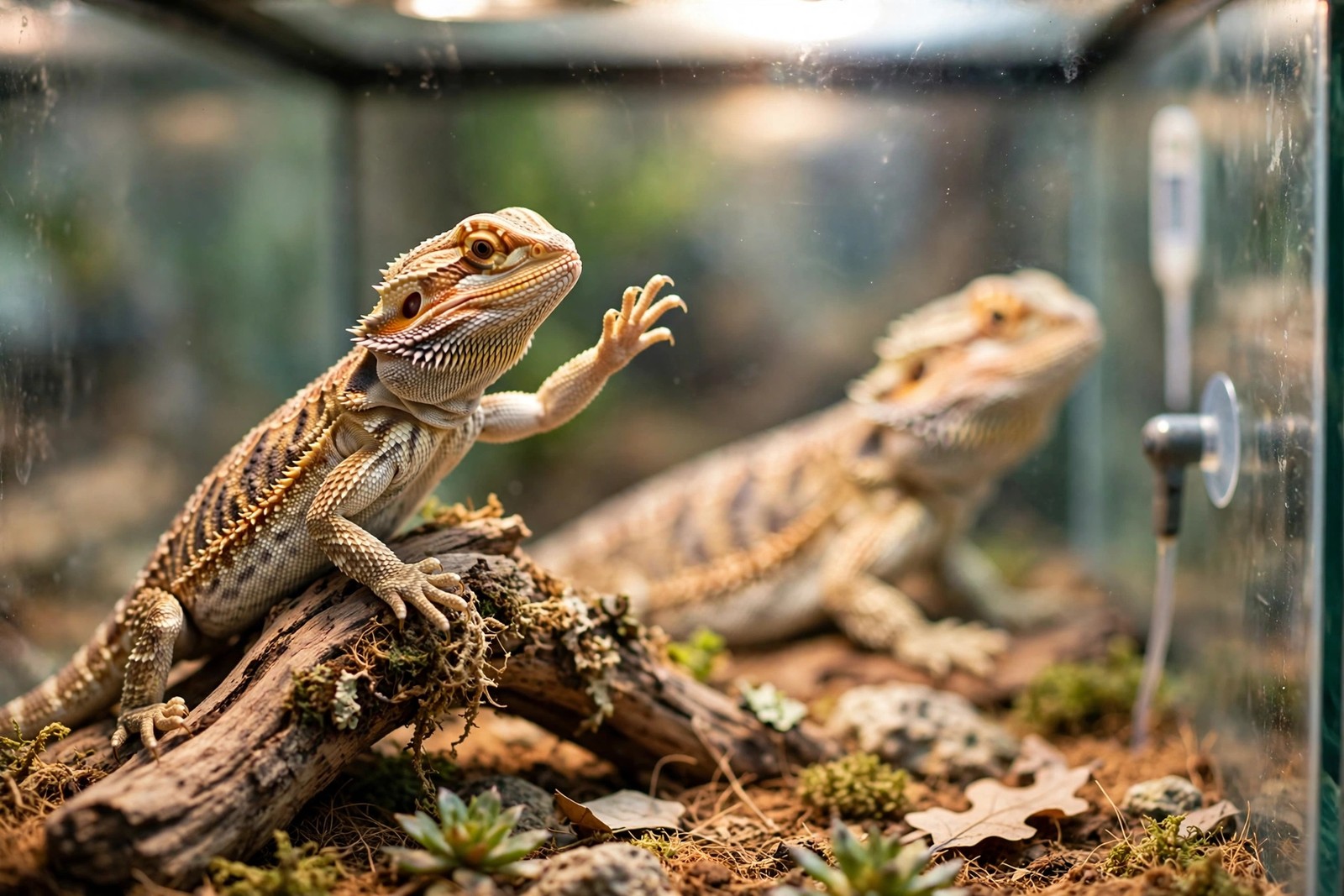
Few reptile behaviours charm new owners like the arm wave, and few are read quite so backwards. The slow, circular lift of one front leg looks like a hello. In bearded dragon language it is closer to a white flag: a deliberate signal of submission from a dragon that wants a larger, stronger animal to know it is no threat and no rival.
What the Wave Is Saying
Arm-waving is appeasement behaviour. A smaller or less confident dragon waves at a bigger one to defuse a possible confrontation before it starts, and juveniles wave the most, because nearly everything in their world outranks them. Captive dragons aim the same signal at people reaching into the enclosure, at cats watching through the glass, at their own reflection, and at a new dragon across the room. Females may also wave in breeding contexts as part of a slower exchange with a courting male. Read it as information about how your dragon feels in that moment: aware, cautious, and keen to keep the peace, rather than relaxed and playful.
Wave Versus Head Bob
The two best-known bearded dragon signals point in opposite directions. The arm wave is slow, smooth, and circular, and it comes from the dragon that feels lower in rank. Head-bobbing is a rapid, jerky up-and-down motion, and it usually comes from the dragon asserting itself: a territorial male bobbing at a rival, a reflection, or a newcomer. A darkened, puffed-out beard adds weight to the display. Slow blinking and a relaxed, level body often travel with the wave, while a bobbing dragon usually stands tall, pushes up on its legs, and fixes its gaze on whatever it is addressing. When one dragon waves while another bobs, you are watching a complete conversation, with one animal claiming status and the other accepting it. A dragon that waves and then flattens itself low, or keeps its eyes half closed, is asking for the pressure to stop rather than inviting more interaction.
When Waving Points to Stress
An occasional wave at something new is normal communication. Waving many times a day, always toward the same trigger, tells you the trigger is a standing problem rather than a passing surprise. Common culprits include a second dragon housed in the same enclosure, a neighbouring enclosure in direct view, a mirror-like reflection in the glass, and a family dog that spends its afternoons staring into the vivarium. Bearded dragons are solitary animals, and a subordinate dragon sharing space cannot leave the dominant one's territory, so its waving can shade into poor appetite, hiding, and slow growth. Stress from a reflection or a watching pet is easier to fix: reposition the enclosure, cover a side panel, or move the audience.
How to Respond
Do not wave back, reach in to reassure the dragon mid-signal, or treat repeated waving as a cute routine to show visitors. Give the dragon space, remove or block the trigger you have identified, and let it settle. Handle a frequently waving youngster in shorter, calmer sessions, supporting its whole body and approaching at its own pace, so that your hand stops being the thing it feels it must appease. If waving comes with weight loss, persistent hiding, or refusal to bask and eat, check enclosure temperatures and lighting carefully and book a reptile veterinarian, because a dragon that feels physically poor also feels vulnerable. For a related question, put a follow-up question to KinsLe's Kinny; he answers using the KinsLe Answers library.