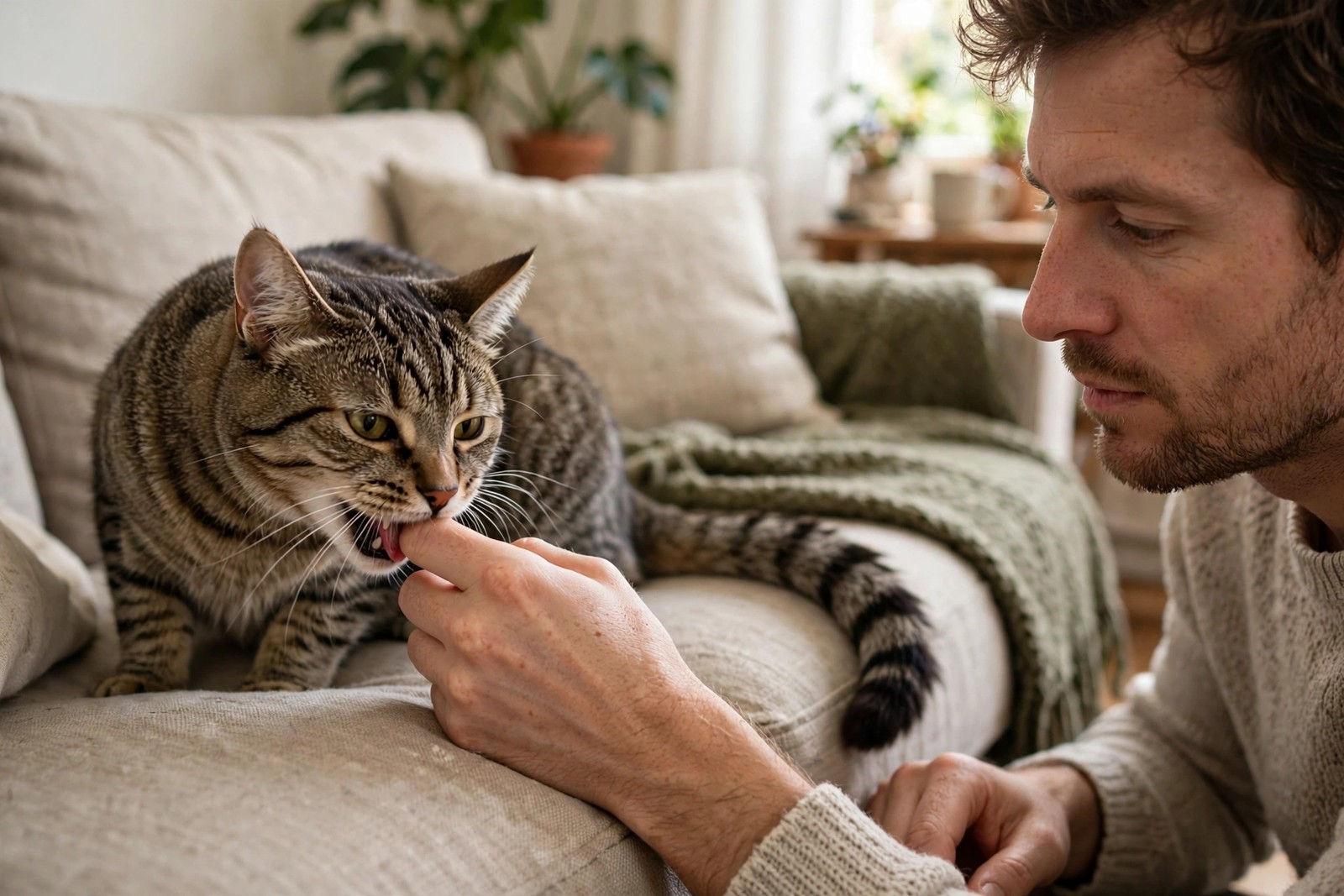
The scene confuses owners because it begins so affectionately. Your cat settles in, licks your hand or forearm with that rough tongue, perhaps holds you gently with a paw, and then, with no apparent change of heart, bites the very skin she was washing. Two different systems are running in sequence: social grooming first, then a stimulation threshold being crossed. The bite is not a betrayal of the licking. It is what happens when the second system takes over and her earlier, quieter requests to stop were missed.
Licking as a Social Gesture
Cats who live amicably together groom each other around the head and neck, and a cat who grooms you is extending that same affiliative behaviour to a much larger companion. Some cats also lick in a self-soothing rhythm when they are content and drowsy, and a grooming bout that stays in this mode looks loose and slow: soft eyes, a still tail, a body that melts rather than braces. Trouble starts when your hand keeps stroking throughout, adding your petting on top of her grooming, because the combined sensation builds arousal in a cat whose tolerance for sustained touch may be measured in minutes or in seconds, depending on the individual and the body area involved.
The Warning Ladder Before the Bite
Cats almost always announce the switch before biting, in signals owners can learn in a week of watching: the tail tip begins to flick, then the whole tail lashes; the skin along the back ripples or twitches under your hand; ears rotate sideways or flatten; whiskers push forward; the head turns sharply toward your hand; the body tenses and may freeze for a beat. A freeze is not permission to continue; it is often the last rung. The bite that follows is frequently inhibited, a grab-and-release or a nip that startles more than it wounds, and many cats immediately move away, shake off, or groom themselves, which is arousal being discharged, not guilt. Punishing any of this teaches her that warnings are pointless and can produce a cat who skips straight to a harder bite.
Working With Her Threshold Instead of Against It
Shorter, cat-led sessions change the pattern fastest. Let her initiate, stroke the areas most cats reliably enjoy, such as the cheeks and chin, keep sessions brief, and pause often with your hand still so she can rub back in for more or walk away; a cat who re-engages is giving clear consent to continue. Keep hands out of play entirely, since hand-wrestling blurs exactly the boundary you are trying to clarify, and redirect rising energy onto a wand toy when you see the tail start to move. Household consistency matters enormously here: one person who keeps petting through the warnings will keep the biting habit alive for everyone.
When a Bite Pattern Deserves a Vet Visit
A cat whose grooming-and-biting is new, suddenly more intense, or focused on one body area may be telling you about discomfort rather than temperament; sore skin, an aching joint, or dental pain can all shorten a cat's fuse around touch. Bites that break skin repeatedly, a cat who has become generally less tolerant, or any change paired with appetite, grooming, or litter habit changes are worth raising with your veterinarian rather than treating as a training puzzle, and any bite that punctures your skin deserves proper cleaning and medical advice for you as well. For the ordinary overstimulated cat, though, the household record is the treatment: KinsLe Messenger gives your cat a single communications hub where the family can note which signals she gives first and which spots are off limits, so her boundaries travel with her profile instead of living in one person's memory.