
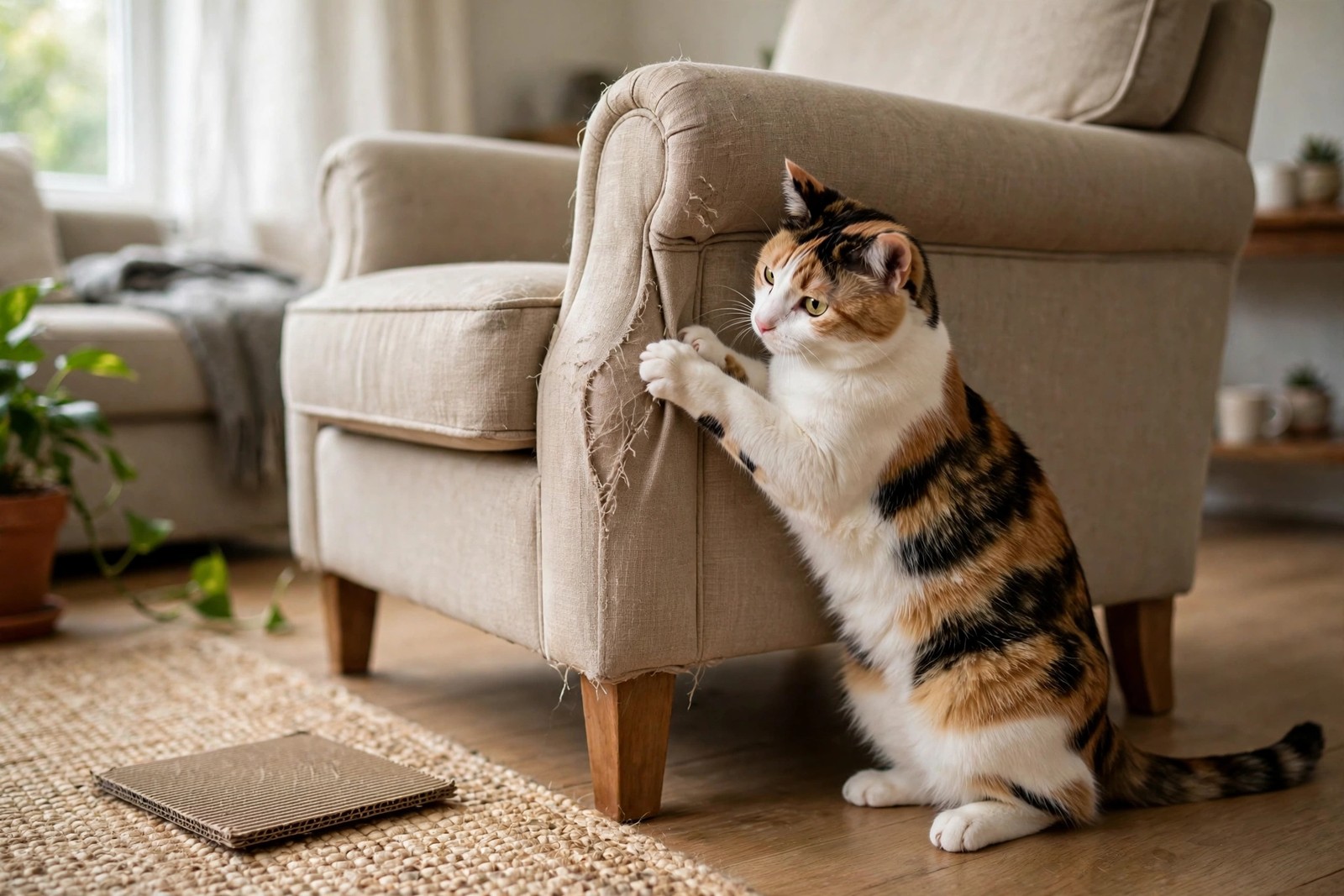
If your cat has a perfectly good scratching post and still works over the couch, the post is failing her in some specific way — wrong feel, wrong place, wrong stability — or the furniture is offering something the post can't. Scratching is too important to a cat to be random, so the answer is always in the details of where, when, and what she's choosing instead.
What Scratching Actually Does for a Cat
A good scratch does three jobs at once. It sheds the worn outer husk of the claw, keeping the sharp new claw beneath in shape. It stretches the muscles and tendons of the shoulders, back, and paws — which is why cats so often scratch right after a nap. And it's a message: glands between the toe pads leave scent, while the visible shred marks leave a sign. Together they announce "I live here" to any cat who passes. Furniture in the middle of your busiest room is, from her perspective, prime billboard space.
Why the Post Loses
Cats reject posts for practical reasons:
- It wobbles. One tip or slide and many cats never trust it again. Weight the base or choose a heavier design.
- It's too short. A post she can't stretch fully upright against forces a crouch — carpet and horizontal surfaces then win.
- Wrong material. Vertical sisal suits most cats, but committed carpet-scratchers may want carpet covering, and sofa-fabric fans may prefer sisal fabric or a flat cardboard scratcher.
- Wrong room. A post in a spare bedroom she never enters isn't an option at all; scratch targets belong where she actually lives and sleeps.
- It's worn out in the wrong way — or the wrong cat used it. Some cats dislike a surface already shredded and scented heavily, particularly in multi-cat homes; a fresh post can reset things.
Test like a scientist: add one different option beside the furniture for a week — a taller post, a flat scratcher, a new texture — and see which one collects marks.
Read the Preference She's Showing You
Her furniture choices are data. Does she scratch vertically on chair arms or horizontally on rugs and carpet? Does she choose rough textures or smooth ones? Does she scratch after naps, after meals, or when you come home — marking excitement and greeting? A cat who scratches the side of the bed at dawn may be working out overnight energy and claiming the room she sleeps in. Match the post to the pattern rather than the catalog description.
When Scratching Spikes Suddenly
A sudden increase can signal stress — a new pet, a move, a changed routine, outdoor cats appearing at windows. It can also appear when claws are overgrown or a paw is sore and she's working at it more. A quick paw check, and a vet visit if anything looks off, is worthwhile before treating it as pure habit.
Note Her Preferences on Her KinsLe Profile
Every cat has a profile worth writing down — favorite scratch texture, the post she actually uses, the rooms she claims. Each KinsLe profile carries a unique QR ID, and keeping those preferences recorded means a sitter, a family member, or a future you can set up her space the way she likes it from day one. It turns guesswork into a written record that travels with her. Verified QR ID Pet Profiles turn that written record into a way home: a neighbor who discovers her outdoors scans the tag, lands on the opened page inside KinsLe, and messages you using the contact details shown there.