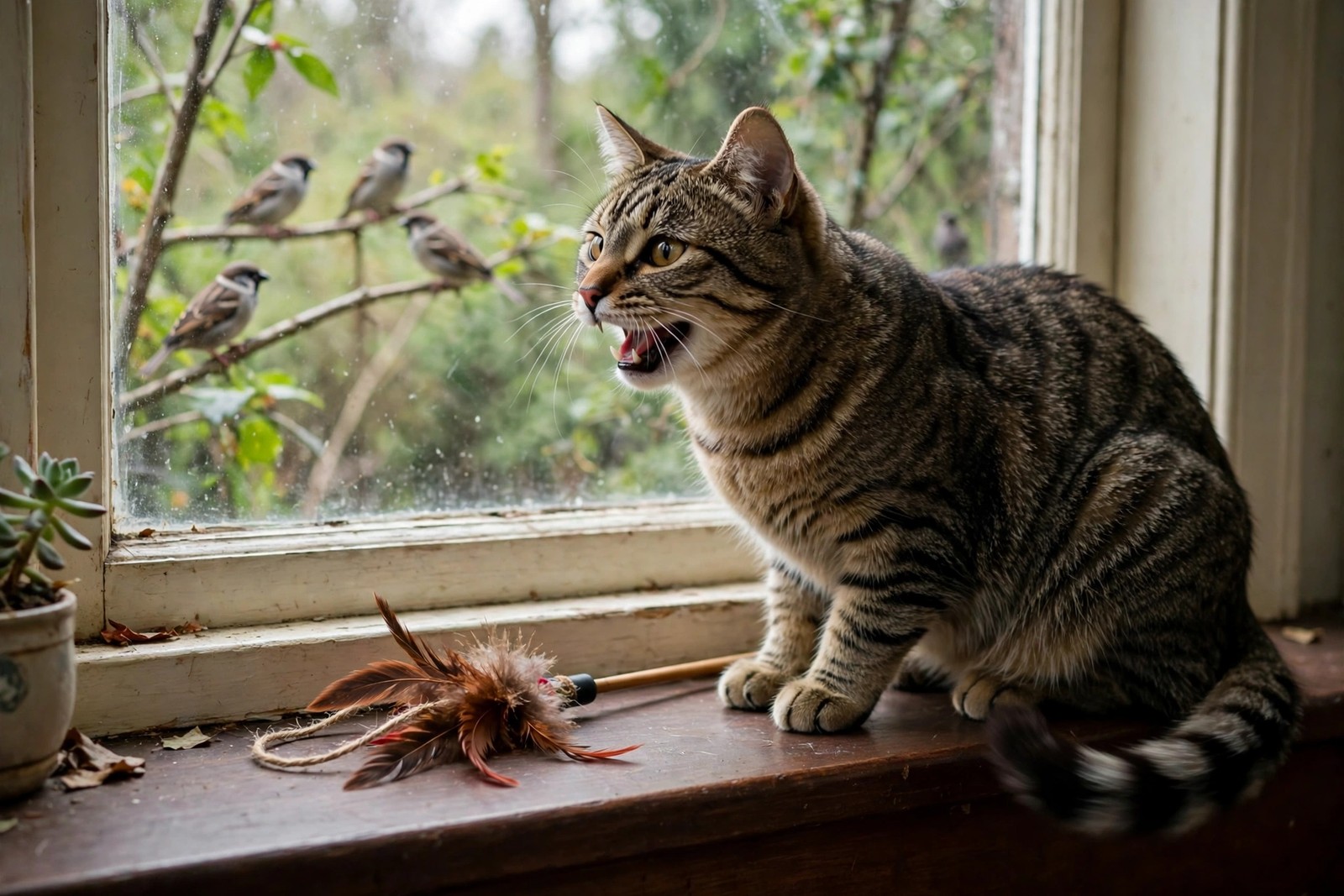
She parks herself on the sill, locks onto a bird outside, and comes apart in the most theatrical way: teeth chattering, a chirping trill running under it, tail twitching in short, sharp flicks, her whole body fixed on the glass. It looks like frustration, excitement, and a short circuit at once. What she is actually doing is hunting. The full predatory sequence she carries switches on when prey appears, and at a window it switches on with nowhere to go, because the bird stays visible, active, and permanently out of reach.
What the Chattering and Twitching Mean
The chatter itself, a rapid clicking of the teeth, often comes with the soft chirping or trilling sound owners find so funny, while the twitching tail and unblinking stare complete the picture of a cat at full arousal. Keepers and behavior watchers read the mix as excitement blended with frustration: the stalk and focus stages of the hunt are running at full strength, but the chase, catch, and finish cannot follow. It is entirely normal, she is not in distress that needs fixing, and a cat can chatter happily at windows for her whole life. Her body stays loose between episodes, she leaves the sill willingly for food or company, and those are the signs this is sport, not suffering.
She Is Not Asking to Go Out After Them
It is tempting to read the performance as a request for the door. It is not one. Letting her out after birds trades a harmless window habit for real harm to the birds themselves, and it does not satisfy the sequence either, since most chases end empty-pawed anyway. The window is not the problem in her day; it is one of the richest parts of it, a live show that exercises her attention and instincts safely. The useful question is not how to stop her watching, but how to give the arousal the watching builds a proper ending once she turns away from the glass.
Give the Sequence Its Ending
A wand toy session offered after window time lets the hunt complete itself: she stalks a moving lure, chases it, pounces, and catches, in the order her instincts expect. Ten unhurried minutes with plenty of catches, ending in a wind-down and a small meal, discharges what the birds built up. Timing matters less than reliability; the session works whenever it follows a long, intense watch, and many cats begin leaving the sill to look for the toy on their own once the pattern is familiar. Keep the lure moving away from her like real prey, let her win often, and put the toy away afterward so it stays special.
One Household Rule for Her Window Time
The response only settles her if everyone in the home gives the same one. Care Teams holds the written plan for her window time in plain terms: watch with her if you like, never tap the glass or tease her through it, never shoo her off the sill mid-watch, and offer the wand session when a long bird watch ends, with turns for that session shared across the household rather than left to whoever happens to notice. Written down, the rule survives guests, busy weeks, and the person who would otherwise rattle the window for a laugh. Posted where everyone can see it, her response plan sits in KinsLe within the Care Teams schedule, naming whose turn brings the wand toy out after each long bird watch.