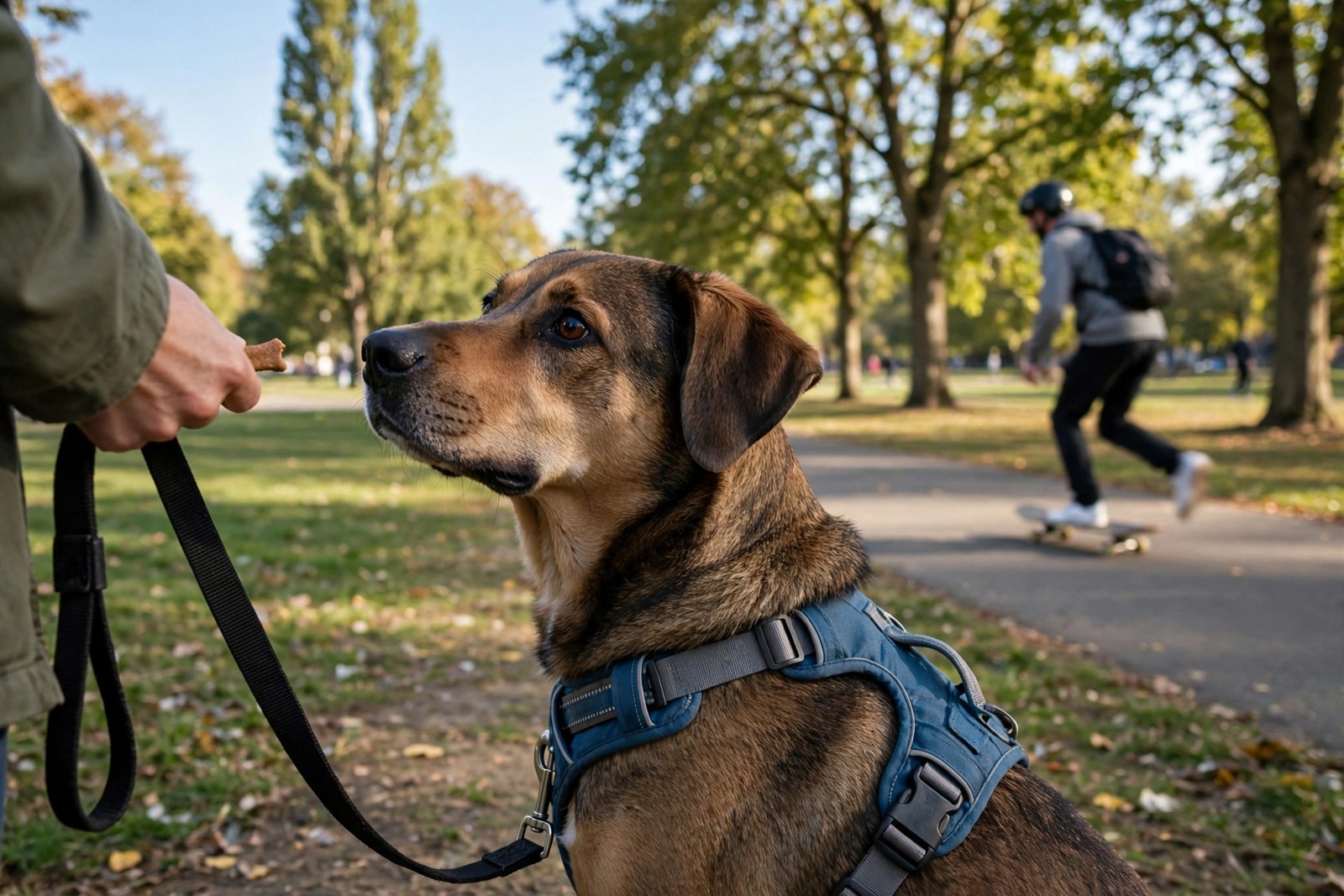
The selectivity is the clue. Your dog is not afraid of wheels, speed, or people in motion in general, because bicycles and joggers supply all three and get ignored. Skateboards and scooters are a specific package of motion, sound, and closeness that happens to press several canine buttons simultaneously, and the high, frantic pitch of the barking is the sound of arousal, chase drive and noise sensitivity firing together rather than the measured woof of a dog announcing a visitor.
Motion, Rattle, and Sidewalk Proximity
A skateboard moves low, fast, and erratically by dog standards: it darts, carves side to side, stops abruptly when the rider kicks or hops off, and then surges again. That darting, ground-hugging pattern is close to the movement signature of fleeing prey and of things herding dogs are built to control, which is why movement-sensitive breeds such as collies can find boards especially hard to ignore. Scooters share the low, quick profile and add a rider who weaves along the pavement rather than holding a line.
Sound is the second ingredient. Small hard wheels on pavement joints produce a rapid, rattling clatter that rises suddenly as a board approaches, and many dogs who tolerate engines and sirens find that particular irregular rattle hard to ignore. The third ingredient is proximity: boards and scooters travel on the sidewalk, your dog's own corridor, passing within a lead's length, while the trigger is already at full speed. Surprise, closeness, and an arousing sound arriving together leave very little room for a calm decision.
Why Bicycles and Joggers Get a Pass
A bicycle is bigger, smoother, and more predictable: it holds a line, approaches at an even pace, and runs comparatively quietly on larger wheels, usually on the road rather than the sidewalk, which adds distance and a curb as a boundary. Your dog has also typically seen bicycles, steadily and at that distance, since puppyhood. A jogger is a familiar human shape moving in an even, rhythmic gait with no mechanical noise at all, and rhythm is soothing information to a dog: nothing about a jogger darts, rattles, or changes direction without warning. Neither trigger rehearses the chase sequence the way a board does, so neither has built the habit.
Train the Board as Its Own Subject, at Your Dog's Distance
General loose-lead manners will not fix this; board reactivity needs its own staged work. Find the distance at which your dog can notice a skateboard, stay able to eat, and look back at you when asked, and work there: a quiet park path with a cooperative helper riding slow, straight passes works well. Reward looking at the board and then disengaging to you, and let the board's retreat be part of the payoff. Close the distance gradually over repeated sessions, and keep your dog below the frantic threshold throughout, because rehearsing full-pitch lunging between training sessions undoes the lessons.
On ordinary walks, manage first: cross the street early when you hear the rattle coming, put parked cars or distance between your dog and a passing board, and use a well-fitted harness and a short, secure lead near roads, since a lunge at a board can carry a dog into traffic or pull a rider down. Choose routes and times that dodge the heaviest board traffic, such as skate parks at peak hours and the school-run scooter rush, while training catches up. If your dog's reactivity is widening to new triggers, or panic rather than arousal seems to drive it, a qualified behaviorist is the right next step, and a vet check is worthwhile for any sudden change. With KinsLe Care Teams, you can assign board-aware routes and the staged practice sessions to everyone who walks your dog, each marked complete with a timestamp, so no walker accidentally rehearses a close-range lunge on a busy sidewalk.